Kubernetes namespace ownership: what to set first
Kubernetes namespace ownership starts with alerts, budgets, and deploy rights. Learn what to define before you split work across teams.
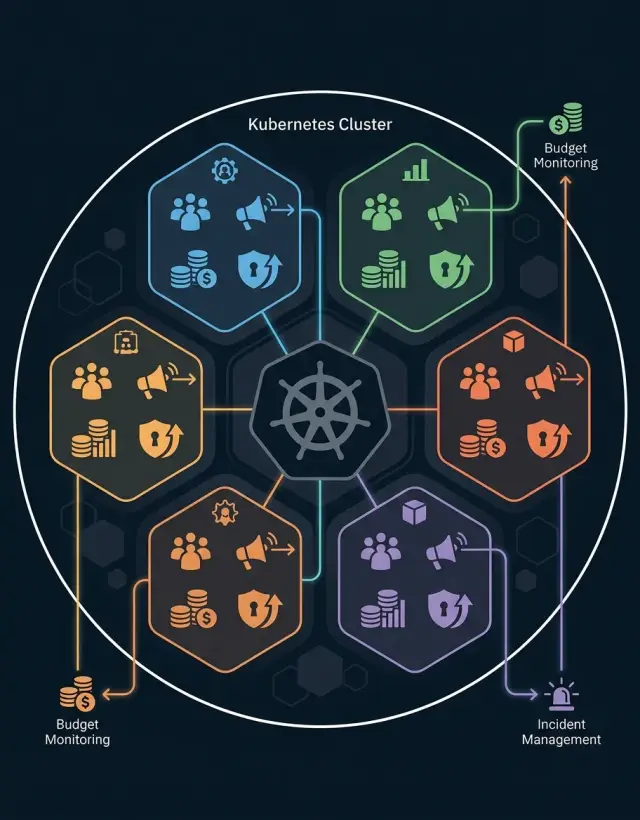
Table of Contents
The problem with ownership by namespace
A namespace is a label, not ownership. Teams often create payments-prod or mobile-staging and assume the name tells everyone who is responsible. It does not. Kubernetes namespace ownership only becomes real when people also set alerts, budgets, and deploy permissions around that namespace.
The gap shows up fast in day to day work. A team thinks it owns a service because it created the namespace, but production alerts still go to a shared ops channel. The people who get paged may not know the app, the code, or the recent changes. The team that can fix the issue may not even see the alert until someone tags them.
Costs get messy in the same way. Cloud spend, logging, and extra services often stay grouped at the cluster or account level. That means one team can scale up usage, while another team gets blamed for a bigger bill. By the time finance asks what changed, nobody has a clean answer by product, environment, or team.
Deploy access is another weak spot. Many companies start with broad permissions because it feels faster. Then almost anyone who can reach the cluster can push changes into almost any namespace. A team may think it owns checkout-prod, but if five other people can still deploy there, ownership is mostly a guess.
Picture a growing software company with three product teams. Each team has its own namespace. On paper, that looks tidy. In practice, alerts still land in one Slack channel, the monthly bill shows one blended total, and senior engineers keep cluster-wide access because nobody narrowed it down. When something breaks on Friday night, the namespace name does not answer the only question that matters: who is on the hook to fix it now?
That is why a namespace alone creates a false sense of order. It looks organized, but the hard parts of ownership still sit somewhere else.
What a team should own
A namespace needs a single owner. If two teams both think they own it, no one fixes small problems early, and bigger ones pile up. Good Kubernetes namespace ownership starts with one clear team name on the record.
That team record should be short, but it has to answer the basic questions people ask during a normal week and during an outage. When a pod keeps restarting, who gets paged? When a new cron job appears, who says yes? When cloud spend jumps 30 percent, who explains it?
A useful ownership record usually includes five things:
- the one team that owns the namespace
- one manager who is accountable for decisions
- one on-call contact for incidents and alerts
- the services, workers, and scheduled jobs that belong there
- the person or role that approves production deploys and watches the budget
Keep the team name specific.
Set the team record before you create anything
A namespace is easy to create. Cleaning up unclear ownership is not. Before anyone runs kubectl create namespace, write one team record that answers who owns the work, who gets paged, who can deploy, and where the spend lands. For Kubernetes namespace ownership, this record matters more than the namespace name.
Use team names that match your real org chart. If the company calls the group "Payments", use "Payments" everywhere. Do not invent a different label for Kubernetes, another one for billing, and a third one for access control. That split looks harmless on day one and turns into confusion during an outage.
A good team record is short, but it should cover the basics:
- the team name and the person who approves access
- the services they run and the environments they need
- shared dependencies such as databases, queues, or ingress rules
- alert contacts for work hours and off hours
- the budget tag and access groups tied to that same team
Keep the names identical across your cloud tags, RBAC groups, alert routing, and internal team list. If billing says "commerce", alerts say "platform", and deploy rights say "backend-admins", nobody knows who owns the problem when a pod crash wakes people up at 2 a.m.
A small software company often learns this the hard way. The app team asks for a new staging namespace, so someone creates it in five minutes. Weeks later, staging starts burning money, alerts go to the wrong Slack channel, and three engineers have deploy access even though only one team uses the service. The fix is not another namespace rule. The fix is the record they skipped.
Create the namespace only after that record is complete and approved. That one pause saves hours of cleanup later, and it keeps team based deploy rights, Kubernetes alert routing, and Kubernetes cost allocation tied to the same owner from the start.
Tie alerts to the right team
Kubernetes namespace ownership falls apart fast when every alert goes to one shared channel. A namespace groups resources, but it does not tell people who must wake up, investigate, and fix the problem. If the checkout service starts failing, the team that owns checkout should get that page. If nodes run out of disk or the API server goes unhealthy, the platform group should get it.
This split keeps work clear. Product teams handle app errors, latency, and failed jobs. Platform engineers handle cluster health, ingress, storage, node pressure, and broken deploy plumbing. When those signals mix, people stop trusting alerts and start muting them.
A good rule is simple: page the team that can act within minutes. Everything else can go to a lower-noise channel for working hours. That usually means two classes of alerts:
- Pages for user-facing failures, crash loops on a live service, sustained error spikes, or a production job that failed and blocks the business
- Warnings for short CPU spikes, a single pod restart, quota trends, or notices that still leave time to act
Keep the route in the service record, not buried in one alert config. Each production service should name the owning team, the on-call target, and one fallback contact. Cluster alerts should point to the platform rotation, even if that rotation is just one person today.
A small example makes this clearer. If a payments pod starts returning 500 errors, the payments team should get the alert because they know the code, the release, and the recent changes. If several nodes show memory pressure, the platform team should get it because the fix may involve scheduling rules, autoscaling, or bad cluster capacity.
Test one real alert path before rollout. Trigger a harmless alert in staging, or run a planned test in production with a clear time window. Check who got the page, how long it took, and whether the message had enough context to act. If the wrong team gets pinged once in testing, it will happen again at 2 a.m.
Make cost visible before it becomes a surprise
A namespace can group workloads, but it will not tell you who should pay for them. Costs stay blurry unless every workload carries the same small set of labels. Start with team, service, environment, and cost center. When someone reviews the bill, they should be able to trace spend back to a team in a few minutes, not after a long Slack thread.
Good Kubernetes namespace ownership includes billing rules, not just names and quotas. If two teams run apps in the same cluster, both teams need clean labels on pods, jobs, and any managed services tied to them.
A simple label set often works better than a fancy model:
- team
- service
- environment
- cost_center
- owner
Shared costs cause most of the arguments. Ingress, logging, monitoring, and cluster base nodes rarely belong to one team. Pick a rule early and write it down. You can split ingress by traffic, logging by volume, and platform overhead by a fixed percentage or by team headcount. Perfect math is less useful than a rule everyone can explain.
Idle environments waste money quietly. A staging app with production sized nodes can sit all night and burn cash for no reason. Review environments that run after office hours, preview apps that nobody opened in days, and batch jobs that still wake up on weekends. One short review each week often finds enough waste to delay a bigger infra change.
Compare team spend before you approve another cluster. If one team drives most of the growth, that team may need tighter limits, smaller nodes, or fewer always on services. If spending is steady and separated cleanly, a new cluster may make sense later. Many requests for more clusters come from poor visibility, not a real isolation need.
Lean teams do this well. They keep one cluster readable, make costs visible by team, and cut idle spend before it turns into a budget surprise.
Set deploy rights with clear limits
A namespace does not protect much if everyone can deploy everywhere. In practice, Kubernetes namespace ownership works only when access matches team boundaries.
Each team should deploy only to its own namespace and its own services. If one team can push changes into another team's area, people stop trusting the boundary. Bugs get harder to trace, and ownership turns into guesswork.
Production needs tighter control. Keep final production approval with a small named group, not a broad engineering role. That group might include the team lead and one platform owner. It adds a short pause before release, but that pause is usually cheaper than an outage.
It also helps to split access by risk. Deploying a new app version is not the same as changing secrets or editing cluster-wide settings. Those should be separate permissions, even for senior engineers.
A simple setup often works well:
- Teams can deploy and roll back only in their own namespace.
- Teams can read logs, events, and metrics for their own services.
- A small approved group can change secrets and cluster settings.
This keeps daily work moving without handing out admin rights to everyone. It also cuts down on accidental damage. A developer who ships a bad image can affect one service. That same developer should not be able to change ingress rules or touch another team's secrets by mistake.
Old access needs cleanup too. This part gets ignored, and it creates quiet risk. When people change teams, take away the rights they no longer need on the same day. When someone leaves the company, remove access from the cluster, CI system, and secret store together.
One growing software company often learns this the hard way. Early on, five engineers share wide access because it feels faster. Six months later, there are three teams, a busy production cluster, and no one knows who can still edit what. The fix is rarely complex. Write down who owns each namespace, who can deploy to it, and who approves production. Then enforce that list in roles, not in memory.
Clear limits do not slow a team down for long. They make ownership real, make incidents smaller, and stop temporary access from becoming permanent.
A simple example from a growing software company
A growing software company had four product teams sharing one Kubernetes cluster. Billing, customer accounts, internal tools, and the public API all had their own namespaces, and each team shipped on its own schedule. On paper, that looked tidy. In practice, nobody had set real Kubernetes namespace ownership.
The billing team pushed changes twice a week. The API team deployed almost every day. Internal tools changed only a few times each month. The platform team kept the cluster running, but they were never meant to own every app inside it.
Then a billing job started creating far more load than usual. Costs went up over the month, and an alert fired when spend crossed the budget threshold. That alert landed with the platform team, not the billing team, because the company had wired alerts to cluster admins instead of the team that owned the service.
The platform engineers now had two problems. First, they had to wake up the billing team and explain an issue they did not cause. Second, finance asked a simple question: which team drove the increase? Nobody could answer with confidence. The workloads had weak labels, shared runners, and no clean cost view by team. The namespace names looked organized, but they did not prove who owned the spend, the alerts, or the right to deploy.
The company paused plans for a second cluster and fixed the basics first. They kept one cluster, but added a clearer team record around it:
- every service got team labels that matched cost and alert rules
- billing alerts routed to the billing team first, with platform as backup
- deploy groups matched team boundaries instead of broad shared access
- monthly cost reports showed usage by team, not just by cluster
A month later, the same company still had one cluster, but far less confusion. When costs moved, they could see where the change came from. When alerts fired, the right people got them. When a team deployed, its permissions matched its own services.
That is usually the better time to ask whether you need another cluster. If one cluster already has clear ownership, the next step is much easier. If it does not, a second cluster often just gives the same mess another place to spread.
Mistakes that make ownership messy
Ownership usually breaks in small, ordinary ways. Nobody plans a mess. It starts when a namespace looks neat on a diagram, but the work inside it belongs to different teams.
A common example is one namespace that holds services from two teams. The API team ships one service, the data team ships another, and both land in the same place because it feels convenient. Then an alert fires at 2 a.m. Nobody knows who should respond first. One team says, "we only changed our worker," and the other says, "we do not manage that database sidecar." The namespace name does not solve that argument.
Alerting gets messy fast when dev, staging, and prod all use the same route. People start ignoring noise because most pages are harmless test failures. Then a real prod issue arrives in the same channel and sits there too long. Good Kubernetes alert routing is boring on purpose. Prod should reach the people on call for prod. Test environments should not compete for the same attention.
Labels are another quiet failure point. Teams add owner, cost center, environment, and service labels on day one, then nobody checks them again. A few months later, half the workloads have old values, missing values, or spelling mistakes. That breaks Kubernetes cost allocation, and it makes reports look more precise than they really are. Bad labels are worse than no labels because they create false confidence.
Access often goes wrong for a simple reason: cluster-admin feels faster. An engineer needs to fix one deploy, gets broad access, and keeps it forever. Soon five people can edit anything in any namespace. That saves ten minutes today and creates weeks of cleanup later, especially when a team changes or a contractor leaves.
The last mistake is adding clusters before fixing the basics. A new cluster can look like progress, but it often spreads the same confusion to one more place. If access rules are loose and cost tracking is patchy in one cluster, two clusters do not help.
You can spot messy Kubernetes namespace ownership early when:
- two teams answer the same alert and neither feels responsible
- staging pages the same people and in the same way as prod
- cost reports need manual cleanup every month
- engineers ask for broad access because the normal path is unclear
If any of that sounds familiar, stop adding structure on top. Clean up team boundaries first, then let namespaces reflect them.
Quick checks before you add a cluster
A new cluster often feels like a clean fix. It usually is not. Teams add one because alerts are noisy, access rules are loose, or the bill is hard to explain. A second or third cluster can make those problems harder to see and more expensive to carry.
Good Kubernetes namespace ownership starts with a short audit. If you cannot answer these points in a few minutes, adding another cluster will probably spread the same confusion to a new place.
- Put one team name next to every namespace. If a namespace has no clear owner, or two teams both claim it, stop there first.
- Check every production alert path. Each alert should land with one clear person or one on-call team, not a shared inbox that everyone ignores.
- Pull the last month of spend and group it by team. If you cannot show who used what, a new cluster will only blur the bill more.
- Compare deploy permissions with real team boundaries. A team should deploy its own services, not half the cluster.
- Ask why you need another cluster. If the answer is "we need separation" or "things feel messy," the issue may be policy, not scale.
Small gaps add up fast. One namespace without an owner becomes a service nobody patches. One alert without a contact becomes a midnight scramble. One shared deploy role becomes a slow argument after a bad release.
When the answer is "not yet"
That is usually fine. Many growing teams do not need another cluster. They need cleaner team based deploy rights, better Kubernetes alert routing, and simple Kubernetes cost allocation that finance and engineering can both read.
A real limit looks concrete. You hit a compliance rule, a hard network boundary, a region requirement, or a workload pattern that does not belong with the rest. An unclear process looks softer: too many people can deploy, nobody owns alerts, and no one trusts the bill. Fix the softer problems first. The cluster count can wait.
What to do next
Do not start by adding another cluster. Start with one real audit in one existing cluster, even if it feels small or messy. That audit will show whether your current setup has actual ownership or only labels that look tidy on paper.
Pick every namespace and write down three plain facts: who owns it, how to reach that team, and what budget or cost center pays for it. If you cannot fill in all three in a few minutes, the namespace does not have clear ownership yet. That gap matters more than the next bit of platform work.
A simple pass looks like this:
- list each namespace and name one team, not a group of possible owners
- add a real contact path for alerts, such as an on-call channel or person
- attach a budget, cost center, or monthly spend limit
- note which shared services the namespace uses
- flag anything with no owner or unclear deploy access
After that, fix alert routing and deploy rights before you split clusters. If alerts still go to a platform team for apps they do not run, the structure is wrong. If any developer can deploy anywhere because it is convenient, the structure is also wrong. Separate clusters will only hide those problems for a while.
Shared services need a short written rule too. Logging, ingress, CI runners, databases, and observability often sit outside one namespace, but they still cost money. Write down how teams share that cost. A rough method is fine at first. The point is to stop surprise bills and quiet arguments.
This is also the moment to decide rollout order. Fix the busiest team first or the team with the noisiest alerts. That usually gives the fastest proof that better Kubernetes namespace ownership reduces confusion.
If you want another set of eyes, book a consultation with Oleg Sotnikov. He helps teams sort out ownership, infrastructure choices, and rollout order without turning a simple cleanup into a large migration project.