Ktor vs Spring Boot for internal APIs: what teams should pick
Ktor vs Spring Boot for internal APIs: compare startup speed, team fit, and maintenance load before your team commits to a backend.
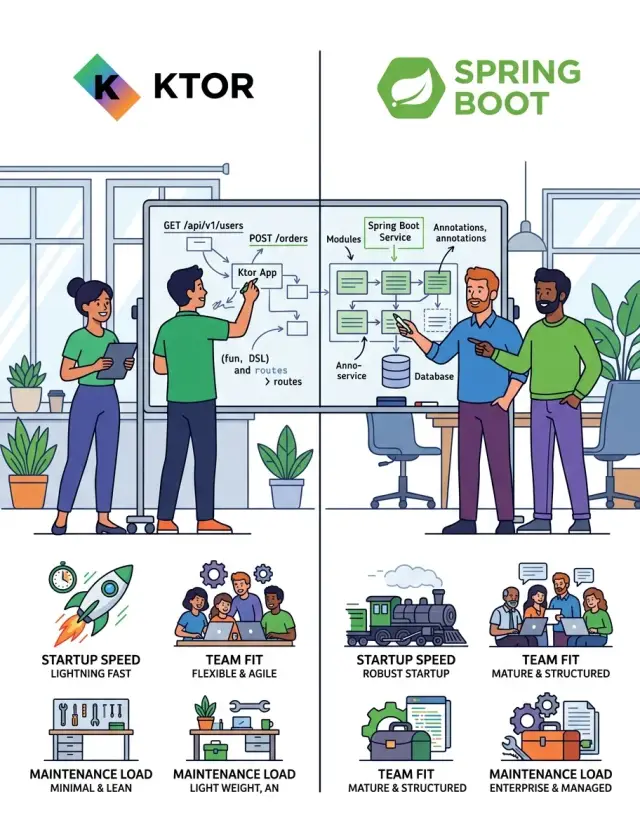
Table of Contents
Why this choice feels harder than it should
Most teams comparing Ktor and Spring Boot are not trying to avoid a bad option. They are choosing between two good ones with different tradeoffs, and that is why the decision takes longer than expected.
Ktor feels lighter. You add what you need, and less gets in the way. Spring Boot gives you more structure from the start. That often saves time when a team wants familiar patterns and fewer choices about setup.
The first demo hides most of the real work. A small internal API can look easy in either framework. You build an endpoint, connect a database, write a test, and it seems done. It is not. Even internal APIs need solid logging, error handling, health checks, test coverage, deployment rules, and access control. If nobody sets those up early, a small helper service turns into steady support work.
That is why this is a team decision before it is a code decision. You are choosing how people will build, read, debug, and maintain the service over time. A framework that looks clean in week one can become frustrating if new developers do not know its patterns. A framework that feels heavy at first can be easier to run if the team already understands how it behaves.
If your team likes explicit setup and a smaller surface area, Ktor often feels natural. If your team wants more built-in structure and expects more developers to work on the service later, Spring Boot often brings fewer surprises.
Day one rarely shows the real cost. Month six does.
What changes when the API stays internal
Internal APIs live by different rules. Your company controls the clients, the release schedule, and the pace of change. That removes a lot of pressure around public versioning, long deprecation periods, and support for every odd client behavior.
That freedom changes the decision. If the mobile app, admin panel, and background jobs all belong to your company, you can update the API and clients together. A breaking change is still annoying, but it is a planning issue, not a public support problem.
Performance still matters, just in a more practical way. For many internal Kotlin services, steady behavior and predictable response times matter more than benchmark headlines. Fast startup helps when you spin services up often, run short jobs, or scale in small containers. If the service stays up for weeks and handles stable traffic, a slightly slower startup may not matter much.
Security does not get easier because the API is private. Internal systems often hold payroll data, customer records, or company metrics. If your company needs strict access rules, audit logs, SSO, and formal review, the better framework is usually the one your team can secure and inspect with less guesswork. In some teams that is Spring Boot because the patterns are already familiar. In others, Ktor is easier because the code stays closer to plain Kotlin and there is less hidden behavior.
A few questions usually make the choice clearer:
- Do you control every client that calls the API?
- Can you deploy API and client changes together?
- Do you need strict audit and security review?
- Which framework does your team already know well?
For internal APIs, the best choice is often the one your team can change safely on a normal afternoon, not the one that wins the most arguments online.
Startup speed and memory use
If you run a small Kotlin service, Ktor often feels lighter the first time you launch it. In many setups, it starts faster and uses less memory before any traffic reaches the app. You notice that on a laptop, in CI, and on small cloud instances.
Spring Boot usually pays more upfront. It loads more framework code, wires more pieces together, and often uses more memory before the first request. That does not make it worse. It just means the cost appears earlier.
For long-running internal APIs, this gap matters less than many teams expect. If a service starts once, stays up for weeks, and handles requests all day, an extra few seconds at boot may not change much.
Short-lived jobs feel the difference right away. A scheduled task, a one-off worker, or a container that scales down to zero keeps paying startup cost again and again. In that setup, Ktor has a practical edge. Saving even 5 to 15 seconds per run adds up when jobs start many times a day.
Memory use follows the same pattern. On a large VM with plenty of room, Spring Boot's baseline may be fine. If you run several small internal services on modest machines, lower idle RAM can save money and reduce noisy resource fights.
Generic benchmarks only help so much. Your own dependencies, logging setup, database client, and container image can change the result more than most blog posts admit. Measure your own service and look at three numbers: cold start time, idle RAM, and build or test time. Those numbers matter more than a framework argument.
Team fit and daily coding
The better framework is often the one your team can read without stopping every few lines. Internal APIs live in daily work: a small fix, one more endpoint, a failing test, a strange request in the logs.
Spring Boot usually feels natural to teams that already know Spring. If people have spent years with annotations, dependency injection, starters, and auto-configuration, they move quickly. They also know where to look when behavior comes from framework rules instead of obvious application code.
Ktor feels closer to plain Kotlin. Routes, plugins, and request handling are usually easier to trace because there are fewer layers between the request and your code. A small senior team often likes that direct style. You can open the project, follow the call path, and change behavior without digging through framework internals.
Hiring matters too. More developers have seen Spring Boot before, so onboarding is often easier. Ktor is not hard, but it asks for stronger Kotlin comfort and clearer local conventions.
The daily tradeoff is simple. Spring Boot gives you more shared structure. Ktor gives you more direct control. Spring Boot usually fits better when you expect junior or mixed-experience hires, or when many people will touch the service over time. Ktor often fits better when a small experienced team owns the service and prefers explicit code over annotations and hidden wiring.
Both options have traps. Spring Boot can bury simple logic under controllers, services, configs, mappers, and wrappers. Ktor gives you freedom, which is great until every service starts using a different structure. If you choose Ktor, set rules early for project layout, error handling, tests, and dependency boundaries.
This part matters more than many teams expect. They compare startup numbers, then spend the next year living with the coding style.
Maintenance after six months
The first release rarely causes the pain. The slow work starts later, when libraries move, tests get flaky, and nobody remembers why one exception handler behaves differently from another.
Spring Boot often feels easier early on because so much is already there. Logging, config, security, validation, and data access usually follow common patterns. Months later, that convenience can turn into wider upgrade work. One framework update may touch auto-configuration, starters, annotations, and third-party integrations at the same time. If your team likes one shared way to build services, that trade may still be worth it.
Ktor keeps the stack smaller. That usually means fewer moving parts in the core app, but your team has to choose more things on its own: auth, validation style, error format, testing setup, and sometimes project structure. That freedom works well when the team is experienced and likes making clear decisions. It creates drag when every service solves the same problem differently.
In practice, framework choice is only part of the cost. Shared rules usually save more time than either framework does. Pick one logging format, one error shape, one way to load config, one test style, and one folder layout. Teams that skip this pay for it every week.
Most ongoing work comes from a few boring jobs: keeping tests reliable when dependencies change, updating docs when endpoints or auth rules change, and planning version bumps before security fixes turn into urgent cleanup.
Assign that work early. If nobody owns upgrades after launch, they slip for months and then land all at once. One person should track versions, group small changes, and call out risky ones.
A small team that wants speed with less ceremony may prefer Ktor, as long as it writes down its rules. A larger team, or one with mixed Kotlin and Java habits, often carries Spring Boot more easily because the defaults are familiar.
A simple way to choose
Start with the job the API must do, not with framework syntax. Teams often get stuck on whether Ktor feels cleaner or Spring Boot feels more complete. That matters less than a short list of requirements: auth, health checks, metrics, database access, validation, background jobs, and deployment rules.
Write that list first. If your internal API needs Spring Security, Actuator, or other Spring parts from day one, the choice gets easier. Spring Boot usually saves time when your team already wants those pieces and knows how to run them.
If the API is small, private, and focused on a few endpoints, Ktor often stays easier to reason about. You carry less framework weight, and the code path is usually easier to follow. That matters when someone opens the project late in the week to fix one failing endpoint.
A short trial beats a long debate. Build the same tiny endpoint in each framework. Use the same database call, validation rule, and auth check. Time the initial setup, the local run, the test run, and the first deployment. Have the same developer do both so the comparison stays fair.
A realistic test helps. An internal API that lets staff search orders and update shipment status is enough to show where setup drags, where tests feel natural, and which project is easier to debug without reading ten files first.
Then use a simple rule: pick the option your current team can support when they are busy. If your developers already live in the Spring world, Spring Boot may be the safer call even if Ktor starts faster. If your team likes lightweight Kotlin code and does not need the wider Spring stack, Ktor can be the better fit.
Good choices often look a little boring. That is fine.
A realistic team example
Picture a three-person startup building an internal billing API and a small admin tool. One engineer has years of Spring experience. The other two prefer plain Kotlin and want less framework code. Traffic is predictable, so huge spikes are not the first concern.
In that setup, Ktor is a sensible first choice. The app will start faster, local restarts will feel quicker, and the two Kotlin-focused engineers will probably move with less friction. For an internal API, that often matters more than getting every built-in feature from a larger framework. If the service mostly handles invoices, permissions, and a few admin screens, Ktor keeps the code close to the work.
The Spring engineer still matters a lot. That person can help set rules for package structure, tests, database migrations, logging, and security. The team gets a clear shape without forcing everyone into Spring because one person knows it best.
Hiring changes the choice. If the company expects to add developers soon, Spring Boot gains a point because more backend hires have seen it before. New people can open a Spring project and usually guess where things live. Ktor is easy to learn, but it gives teams more freedom, and freedom turns into confusion if nobody writes down the patterns.
If that same team plans to split the product into many small services next quarter, it should pause before locking in Ktor. This choice is not only about startup speed. It is also about how many framework decisions the team wants to repeat across service after service.
If this stays one or two focused internal APIs, Ktor looks strong. If the roadmap points to several services, more hires, and more shared conventions, Spring Boot starts to look safer.
Mistakes that waste time later
A lot of teams make this choice by staring at startup charts and memory numbers. That data matters, but it rarely tells you who will have the easier week three months later. A fast boot time looks great in a benchmark. It matters less if your team spends extra hours wiring logging, security, health checks, or debugging behavior that experienced Spring developers already know well.
The more expensive mistake is choosing a stack without naming who will own upgrades and production issues. If one person understands the framework and everyone else avoids touching it, you already have a one-person risk. Internal services still fail at odd times, and someone has to read stack traces, patch dependencies, and keep deployments boring.
Teams also lose time when they copy public API habits into a small internal service. A service used by two other systems inside one company usually does not need versioned public contracts, gateway-style layers, complex rate limiting, or a pile of generic wrappers. That structure looks neat early on. Months later, every small change touches five files.
Heavy abstraction is often the slow leak. Many teams build for scale they do not have yet, then pay for that guess in every review and bug fix. If the service has five endpoints and a small group of internal users, simple code usually wins.
The last bad assumption is that switching later will be cheap if the first choice goes wrong. It usually is not. By then, the framework sits inside tests, deployment scripts, auth rules, monitoring, and team habits. Moving the code is only part of the bill.
If your team is split between a familiar Spring setup and a leaner Ktor approach, a short outside review can help. Oleg Sotnikov at oleg.is does this kind of work as a Fractional CTO and startup advisor, especially for small teams that need a clear technical direction without dragging the decision out for weeks.
Checks before you commit
A short trial tells you more than a feature chart. Build one small endpoint, one database call, one test, and one deployment. That usually makes the choice much clearer.
Start with setup. Ask the newest person on the team to clone the service and run it from scratch. If they need half a day to fix local config, missing plugins, or build quirks, that cost will repeat every time someone joins or changes machines.
Then trace a single request from the route or controller to the database and back. Ktor often feels easier here because there are fewer layers by default. Spring Boot can still be clear, but only if the team keeps the structure simple and avoids extra abstraction.
Test speed matters more than teams admit. If local tests take long enough that people stop running them, maintenance gets worse fast. Ktor often feels lighter here. Spring Boot tests can stay reasonable too, but only if you are selective about full-context tests and do not load the whole app for every small check.
Your deployment target should shape the choice as well. If you run on platforms with frequent cold starts, startup time matters every day. If your services stay warm on stable servers, that pain matters less.
It also helps to look at the tools you already use. Teams that rely on Spring Security, Spring Data, Actuator, and shared Spring conventions usually hit less friction with Spring Boot. Teams that want a smaller codebase, faster startup, and more direct control over request handling often prefer Ktor. If the team has mixed experience, pick the option people can debug late in the day without needing a guided tour.
What to do next
Do not choose from habit. Write down three facts first: how many developers will work on the API, when you need the first version in production, and how many services you might add over the next year. Those numbers narrow the choice quickly.
A small team with a short deadline often leans toward less framework weight. A bigger team, or one with more Java than Kotlin experience, may prefer stronger conventions even if startup time is slower. The right answer depends less on internet debates and more on who will maintain the code later.
Next, run a one-day spike with both frameworks. Build the same tiny internal API twice. Keep the scope plain: one endpoint, one database call, one test, one config change, and one local run. Plain examples show the real work.
After that, score both options on a short checklist: cold start time on a developer machine, readability for the people who will own the code, test speed and setup effort, and upgrade effort, including config and dependency friction. Give each item a score from 1 to 5, then add one sentence that explains the score. That sentence matters more than the number.
If the result is still close, look at service count again. One or two internal APIs can live happily with a lighter setup. A growing set of services may push you toward the framework your team can standardize around with less debate and less cleanup work.
Pick the option your team can ship, run, read, and fix without friction. That is usually the right answer.
Frequently Asked Questions
Is Ktor a good default for a small internal API?
Often, yes. Ktor fits small internal APIs well when your team wants direct Kotlin code, quick local restarts, and less framework setup. It works best when a small experienced team owns the service and agrees on project rules early.
When should we pick Spring Boot instead?
Spring Boot usually wins when your team already knows Spring, expects more people to touch the code, or wants Spring Security, Actuator, and other Spring tools from the start. That shared structure can save time long after the first release.
Does startup speed really matter for internal services?
It matters most when services start often. Jobs that run many times a day, containers that scale to zero, and CI runs all feel startup cost right away. If your API starts once and stays up for weeks, team fit usually matters more than a few seconds at boot.
How much should memory use affect the choice?
Treat memory as a cost question, not a bragging point. On small machines or in a group of small services, lower idle RAM can cut spend and reduce resource fights. On a larger server with stable traffic, the gap may not change much.
Which framework is easier for onboarding new developers?
Spring Boot often feels easier for mixed teams because more developers have seen its patterns before. Junior hires and Java-heavy teams usually find their way faster. Ktor stays clear too, but it asks for stronger Kotlin comfort and firmer local conventions.
Is Ktor harder to maintain after a few months?
Not if your team writes down its rules. Ktor stays maintainable when you standardize error handling, logging, config, tests, and folder layout from the start. Without those rules, each service can drift and create extra cleanup later.
What should we test in a short Ktor vs Spring Boot trial?
Build the same small API twice and compare real work. Time setup, local run, test run, and first deployment, then trace one request from endpoint to database and back. That small trial shows more than any feature chart.
Do internal APIs need the same versioning rules as public APIs?
No, not in the same way. If your company controls every client, you can often ship API and client changes together and skip a lot of public API ceremony. Still, keep changes planned and clear so you do not break internal tools by surprise.
Do internal APIs still need strong security and audit rules?
Yes. Private does not mean low risk. Internal APIs often handle payroll, customer data, or company metrics, so you still need clear auth, audit logs, and predictable access rules. Pick the framework your team can secure and inspect without guessing.
Can we switch later if our first choice feels wrong?
Switching later usually costs more than teams expect. The framework ends up inside tests, auth flow, deployment scripts, monitoring, and team habits, not just route code. Make the choice with a small trial now instead of planning a rewrite later.


