Idempotency patterns for payments that stop billing chaos
Idempotency patterns help payment and webhook flows ignore duplicates, stop double charges, and cut support tickets before they pile up.
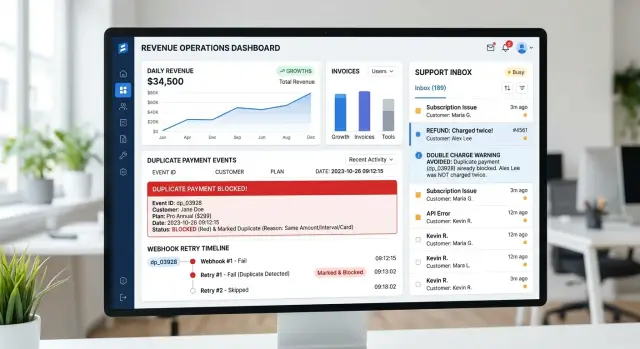
Table of Contents
Why duplicate events hurt customers
Customers can forgive a slow page or a small UI bug. They rarely forgive a billing mistake.
If someone tries to pay once and sees two charges, your product stops feeling safe right away. That single error spreads fast. The customer checks their bank, takes screenshots, replies to old emails, and opens a support ticket with an angry subject line. Some ask for a refund. Some call their bank first. A few go straight to a chargeback, which costs more than the original payment and creates extra work for the team.
One duplicate payment can pull in support, finance, and engineering at the same time. Support checks the payment provider and the customer account. Finance confirms what settled and what needs a refund. Someone has to explain the issue, sometimes more than once. Then the team checks whether access, invoices, or tax records changed twice.
Support usually feels the pain first. Billing data lives in more than one place, so a "simple" case rarely stays simple. The payment processor may show one status. The app may show another. The customer only cares that their card got charged twice. A ticket that should take five minutes can easily take half an hour, especially when an engineer has to confirm what happened.
Money changes the tone fast. If a dashboard loads slowly, users may complain and move on. If money leaves their account by mistake, they start wondering what else is broken. Some cancel. Some warn teammates. Some post about it publicly. A polite apology rarely fixes that.
Finance pays a price too. Duplicate events create refund logs, reconciliation mismatches, and status meetings where nobody has a clear answer yet. Teams end up comparing provider records, internal logs, and customer messages line by line.
That is why idempotency patterns matter so much in payment systems. They do more than stop technical noise. They prevent duplicate charges from turning into billing support tickets, refund work, and lost trust.
Where duplicate events usually start
Duplicate events rarely begin with one dramatic failure. They usually start with ordinary problems: a slow network, a timeout, a stuck loading screen, or a worker that runs the same job again. Each problem feels minor on its own. Together, they create duplicate charges and a messy support queue.
On the customer side, the most common case is simple. Someone taps "Pay," the screen hangs, and nothing seems to happen. Most people do the obvious thing and tap again. If your system treats both requests as new payments, one shaky moment becomes two charges.
Timeouts cause the same trouble even when the customer taps only once. The app sends a payment request, waits too long for a response, and retries. Mobile apps do this all the time after weak reception, a network switch, or waking from the background. The first request may have reached your server. The retry often does too.
Picture a customer buying a $29 subscription on a train. The signal drops, the app spins, then reconnects and sends the request again. The customer sees one purchase attempt. Your payment system may see two.
Your own backend can create duplicates too. Payment webhooks retry when your endpoint returns an error, takes too long, or closes the connection before the provider gets a clear success response. That retry is normal behavior. If your handler creates a charge, invoice, or account update every time it sees the event, normal retries turn into repeated work.
Background workers cause the same problem. A job starts, the worker crashes before it marks the job complete, and another worker picks it up again. Most queue systems promise delivery, not one-time execution. In billing, that difference matters a lot.
Most duplicate events happen because systems try hard not to lose data. That part is good. The problem starts when the payment flow is not ready for retries from clients, apps, webhooks, and workers.
What a duplicate payment looks like
A customer buys a monthly plan on a Friday evening. She enters her card, clicks pay, and watches a spinner for several seconds. Nothing changes, so she clicks again.
Behind the scenes, the first request already reached the payment provider. The bank approves it. Your app times out before it gets a clean response, so it sends the request again. Now you have two requests tied to one customer action.
The trouble does not stop with the charge itself. A few seconds later, your system receives two follow-up events. One is the original success event. The other is a retry from the webhook sender because your endpoint answered too slowly or failed for a moment.
If your app treats every event as new work, things go bad quickly. It may send two receipts, mark the subscription active twice, create two invoices, or write a second internal billing record. The customer opens her email, sees duplicate messages, checks her bank, and assumes she was charged twice.
Now support has a nervous customer asking for a refund. Someone on the team has to stop and untangle the case by hand: compare request IDs and event IDs, check whether the second charge settled or only appeared as pending, issue a refund if money moved twice, and explain the result to the customer. One ticket can burn 15 to 30 minutes. If it happens a few times a week, the cost adds up fast.
The bigger problem is trust. Customers do not care whether the duplicate came from a timeout, a retry, or a bad webhook handler. They care that billing felt unsafe.
What idempotency means in plain language
When the same payment request shows up more than once, your system should treat it as one payment attempt, not several. That is idempotency in plain language.
A customer may tap "Pay" twice, refresh a stuck page, or lose signal while the app retries in the background. They still expect one charge and one receipt. Your system should give them that.
The idea is simple: the same request should lead to the same result every time it is retried. If the first attempt created a charge, the retry should return that same charge result. If the first attempt failed, the retry should return that failure instead of trying again as if nothing happened.
This only works if each payment attempt has one stable ID. Think of it as a label that stays attached to that attempt from start to finish. If checkout creates a payment attempt like pay_attempt_123, every retry for that same click or submit action must reuse pay_attempt_123.
Without that stable ID, your server cannot tell the difference between a real new payment and the same payment coming back again. That is where duplicate charges start.
Your system also needs a memory. When it handles the first request, it should store the outcome before it answers. That record should include the result, the provider reference, and the order or invoice tied to the attempt. If the same ID comes back, your code should look up the saved outcome and return it. It should not create another charge, another invoice, or another order.
Here is the simple version. A customer clicks "Pay" and the request times out on their phone. Your server already charged the card and saved the result. The phone retries a second later with the same payment attempt ID. Instead of charging again, the server returns the first success response. The customer sees one payment. Support never gets the ticket.
How to add it to a payment flow
A payment flow needs one stable reference before it talks to the payment provider. Create the idempotency key when your app creates the charge request, not after the first attempt fails. If a customer taps the button twice, refreshes the page, or loses connection, each retry should carry that same idempotency key.
Save that key with the order ID, customer ID, amount, currency, and the result you return to the app. Keep the provider response too, including the payment status and transaction ID. That small record does most of the work later.
When the app sends a charge request, check your own database first. If you already have a completed record for that idempotency key, do not call the payment provider again. Return the original response instead, so the customer sees one clear outcome instead of a second charge or a vague error.
The rule should stay strict:
- Same idempotency key plus the same payment details means return the same response.
- The same idempotency key with different details means reject the request and log it.
That second rule matters more than many teams expect. A retry only counts as the same request when the amount, currency, and customer match the original. If someone reuses the same idempotency key for a different amount or a different customer, that is not a retry. It is a bad request or a bug.
When this part is done well, support sees fewer "I only paid once, why do I have two receipts?" tickets. Finance gets cleaner records. Customers get one answer even when networks, apps, and payment webhooks retry behind the scenes.
How to handle payment webhooks without a mess
Payment webhooks fail in boring ways. A provider sends the same event again because your server timed out or returned an error. If your app processes the event twice, the customer may see two receipts or a paid invoice that flips state again.
Start by verifying the webhook signature. If the sender is not real, nothing else matters.
After that, treat the event ID as the fingerprint for that message. Save the event ID before you change any billing status. The order matters. If you mark an invoice as paid first and save the ID second, a crash in the middle leaves the door open for duplicate credits, duplicate receipts, or another bad state when retries arrive.
A safe webhook flow is short. Verify the sender. Check whether the event ID already exists. Store the event ID in the same transaction as the billing update. Return success only after both steps finish.
That pattern works because it stops repeat events at the door. Your code applies each state change once, then ignores the same event if it comes back five more times. A repeated invoice.paid event should not create five payments. A repeated refund.created event should not keep reducing the balance.
Order can get messy when several events touch the same customer. A refund may arrive before the payment event that created the charge, or two invoices may update at nearly the same time. In those cases, queue events by customer or invoice and process them in order. That slows things down by a few seconds, but it prevents the kind of billing history nobody can explain later.
Good logs save real time here. Write logs that support and finance can scan in seconds. Include the event ID, customer ID, invoice number, event type, result, and the reason you skipped anything. "Skipped duplicate event evt_123 for invoice 456" is useful. "Webhook handled" is not.
Mistakes that cause double charges
A lot of double charges start with one bad assumption: if the request comes in again, it must be new. That logic breaks fast in payments.
One common mistake is creating a new idempotency key for every retry. If the client or server changes the token each time, your system cannot tell a true second purchase from the same purchase sent again. Retries need the same stable ID, or the payment flow forgets its own history.
Another mistake is checking for duplicates only after you charge the card. By then, the expensive part already happened. The first write should answer one question: have we seen this payment request before? If the answer is yes, return the saved result and stop.
Timestamps also cause trouble. They look tidy, but they are weak duplicate detection. Two requests can land in the same second, and one delayed webhook can show up much later while still referring to the same payment. Stable request IDs, order IDs, and event IDs work better because they do not depend on timing.
The order of operations matters too. If your flow charges the card, updates billing, sends the receipt, updates the CRM, and only saves the original payment result at the end, you are asking for repeats. If one of those later steps fails and the client retries, your system may charge again because it never stored the first outcome in the right place.
Support pain gets worse when agents cannot see the event trail. If a customer says, "I was charged twice," the agent should be able to see the first request, every retry, webhook delivery attempts, and the final payment state in one place. Without that record, people guess. Guessing leads to refunds, escalations, and more billing support tickets.
Good idempotency patterns are boring on purpose. One stable ID, one stored result, and one clear history prevent a lot of angry email.
Check before you ship
Before you push a payment change to production, test what happens when the same action shows up twice. That sounds dull, but this is where many payment bugs hide.
A short pre-release check helps:
- Give each payment attempt one request ID and keep it stable across client retries, network retries, and background jobs.
- Save every webhook event before you process it, including the event ID, type, payload snapshot, processing status, and timestamps.
- Write plain rules for retries, refunds, and renewals so each one creates exactly the records it should.
- Make payment history easy for support to search by customer, order number, request ID, or webhook event ID.
- Watch duplicate and retry rates, and alert the team when they jump.
Then run small tests for each rule. Trigger the same checkout request twice. Replay the same webhook three times. Send a refund event after a timeout. After that, read the database the way a support agent would, not the way a developer would.
If the records tell one clear story, you are in good shape. If two tables disagree, or support cannot trace what happened in under a minute, do not ship yet. Payment bugs rarely stay small.
What to do next
Start with one real payment path and trace it from end to end. Follow the charge request, the webhook that confirms it, and the refund path that reverses it. Teams often test these pieces one by one, then miss the bug that appears only when they interact.
The review should stay plain and practical. You want to know which request creates the order, which one marks it paid, which one sends email, and which one can run twice without damage. If that map is fuzzy, support will keep paying the price.
Write down every step in the charge, webhook, and refund flow. In a test environment, replay timeouts, client retries, and repeated webhook deliveries. Check what happens if the payment provider reports success twice or sends events out of order. Then ask support which billing cases eat the most time each week. They usually know exactly where the ugly failures are: two receipts for one order, a paid invoice that still looks unpaid, or a refund that worked in the processor but not in your app.
Keep score while you test. Count how many duplicate requests create extra records, how many retries send another email, and how many webhook replays change the final state. Small failures add up quickly when webhook retries run all day.
If your team already has a live system, you probably do not need a big rewrite. Often the fix is a tighter idempotency key policy, a better event log, or a rule that only one path can change billing status. That cleanup is usually cheaper than another month of refund work and billing support tickets.
If you want an outside review, Oleg Sotnikov at oleg.is works as a Fractional CTO and startup advisor and can inspect payment and webhook flows with your team. A second pass on retries, event handling, and billing state changes can catch weak spots before they turn into more customer pain.
Frequently Asked Questions
What usually causes duplicate payments?
Most double charges start with normal retries. A customer taps Pay twice, the app times out and sends the request again, or a worker reruns the same job after a crash.
The retry is not the problem by itself. Trouble starts when your system treats the repeated request like a brand new payment.
What does idempotency mean in plain English?
It means the same payment attempt gets one result, even if the request shows up more than once.
If the first try created a charge, every retry should return that same charge result instead of making another one.
Should every retry use the same payment attempt ID?
Yes. One customer action needs one stable payment attempt ID from start to finish.
If your app creates a new ID on every retry, your server loses the ability to tell a retry from a real new purchase.
What should I save for each payment attempt?
Store the payment attempt ID, customer, order, amount, currency, provider transaction reference, and the final result you returned.
That record lets your server answer retries from its own data instead of calling the payment provider again.
What if the same idempotency ID comes back with a different amount?
Reject it and log it. A retry only counts as the same request when the details match the original payment.
If the amount, currency, or customer changed, you probably have a bug or a bad client request.
Can a customer get charged even when the app shows a timeout?
A timeout does not mean the charge failed. The payment provider may have approved the first request while your app missed the response.
That is why retries must look up the saved result first. Without that check, the second try can charge the card again.
Why do payment webhooks need duplicate protection too?
Providers retry webhooks all the time when your endpoint is slow or returns an error. That is normal behavior.
If you do not deduplicate by event ID, one payment event can send two receipts, create two records, or flip billing state more than once.
When should I store the webhook event ID?
Save the event ID before you change billing state, and do both steps in one transaction.
If you update the invoice first and store the event later, a crash in the middle can let the same webhook apply the change again.
What does support need to investigate a double-charge complaint?
Support should see one clear timeline in one place. Show the original request, retries, webhook deliveries, provider references, and the final billing state.
When agents can trace the whole path fast, they stop guessing and solve billing tickets much faster.
Do I need a full rewrite to stop billing chaos?
Usually not. Many teams fix this with a tighter rule for stable payment IDs, better webhook deduplication, and cleaner logs.
Start with one live payment path, replay retries and webhook repeats in test, and fix the places that create extra charges or records.


