When to hire for reliability before features slow down
Learn when to hire for reliability by tracking incident load, release fear, and support drag before feature work starts slipping.
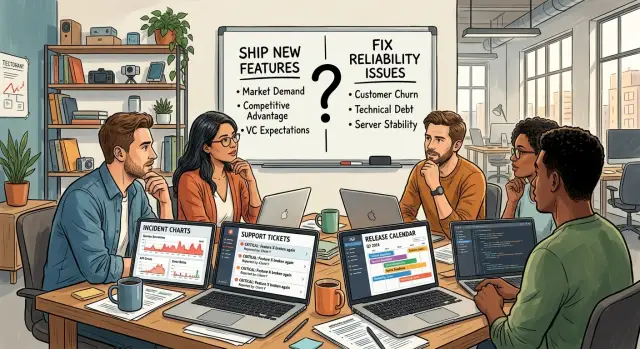
Table of Contents
Why feature work starts slowing down
Most teams think they have a planning problem when they really have a reliability problem. The roadmap looks reasonable on Monday. By Thursday, two people are fixing a bad deploy, one engineer is answering support questions, and the feature that looked 'almost done' slips again.
Outages do more than eat a few hours. They break the week into scraps. Engineers lose the thread of their work. Product managers reshuffle priorities. Founders start asking for smaller bets because bigger ones feel risky. Everyone stays busy, but less product ships.
Small failures create a quieter drag. A broken email flow, a flaky import, or a payment edge case might look minor on its own. In practice, the same few people keep getting pulled back into the same systems. They stop building new things and start babysitting old ones.
A startup can absorb one rough week. It can even survive a bad month if the team is small and stubborn. Trouble starts when interruptions become normal. Estimates get fuzzy. Releases slip. Simple tasks take two or three tries because the team no longer trusts the product.
Founders usually notice the symptom before the cause. Output drops, deadlines move, and energy fades. It's easy to blame focus, hiring pace, or execution. Often the real issue is simpler: reliability work has become part of product speed. Once that happens, waiting too long to staff it slows everything else.
Three signs your team needs reliability work
Most teams miss this moment because feature delivery still looks busy from the outside. People ship, fix, answer questions, and stay late. But the pace is fake. The team spends more energy recovering than building.
The first sign is constant interruption. If incidents break into planned work every week, the roadmap stops meaning much. Engineers start a feature on Monday and lose half the week to production issues, urgent patches, and follow up checks. A few incidents are normal. A steady pattern means reliability work is already part of the job, just without clear ownership.
The second sign is release fear. You can hear it in small comments: 'Let's wait until next week' or 'Bundle these changes so we only deploy once.' That sounds careful, but it usually means the team doesn't trust testing, deployment, or rollback. Teams that fear releases make bigger batches, and bigger batches fail in bigger ways.
The third sign is support drag. Product engineers spend their days in triage instead of moving new work forward. They answer customer reports, dig through logs, explain odd edge cases, and patch small breakages. None of that is pointless work. It just means feature builders have become part time reliability staff.
When all three show up together, product speed starts dropping even if headcount stays the same. At that point, the question is no longer whether reliability matters. It's whether you will give it a real owner now or keep paying for it through missed feature work.
Check incident load over the last two months
A single ugly outage can scare any founder, but hiring off one bad day is a mistake. Look at the last 6 to 8 weeks instead. That window shows whether reliability problems are rare or whether they keep pulling the team away from product work.
Start with three counts: repeat incidents from the same service or dependency, fixes that pulled engineers back at night or on weekends, and emergency patches that jumped ahead of planned work.
The total matters, but the pattern matters more. Five incidents spread across five people is annoying. Five incidents that always land on the same two engineers will drag delivery down fast.
Check who gets interrupted each time. If the same backend lead, staff engineer, or operations person keeps dropping feature work to fight fires, your roadmap is already paying the price. Reviews sit longer. Decisions get delayed. Small bugs stay open because the people everyone depends on are cleaning up the next mess.
Look at time, not just tickets. One late night fix, half a day spent in logs, and a rushed patch before Monday can quietly erase several days of progress. Most teams miss this because much of the work happens in chat, calls, and ad hoc debugging instead of the sprint board.
Repeat incidents are the clearest signal. If the team patched the same class of failure three times in two months, that isn't bad luck. It usually means nobody owns the root cause strongly enough to fix it.
That is often the clearest answer to the hiring question. If incident load keeps stealing time from the same engineers every week, features are already slowing down. Hiring earlier usually costs less than letting your most expensive people spend another month on emergency repair.
Look for release fear in daily work
Release fear is easy to miss because it sounds like caution. It usually starts with small delays, soft language, and a growing habit of waiting for a safer moment to ship.
Listen for how often people say, 'Let's wait until next week.' If that comes up for minor fixes or low risk changes, the team doesn't trust its release process. They may want more people online, lower traffic, or one specific engineer available before they push anything.
That fear gets expensive quickly. A bug fix that should go out today sits in review until Monday. A copy change turns into a release window. The team still looks busy, but feature work slows because shipping feels risky.
Long test cycles are another clear signal. When a simple release needs a day or two of manual checks, something is off. Teams often call this caution. In practice, nobody trusts the build, the rollout, or the rollback path.
Manual approval from a senior engineer is another clue. If one staff engineer, tech lead, or founder has to inspect each change before it goes live, that person becomes the release system. It works for a while. Then it turns into a queue.
Ask a few plain questions. How often did the team delay a release for a few days just to feel safer? How long does a small change sit in testing before anyone ships it? How often does a senior engineer step in for final checks or approval?
If those numbers keep rising, product speed is already dropping. The team spends more time avoiding incidents than building useful things. The point of reliability work isn't more process. It's to make small releases feel normal again.
Count the support drag on your product team
Support drag is easy to miss because it shows up in small pieces. A bug report in chat, a customer call, a broken export, a deploy check after hours. Each one looks minor. Together they eat the time your team needs for product work.
Start with one plain number: how many engineering hours went to support last week? Count bug triage, hotfixes, log checks, customer follow up, and internal questions that needed an engineer. If nobody tracks this yet, that tells you something too. A simple spreadsheet covering the last four weeks is usually enough to show the pattern.
Don't throw everything into one bucket. A customer asking how to use a feature is different from an engineer fixing a crash or cleaning up bad data. The first problem often points to onboarding, docs, or product design. The second points to reliability work.
Break support time into a few simple groups: product questions that support or success could answer without engineering, repeat bugs and cleanup, release checks and rollback help, and one off customer issues caused by fragile edge cases.
That split matters because only some support work means you need a reliability hire. If half the load is bug cleanup and release babysitting, feature speed will keep dropping until someone owns those problems.
Look at people, not just totals. One engineer losing 60 minutes at a time to urgent pings may get less done than someone who spends three planned hours on support. Interruptions ruin maker time. The cost isn't just the hour itself. It's the restart after every context switch.
Watch for the same names each week. Usually the most experienced engineer, team lead, or infrastructure person gets pulled in again and again. Then reviews slow down, roadmap work slips, and the rest of the team starts waiting for answers.
A rough rule works well. If support takes more than 15% to 20% of engineering time most weeks, or if two or three people can't protect long blocks for focused work, the team is already paying a reliability tax. Another feature hire may add output for a month or two. It won't fix the interruptions dragging everyone back.
How to decide if you should hire now
Pull one month of work into a single view. List every production incident, every release that slipped because the team didn't trust the rollout, and every hour spent on support, hotfixes, and cleanup. Use tickets, chat logs, calendar blocks, and customer messages so the count is real.
Then put that number next to one normal sprint of feature work. If the team planned 80 hours for product changes but lost 25 to fires and support, that's not background noise. Reliability is already deciding what gets built.
Count the full cost: time spent fixing incidents, release delays and extra checks caused by fear, support issues that pull engineers off planned work, and rework after rushed fixes.
The decision gets easier once you compare those hours with actual output. If reliability work keeps taking a third of a sprint, or wipes out important work two sprints in a row, you need a dedicated owner. That owner might be a new hire. It might also be an existing engineer with feature work removed from their plate.
Start with the part of the product that hurts most. If deployments keep breaking, focus the role on release safety, testing, and monitoring. If support keeps dragging engineers into customer issues, focus on alerts, triage, and better internal tools.
Avoid a vague platform or DevOps opening that tries to fix everything at once. Small teams do better with a narrow first role tied to one obvious problem area. If you're not ready for a full time hire, outside help can still define the first reliability owner, the scope, and the order of work before you spend months recruiting the wrong person.
A simple startup example
A six person SaaS team spent eight months moving fast. They pushed small updates three or four times a week, customers liked the pace, and the roadmap still felt real. Then the pattern changed. Two outages hit in one month, then three more landed close together.
None of those incidents looked huge on paper. Still, each one pulled the same people away from planned work. A login bug took half a day. A queue backlog ate most of another. By the end of the month, the team had lost more build time than anyone wanted to admit.
The company had two senior engineers who knew the shaky parts of the system best. Every Friday, both disappeared into cleanup. One checked logs, patched edge cases, and helped answer customer emails. The other rolled back part of a release, fixed bad data, and wrote a short postmortem so the same issue wouldn't return on Monday.
Feature work still shipped, but each release left a mess behind. A new billing option went live and triggered a queue problem the next day. A search update shipped, then support found strange results for older accounts. The team kept telling itself it was still moving fast because releases hadn't stopped. In reality, progress had slowed. They were spending more time repairing work than finishing it.
Release fear started to show up in small ways. Engineers avoided Friday deploys. The product manager asked for extra manual checks before every launch. Support waited nervously after each update because they expected a wave of tickets. When a team works like that, speed is already dropping even if the roadmap still looks full.
That is usually the moment to add reliability work. Not after a major failure. Not after customers start leaving. Right when incident load, release fear, and support drag begin to eat the same hours every week.
A good reliability hire doesn't slow product work. Done at the right time, that person gives the team its Fridays back.
Mistakes that make the switch harder
Most teams don't miss the technical problem first. They miss the timing. The need for reliability work becomes clear only after feature work has already started to slow, and by then the fix costs more.
Waiting for one major outage is the most common mistake. Small incidents feel manageable, so the team patches them, clears the queue, and goes back to roadmap work. Then one bad release lands on a busy day, support spikes, and the team loses a week rebuilding trust instead of shipping.
Another mistake is opening a vague DevOps role with no clear ownership. That title can mean almost anything, and that's the problem. If nobody decides who owns deploy safety, alert cleanup, incident follow up, and recurring stability issues, the new hire becomes the person for miscellaneous infrastructure work and the team stays stuck.
Founders also make the switch harder when they ask feature engineers to carry reliability work on top of full sprint plans. That sounds efficient on paper. In practice, people pick the deadline everyone can see, so noisy alerts, flaky tests, slow rollbacks, and repeat bugs keep getting pushed to later. Later usually becomes another release with the same problems.
Blame makes it worse. One engineer gets labeled careless, support gets blamed for raising too many issues, or the new operations hire gets every production problem thrown at them. Most of the time, one person isn't the cause. The team has weak release habits, too much alert noise, and no protected time to remove repeat failures.
A simple check helps. If the same people build features, answer support, calm alerts, and watch every release like it might break, you don't have a motivation problem. You have a load problem.
A quick checklist before you open the role
Open the role when the pain is steady, not when one bad week scares you. A reliability hire makes sense when the same problems keep eating planned work week after week.
Ask these five questions and answer them with examples from the last 6 to 8 weeks:
- Did incidents interrupt planned work almost every week?
- Did releases slip because people worried a change might break something?
- Did support keep pulling the same engineers away from product work?
- Does one person still hold too much system knowledge in their head?
- Does the team avoid certain parts of the product because they feel fragile?
One yes can be noise. Two means you should watch the trend. Three or more usually means feature speed is already dropping, even if the roadmap still looks full on paper.
The pattern matters more than the size of any single outage. A startup can survive a rough week. It gets expensive when engineers start planning around failure. They leave extra time for rollbacks, avoid cleanup work, and delay changes that touch risky areas.
Watch who pays the tax. If the same senior engineer gets dragged into support, incident fixes, and release checks, you don't just have a busy person. You have a bottleneck.
Write the role after you collect the evidence. Keep it simple. Name the recurring incidents, the release delays, the support hours lost, and the systems nobody wants to touch. That gives you a real job to fill, not a vague hope that someone will fix operations.
If you can't answer these questions with specifics, wait a bit and measure for another month. If you can answer them quickly, the need is probably already there.
What to do next
If you're still unsure, don't start with a job post. Start with a short brief. One page is enough. Write down what keeps breaking, how often releases get delayed, and how much product time disappears into support, fixes, and cleanup.
Then choose one or two outcomes for the next 60 to 90 days. Keep them plain and measurable. You might want fewer repeat incidents, less engineer time pulled into support, or calmer releases with fewer last minute rollbacks. A short list forces focus, and that makes hiring easier.
The brief should answer four questions: what breaks again and again, how much feature work slips because of incidents or support, what should improve first, and who will own the work after the first fixes land.
After that, decide what kind of help fits the problem. A full time hire makes sense when incidents are steady, releases feel tense every week, and the product team can't protect build time anymore. A contractor can work well when the pain is narrow, such as one shaky service, weak observability, or a release process that needs cleanup. Fractional CTO help often fits earlier, when the problem is broader than one person and you need someone to sort the plan before you commit.
If you want a second opinion before opening the role, Oleg Sotnikov at oleg.is does this kind of review with startups and small teams as a Fractional CTO. He looks at incident load, release flow, infrastructure, and team strain before recommending whether the team needs a hire, a short engagement, or a process change first.
The next step is simple: write the brief, pick the outcome, and match the help to the actual pain.
Frequently Asked Questions
When should a startup hire for reliability?
Hire for reliability when incidents, release delays, and support work steal time from the same engineers most weeks. If reliability work keeps wiping out a big chunk of sprint time, product speed already dropped.
What are the first signs that reliability work needs a real owner?
Watch for three patterns: weekly interruptions, fear around small releases, and product engineers stuck in support or cleanup. When all three show up together, the team spends more time recovering than building.
Should I hire after one bad outage?
One ugly outage is not enough. Look at the last 6 to 8 weeks and check for repeat incidents, late-night fixes, and emergency patches that jump ahead of planned work. Repeated problems matter more than one dramatic failure.
What does release fear look like in day-to-day work?
Release fear shows up in small delays. People wait until next week to ship, bundle too many changes into one deploy, or ask one senior engineer to approve every release. That usually means the team does not trust testing, rollout, or rollback.
How much support work is too much for the product team?
Start with a rough rule: if support takes more than 15% to 20% of engineering time most weeks, you have a real drag on delivery. Even less can hurt if the same people lose focus every day to urgent pings and quick fixes.
Do I need a new hire, or can I reassign someone on the team?
Not always. If the load is steady, you can pull one engineer off feature work and give them clear ownership. If the problems keep growing or touch too many systems, a dedicated hire usually makes more sense.
Should I open a DevOps role or a reliability role?
Start narrow. Tie the role to the pain you feel every week, such as deploy safety, alert cleanup, monitoring, rollback flow, or repeat incident follow-up. A vague DevOps role often turns into random infrastructure work and fixes less than you expect.
What should the reliability role own first?
Give them one obvious problem area first. If deploys keep breaking, let them own release safety, testing, and rollback. If support keeps pulling engineers away, let them own alerts, triage, and the tools that cut repeat issues.
How do I know if reliability work already hurts feature delivery?
Pull one month into a simple brief. Count incidents, delayed releases, support hours, hotfixes, and cleanup time, then compare that with planned feature work. The numbers usually make the decision much clearer.
What should I do if I am still unsure?
Do not rush into a job post. Write a one-page brief with what keeps breaking, how often releases slip, and how much engineering time disappears into support and fixes. If you still want a second opinion, a Fractional CTO can review the load and tell you whether you need a hire, a short engagement, or a process change first.


