ORM vs query builder vs raw SQL in Go: how to choose
ORM vs query builder vs raw SQL in Go: compare migrations, debugging, and query control so your team can choose with fewer regrets.
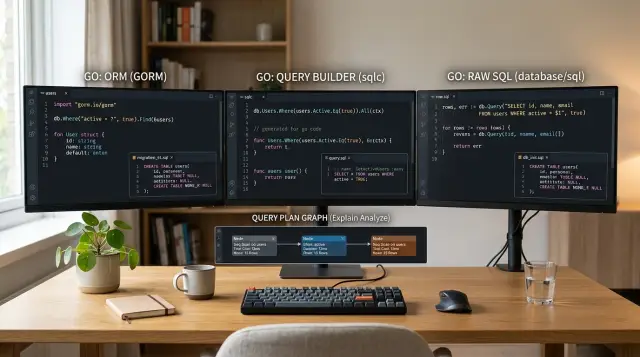
Table of Contents
Why this decision gets messy fast
Most Go apps start with a small, clear shape. You need a few tables, a handful of endpoints, and basic create-read-update-delete work. At that stage, almost any database approach feels fine.
Then the app grows up.
A product rarely stays on simple CRUD for long. Someone asks for admin filters, exports, dashboards, search, billing history, or a report that joins six tables and groups data three different ways. The same codebase now has boring reads, messy writes, background jobs, and a few queries that nobody wants to touch on Friday.
That is why "ORM vs query builder vs raw SQL in Go" gets messy so fast. You are not choosing for the app you have today. You are choosing for the app after six months of feature requests, schema changes, and one painful slowdown in production.
The first trap is setup. Early setup can make a tool look better than it really is. An ORM often feels fast on day one because models, relations, and common queries come together quickly. Raw SQL can feel clean too because every query is obvious. A query builder sits in the middle and seems like a safe compromise.
The pain usually starts later, when the database changes.
A new column sounds small until you need to update structs, scans, generated code, tests, and migrations. A renamed table can ripple through dozens of queries. Soft deletes, tenant rules, and custom indexes make the tradeoffs much more obvious than the first happy-path demo ever did.
Slow queries expose the same problem. When a page takes two seconds instead of 200 milliseconds, your team has to find the exact SQL, inspect the plan, and decide what to change. If that query came from layers of ORM behavior, debugging gets slower. If everything is raw SQL, you get control, but you also carry more manual work every day.
Migrations make the choice even more real. They force your team to answer practical questions: who owns schema changes, how carefully you review them, and how much query control you want once the schema stops being simple. That is where the real cost shows up.
What each option actually changes
An ORM changes how your team thinks about database work. People start with Go structs, relations, and method calls, and the tool turns that into SQL. That feels fast at first, especially for simple CRUD, but it also means more of the real query lives behind the library.
A query builder changes less. You still write the query in code, but the SQL shape stays visible: selected columns, joins, filters, sorting, limits. You trade some convenience for clarity, and many Go teams find that balance easier to live with after the project grows.
Raw SQL changes the job the most. You write the exact statement, you review the exact statement, and you own every mistake. That sounds heavier, but it removes guesswork when a query gets slow or returns the wrong rows.
The daily differences usually look like this:
- ORM: fastest start for basic create, read, update, delete work
- Query builder: clearer query logic without building SQL strings by hand
- Raw SQL: full control over joins, indexes, CTEs, window functions, and odd edge cases
A small example makes this clearer. Say you need a customer search with filters for status, signup date, and last order value. In an ORM, that often starts clean, then gets awkward once you add custom sorting, aggregates, or database-specific functions. In a query builder, the query usually stays readable because the SQL structure is still right there in the Go code. In raw SQL, the statement is easiest to reason about if the query is already complex.
This choice also changes who can work comfortably in the codebase. Teams with stronger SQL skills often prefer query builders or raw SQL because they can see what the database will do. Teams with more app-focused engineers may move faster with an ORM, at least for routine work.
Most teams do not need to pick one tool for every case. A practical setup is one default and one fallback. For example, use a query builder for most read and write paths, then drop to raw SQL for reports, search, and anything performance-sensitive.
A simple way to choose
Start with the queries that matter most to your product, not with personal taste. A settings page with basic create, read, update, and delete work is one thing. A billing report with joins, totals, and bulk updates is another. When people argue about ORM vs query builder vs raw SQL in Go, they often compare tools in the abstract. That usually leads nowhere.
Make a short list of the queries your product depends on every day. Think about checkout flows, user permissions, search, reporting, background jobs, and anything that touches a lot of rows at once. Then mark the ones that have joins, aggregates, or batch writes. Those queries will tell you where you need convenience and where you need control.
- Name the person who will inspect slow queries when production gets noisy.
- Mark the queries where exact SQL matters.
- Choose one default for normal feature work.
- Keep one escape hatch for the awkward cases.
- Try the setup on a real feature before you make it a rule.
That first point is more practical than it sounds. If nobody on the team wants to read SQL, an ORM may help you move faster at first, but slow query work will still land somewhere. If one or two people are comfortable with SQL and query plans, a query builder or raw SQL may save time later because the code maps more closely to what the database runs.
Also think about schema changes. If your tables change every week, pick an approach that keeps migrations and query updates easy to review together. A fancy abstraction is not much help if every migration turns into a hunt across models, tags, generated code, and handwritten patches.
Then test the choice on a real feature, not a toy example. Build one endpoint, one report, or one batch job. You will notice the friction fast: unreadable queries, too much boilerplate, weak type safety, or hard-to-review migrations. That small test tells you more than a long team debate.
Think about migrations first
Migrations usually settle this choice faster than query style does. If your team struggles to read schema changes in review, an ORM can turn a small table update into a noisy diff that nobody wants to check closely. Raw SQL takes longer to write, but reviewers can see exactly what changes in the database.
A query builder rarely solves migrations on its own. Many Go teams use a builder for app queries and still keep migrations as plain SQL files. That split is often easier to live with because schema history stays clear, even if application code uses higher-level helpers.
Readability beats automation
Look at how your team already works. Do people review migrations line by line, or do they trust generated output and move on? If reviewers cannot spot a dropped index, a renamed column, or a default value change in under a minute, the process is too opaque.
Generated diffs need extra care. They can include column reordering, default changes you did not mean, or engine-specific details that clutter review. Those surprises waste time, and worse, they make people stop reading closely.
Rollback rules need a home too. Some teams keep rollback SQL next to every forward migration. Others write one-way migrations and restore from backups if something goes wrong. Both approaches can work, but you should choose one early and stick to it.
A simple check helps:
- Can a new team member read a migration from six months ago and understand it?
- Can reviewers tell what happens on rollback?
- Can you run the change safely in staging with production-like data?
- Can you separate schema updates from data fixes?
That last point matters more than people expect. Adding a column is one kind of change. Backfilling ten million rows is another. When you split them, you get simpler deploys, cleaner rollbacks, and fewer late-night surprises.
If your team wants tight control, keep migrations close to raw SQL even if the app uses an ORM or query builder. It is a boring choice, and that is usually the right one.
Plan for performance debugging
A database layer feels easy when traffic is low. The trouble starts when one endpoint turns slow and nobody can tell which query caused it, how often it ran, or what the database actually received.
Plain SQL is the easiest to inspect in slow query logs because the text in your code is almost the same text the database executes. When a query takes 800 ms, you can copy it, run EXPLAIN, and see where the time goes.
ORMs make this harder. The code can look clean while it quietly fires an N+1 pattern in the background. A loop that loads 50 records can turn into 51 queries, and you may not notice until users feel the delay.
Query builders sit in the middle. They still add a layer, but most make it simple to print the final SQL and bound values. That alone saves time when you debug a heavy endpoint under pressure.
A simple example: a dashboard loads accounts, then loads recent invoices for each account. In an ORM, that can happen through neat model calls that read well in a review. In production, it may hammer the database with dozens of extra reads. With raw SQL or a query builder, teams usually spot the repeated access sooner because the query count is more visible.
What to measure
Do not stop at query duration alone. Track a few numbers together:
- final SQL for slow requests
- total query count per request
- transaction time from begin to commit
- connection pool wait time
- rows scanned versus rows returned
Pool waits matter more than many teams expect. Sometimes the query plan is fine, but requests still stall because every connection is busy inside long transactions. That points to app behavior, not just SQL tuning.
Run EXPLAIN on heavy endpoints early, before they become a fire drill. Check the endpoints that drive revenue, reports, imports, and admin screens with lots of filters. Those paths usually break first.
If your team wants the fastest path from
How much control your team really wants
In the "ORM vs query builder vs raw SQL in Go" debate, team habits often decide more than benchmarks do. The best option is usually the one your team can read, review, and change without guessing what the database layer is doing.
Some teams want every join, filter, and transaction spelled out. That usually points to raw SQL. You can see the exact query, reason about locks, and review every change in a pull request. If someone needs to debug a slow report at 2 a.m., explicit SQL is much easier to trust than generated queries hidden behind model methods.
Other teams care more about shipping common screens fast. Admin panels, settings pages, and basic CRUD often do not need hand-written SQL from day one. An ORM can cut a lot of repetitive code. That speed is real, but only if the team accepts the tradeoff: less control over query shape, more framework rules, and more work when a simple page turns into a messy set of joins.
A query builder sits in the middle. It gives structure and safer patterns, but you still choose the joins, selected columns, and transaction flow. For newer Go teams, that middle ground is often easier to manage. People can follow one style, avoid string-built SQL scattered across the codebase, and still learn what the database is actually doing.
Audit and review needs matter more than many teams expect. If your company must explain who changed a query, why a transaction spans three writes, or how a report pulls its numbers, explicit queries are easier to inspect. Teams that use automated code review and AI coding tools often find the same thing: clear SQL is easier to review than ORM behavior spread across tags, hooks, and model helpers.
A simple rule works well:
- Use raw SQL when control and debugging matter most.
- Use a query builder when you want structure without giving up query design.
- Use an ORM when speed on routine CRUD matters more than fine control.
- Mix them if needed, but set the boundary early.
That last part matters. A team can live with almost any choice. Chaos starts when nobody agrees which parts of the app deserve full query control and which parts do not.
A realistic example from a growing product
A SaaS startup begins with a small Go service and one Postgres database. At first, the team only needs basic admin screens: edit customers, correct invoices, and update plan names. An ORM fits this stage well because most queries map to one table, the forms change often, and the team wants to move fast.
The schema also changes a lot early on. Go database migrations are easier to manage when the data model is still simple and developers are not hand-writing every query for every screen.
A few months later, support asks for customer search. Finance wants billing history with filters for date range, plan, payment status, and account owner. Now the same conditions appear on several list pages and in an API endpoint.
That is where a query builder starts to help. The team can reuse the same filters, add optional conditions without messy string building, and keep the query logic in one place. It is a good middle ground when developers want more query control in Go but do not want to write every statement from scratch.
Then the export job shows up. The product manager wants a CSV with invoice lines, refunds, coupons, and taxes for the last 18 months. That job runs in the background, reads a lot of rows, and usually becomes the first place where performance pain is obvious.
Raw SQL is often the easiest way to handle that job. Developers can inspect the exact statement, run an execution plan, add an index, trim selected columns, or batch the export if it takes too long. Go SQL performance debugging is much simpler when the query is explicit.
A mixed setup usually works best:
- Use the ORM for simple admin forms and plain CRUD work.
- Use a query builder for shared filters and list pages with many optional conditions.
- Use raw SQL for exports, reports, and queries you expect to tune by hand.
That split gives the team speed in ordinary product work and control where slow queries can hurt customers or internal teams.
Mistakes that create pain later
Teams usually regret the rules, not the first tool they picked. Trouble starts when they decide one layer must handle every query.
An ORM may work well for inserts, updates, and basic reads. Then reporting, search, or batch jobs arrive, and the team keeps pushing the same layer long after it stops helping. The code gets harder to read, and the SQL gets harder to inspect.
Migration habits can hurt even more. Hiding schema changes inside app startup feels convenient when one service talks to one database, but that habit ages badly.
Later, deploys race each other, startup time becomes unpredictable, and one failed migration can block the whole release. Keep migrations explicit, versioned, and separate from the code that serves requests.
Performance debugging often starts too late. If nobody checks query plans until production slows down, the first real lesson arrives at the worst time.
Teams often waste hours tuning tiny lookups because those queries look easy to tweak. Meanwhile, one bad join, one missing index, or one accidental full scan does most of the damage on every request.
Raw SQL creates a different kind of pain. It gives you full control, but you have to earn that control with tests.
If you skip tests for result mapping, small schema changes can break scans, NULL handling, or column aliases without much warning. In Go, one mismatched field type can turn a normal query into an annoying bug hunt.
A growing product usually needs a mix. One Go service might use an ORM for admin CRUD, a query builder for search filters, and raw SQL for reports or bulk jobs. That is normal. The mistake is pretending the team must choose one style forever.
Before you merge a new pattern, check a few things:
- Does this query still fit the tool, or are you forcing it?
- Can you run migrations before the app starts serving requests?
- Did someone inspect the query plan with realistic row counts?
- Do tests cover scans, NULLs, and renamed columns?
- Are you tuning the slow query, not the easiest one to tweak?
Quick checks before you commit
Pick a tool when your team is calm, but judge it by what happens on a bad day. A slow endpoint, a broken deploy, or a migration that touched the wrong column will tell you more than a clean demo ever will.
Run one small exercise before you commit. Take a real endpoint and ask a teammate to answer a few basic questions in under 10 minutes: what SQL runs, where the migration history lives, how to reproduce one slow query, and how to replace one hot path with hand-written SQL. If that turns into detective work, the tool is hiding too much.
A setup is usually healthy when a few things are true:
- Your team can get from Go code to the final SQL without digging through layers of indirection.
- A new teammate can add, run, and roll back a small migration safely on day one.
- When one endpoint gets slow, logs and traces point to one query and its inputs.
- You can drop raw SQL into one expensive path without rewriting the whole data layer.
- Reviewers can read schema changes clearly and catch risky drops, renames, or locks.
The best answer in ORM vs query builder vs raw SQL in Go is often the one that fails in the most obvious way. Hidden magic feels nice early on. Later, it wastes hours.
If your team wants tight query control, a query builder or raw SQL usually makes debugging simpler. You see what runs, and code review stays honest. If your team mostly ships standard CRUD screens and only writes custom queries now and then, an ORM can still work, but only if everyone can inspect the generated SQL without friction.
One last test is blunt, and it works. Ask a new engineer to trace a request from handler to query to migration. If they can do it in their first week, your setup is probably fine. If they need someone to explain hidden rules, that pain will grow with the codebase.
Next steps for your team
Teams get stuck on ORM vs query builder vs raw SQL in Go when they try to force one rule onto every query. That usually backfires. A better plan is to decide where each approach fits, test it on real work, and write down a few team rules before habits set in.
A small product team often has three very different jobs: basic CRUD screens, reporting queries, and background jobs that touch a lot of rows. Those jobs do not need the same tool. If you write that down early, you avoid weeks of debate later.
A simple first pass looks like this:
- Use one default for normal CRUD work so new code stays consistent.
- Decide whether reports can bypass that default when queries get complex.
- Set rules for background jobs, especially batch updates, retries, and long-running queries.
- Agree on when raw SQL is allowed without extra discussion.
After that, run a short spike with your top two options. Keep it small. Build one real CRUD flow, one report with joins and filters, and one job that updates data in batches. Time how long it takes to write, test, and debug each version. Most teams learn more in two days of this than in ten meetings.
Write a short style guide while the test is fresh. It does not need to be fancy. One page is enough if it covers how you name migrations, how you review destructive changes, where query logs go, and how engineers capture slow SQL during production incidents. That page saves a lot of repeated arguments.
If your team is growing fast or carries old database baggage, an outside review can help. Oleg Sotnikov works as a Fractional CTO and helps startups and smaller companies with Go architecture, infrastructure, and practical team setup. He can review the tradeoffs, pressure-test your migration process, and help you choose a setup your team can actually live with.
By the end of the spike, you should have a default for everyday queries, a clear exception rule for complex SQL, and a migration and logging standard your whole team follows.


