Go libraries for multi tenant SaaS apps that cut risk
Go libraries for multi tenant SaaS apps can reduce query leaks, weak admin flows, and brittle context handling. This plan covers safer package choices.
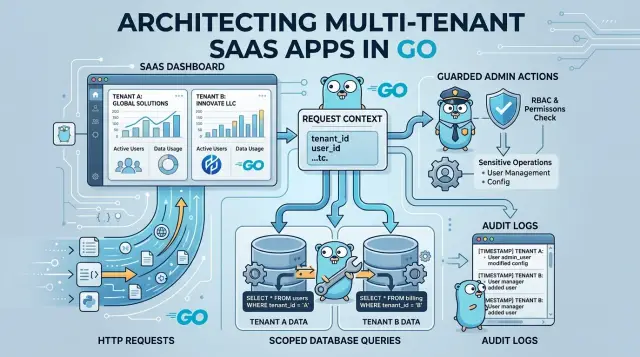
Table of Contents
Where multi tenant bugs start
Most tenant leaks do not come from some exotic attack. They start with one ordinary query that forgot a tenant filter.
A developer adds a new search, export, or report. The code works, the page loads, and the test passes. But one missing tenant_id condition can pull records from another account. In Go, this often happens when teams build fast and trust people to remember the rule every time.
That is why people look for Go libraries for multi tenant SaaS apps in the first place. The risk is rarely the big design idea. The risk is the small, boring line of code someone skipped on a busy Tuesday.
Background jobs cause a different kind of trouble. A request comes in with the right tenant context, but the job queue only stores an ID and some payload. Hours later, a worker picks it up with no tenant attached, runs a query, and touches the wrong data. Email digests, invoice runs, and cleanup tasks are common places where this slips in.
Admin tools create their own sharp edge. Teams often treat internal dashboards as special and bypass the usual checks to save time. That feels harmless until a support action updates the wrong customer, or a bulk job runs across every tenant when it should touch one. "Internal only" is not a safety system.
Tests can hide the problem instead of catching it. Many fixtures create one sample tenant and reuse it everywhere. With that setup, scoped queries in Go look correct because there is nothing else to leak into. The bug only appears when two tenants have similar records and the wrong one shows up.
A simple example: imagine two companies both have a project called "Website redesign." If your code loads by project name and forgets tenant scope, you might show the right-looking record from the wrong customer. That is the worst kind of bug because nobody notices it right away.
The early warning signs are plain: queries that accept tenant IDs as optional, jobs that rebuild context from guesswork, admin paths with custom shortcuts, and tests that never create conflicting data. Fix those first.
What a package should handle
A useful package should remove the easy ways people make tenant mistakes. If a developer has to remember one more filter on every query, someone will forget. The package should carry the tenant ID from the request all the way to the database call, with as little manual work as possible.
That usually starts at the edge of the app. Your router or middleware reads the tenant from the subdomain, token, header, or session, then stores it in a request context. After that, handlers, services, and repositories should read the same value from one place. If every layer passes tenant IDs in its own way, bugs creep in fast.
The next job is scoped queries in Go that happen by default, not by habit. A good package should make the safe path the normal path. When code loads invoices, users, or projects, the tenant filter should already be there. Developers should have to opt out on purpose, not remember to opt in every time.
Cross tenant access needs a different tone. It should feel loud, a little annoying, and very explicit. If an admin needs to read across tenants, the code should call a separate method or use a named override with a reason. Quiet bypasses are where bad incidents start.
A package also needs an audit trail for admin actions. If someone switches tenant context, the app should log who did it, when they did it, and why. That log should cover support sessions, data fixes, exports, and background jobs. Six months later, you want a clear answer, not a guess.
A solid package usually handles these five jobs:
- store tenant context once and pass it through the request
- apply tenant filters to normal reads and writes
- require an explicit override for cross tenant work
- record actor, reason, and time for tenant switches
- work in HTTP handlers, ORM models, and queued jobs
The last point gets missed a lot. Web requests are only part of the app. Cron jobs, workers, and import scripts also touch data, and they need the same guardrails. Oleg Sotnikov often talks about building systems that stay lean without giving up safety, and this is one of those cases where a small shared package can save a very expensive mistake.
Packages for tenant context
A lot of multi-tenant bugs start before the database. The request arrives, your app reads a header or subdomain, and then that tenant ID gets lost halfway through the call. A small middleware layer in chi or gin fixes that early.
With go-chi/chi, you can add middleware that reads X-Tenant-ID or parses the subdomain from the host. With gin-gonic/gin, the same idea works through a request handler that runs first and stores the result for the rest of the chain. Keep the rule simple: resolve the tenant once, validate it once, and treat that value as the only tenant source for the request.
Keep one typed tenant helper
Do not scatter raw string context keys across handlers. Use one typed helper around context.Context so every service reads and writes tenant data the same way.
type tenantKey struct{}

func WithTenant(ctx context.Context, tenantID string) context.Context {
    return context.WithValue(ctx, tenantKey{}, tenantID)
}

func TenantFrom(ctx context.Context) (string, bool) {
    v, ok := ctx.Value(tenantKey{}).(string)
    return v, ok
}
This looks boring, and that is the point. Boring code prevents weird bugs.
Logs should pick up the tenant ID at the start of the request, not deep inside the code after three function calls. If you use log/slog, zap, or zerolog, create a request logger with tenant_id attached once and pass it through. When support needs to trace one bad export or one mistaken admin action, that field saves real time.
Do not drop tenant context in background work
Request context ends when the request ends. Jobs do not. If you send work to a queue, copy the tenant ID into the job payload or task metadata before you enqueue it.
Packages like hibiken/asynq make this easy because each task can carry a payload with tenant_id, user_id, and a short action name. When the worker starts, it rebuilds the same tenant context before it touches storage, logs, or external APIs.
That extra step matters most for admin tools. A support agent might retry an import for one customer, while a worker runs five minutes later on another machine. If the job does not carry the tenant explicitly, the worker has to guess. Guessing is where boundary bugs begin.
Packages for scoped queries
Most tenant leaks start with one missed filter. A handler builds a query, forgets tenant_id, and the database returns rows from another account.
Ent helps by putting privacy rules near the schema. That keeps tenant checks close to the data model instead of scattering them across handlers and services. If your app carries tenant info in context, Ent can block queries that do not match it, even when developers traverse edges and preload relations.
GORM takes a simpler route with scopes. A WithTenant(id) scope can wrap the tenant filter once, then every repository method can reuse it. This works well if your team already uses GORM, but it only stays safe when you make the scoped path the default and keep admin bypasses in separate methods.
Bun is useful when writes are the weak spot. Query hooks can reject inserts or updates that arrive without tenant data, and they can fill tenant_id from context before the query runs. That does not solve every read path, so Bun works best when you pair hooks with a clear query helper or repository rule.
If you use raw SQL with pgx, Postgres row level security adds a stronger guard at the database layer. Your app sets the tenant for a session or transaction, and Postgres enforces the match even if someone writes bad SQL. That is especially helpful for search, exports, background jobs, and support tools where developers often step outside the ORM.
A simple rule helps more than mixing patterns:
- Use one default path for reads.
- Use one default path for writes.
- Apply the same tenant rule to search.
- Put admin bypasses in a separate, obvious code path.
Mixing Ent privacy for some reads, ad hoc GORM filters for others, and raw pgx queries for search usually creates holes. Pick one approach your team will actually use every day. For many Go libraries for multi tenant SaaS apps, boring consistency beats a clever setup.
Packages for safer admin work
Admin tools cause some of the worst tenant leaks. Normal user flows usually hit the same checks every time. Support screens often skip them because someone needed a quick fix and shipped it fast.
Casbin works well here if you treat support actions as a separate class of access. A customer user, a support agent, and a super admin should not share the same policy rules. Read access for troubleshooting is one thing. Exporting data, deleting records, or switching tenants is a different risk and should need a different rule.
Keep admin features on their own code path. Give them separate handlers, separate middleware, and often separate service methods too. If your regular app code accepts a tenant from session context, your admin code should do the same, but with stricter checks and clearer logging. Reusing public handlers with an extra "tenant_id" parameter is where a lot of trouble starts.
Impersonation needs friction. It helps support teams solve real problems, but it should never be one click. A safer pattern is a short-lived impersonation token that works for one tenant and one stated reason, plus an approval step before it gets issued. In small teams, even a second person approving the request cuts down on careless mistakes.
For audit records, structured logs matter more than fancy dashboards. Go's built-in slog or a package like zap can record who did what, when, and for which tenant. Store those events in an append-only audit table, not just application logs.
Always record actions such as:
- data exports
- deletes and bulk edits
- tenant switches
- impersonation start and stop
The admin screen itself should also reduce mistakes. Show the active tenant name and ID on every page, every modal, and every dangerous action. If an admin can delete a record, they should see exactly which tenant owns it before they press the button.
Good admin tooling feels a little slower, and that is fine. A two-second pause is cheaper than explaining why one customer saw another customer's data.
A simple example stack
Picture a B2B app that serves five customer companies from one Postgres database. That setup is normal, but it gets risky fast if one handler forgets a filter or an admin tool skips a permission check.
A safer stack in Go keeps the tenant boundary in more than one place. You want the app to know the tenant early, keep that tenant attached to every request, and let the database catch mistakes when app code slips.
A clean request flow looks like this:
chimiddleware reads the subdomain, maps it to a tenant ID, and puts that ID in the request context.- Application code reads the tenant from context instead of trusting query params or form input.
- Ent privacy rules add the tenant filter to every query path that should stay scoped.
pgxsends queries to Postgres, where row level security acts as a second lock on the door.- Casbin decides what internal staff can do, especially in support screens.
That mix works well because each layer has one job. chi handles request plumbing. Ent keeps normal reads and writes scoped without asking every developer to remember WHERE tenant_id = ? all day. pgx gives you direct, fast access to Postgres when you need it, and Postgres RLS helps stop a bad query from turning into a data leak.
The admin side needs extra care. Support teams often need broad visibility, but they rarely need full write access. Casbin is a good fit here if you keep the rules narrow. For example, a support agent might export usage data for one customer and open that customer account page, but nothing more. They should not switch tenants freely, edit billing, or browse across all accounts because they "need to check something."
This is why Go libraries for multi tenant SaaS apps work best in layers, not as a single magic package. One layer carries tenant context in Go, another enforces scoped queries in Go, and another limits staff actions that could break trust.
If you build this way, a missed filter in one handler does not become your only line of defense. The request, the ORM, the database, and the admin policy all push in the same direction. That is the kind of overlap that saves teams from ugly incidents.
How to put the pieces together
The build order matters more than most teams think. Start with one source of tenant identity and treat it like a fact the rest of the app consumes, not something each handler figures out on its own. That can come from a subdomain, a signed token, or a session, but it should become one typed value in request context and stay consistent for the whole request.
After that, wrap database access before you add more product logic. This is where many multi tenant apps go wrong: the team adds features first, then tries to patch access rules later. In practice, you want every repository, query helper, or ORM hook to require tenant context up front.
A good rule is simple: raw queries do not belong in normal app code. If someone needs to write a custom query, they should go through a wrapper that adds tenant scope automatically or refuses to run. For scoped queries in Go, boring is good. If the safe path takes one line and the unsafe path needs special approval, developers usually pick the right path.
A small stack often looks like this:
- middleware resolves tenant ID and user role once
- context carries that tenant through handlers, jobs, and services
- the data layer rejects reads and writes without tenant scope
- a separate admin path handles cross-tenant access
Only after that base is in place should you add admin tools. Support teams do need wider access sometimes, but safer admin operations depend on friction in the right spots. Ask for the tenant first, require a reason for sensitive actions, and log who viewed or changed what.
Go authorization packages help here, but they should sit on top of tenant scoping, not replace it. A role check can say who may act. Tenant filters say which data they can touch. You need both.
Tests should try to break the boundary on purpose. Write one test that loads a record from tenant A while the request carries tenant B, and make sure the app returns nothing. Do the same for background jobs, exports, and admin screens. If a simple test can cross tenants, a real user eventually will.
Mistakes that break tenant boundaries
Most cross-tenant leaks start with convenience. A handler reads tenant_id from a header, passes it as a plain string through service calls, and three layers later one query forgets to use it. That string has no meaning to the compiler, so any function can drop it, swap it, or replace it with an empty value.
If you write Go, make tenant context hard to ignore. Use a typed tenant ID, put it in request context with care, and require it in the repository layer. Go libraries for multi tenant SaaS apps can help, but they work best when your own function signatures make the safe path obvious.
Another common leak appears when teams mix ORM code with raw SQL. The ORM may add a tenant scope by default, then one reporting query uses raw SQL for speed and forgets the WHERE clause. That single shortcut can expose every customer's rows. The fix is boring and effective: wrap raw queries in helpers that require tenant scope, and reserve unscoped access for a very small admin path.
Admin code causes its own trouble. Teams often reuse an internal "list all invoices" endpoint for normal user screens and rely on the front end to filter results. That is upside down. The server must decide what a user can see. Front end filters only change the view. They do not protect data.
Background jobs can break rules too. A nightly sync, email sender, or cleanup task often runs without tenant context because nobody clicked through a request first. Then the job updates all rows, sends the wrong report, or deletes files across accounts. Every job should declare whether it runs for one tenant or for all tenants, and the code should treat those two modes as different paths.
A small example makes this real. A support tool lets staff impersonate a customer account. If that tool reuses normal user endpoints and only swaps a tenant ID in the browser, one missed check can turn support access into global access. Safer admin operations start with separate routes, explicit audit logs, and a second confirmation before any cross-tenant action.
The boring rule wins: never trust client input, never assume scope, and never hide global access inside shared code. Multi-tenant safety usually breaks in the quiet shortcuts, not in the big architecture decisions.
Quick checks before you ship
Most tenant leaks are boring. A handler misses one filter, a support tool keeps the last tenant in memory, or a job runs with no tenant at all. Ten minutes of deliberate checks can catch more risk than another pass on code style.
Use this as a release gate, not a nice-to-have. When you pick Go libraries for multi tenant SaaS apps, judge them by what happens when a developer forgets a step.
- Sign in as one test user, then try to fetch another tenant's record by changing the ID in a URL, API call, or form input. You want a clean denial, not a partial response.
- Start a background job such as invoice sending or report sync. The first log entry should include the tenant ID and a job ID so you can trace mistakes fast.
- Open export and delete actions in admin tools. These should ask for a second confirmation, and hard deletes should feel slow and deliberate.
- Watch a support user switch tenants. They should always know which tenant they are in, why they switched, and how to switch back without guessing.
- Check where default scoping lives. One package should own tenant context and default query scope so every handler does not invent its own rules.
A simple example makes the point. If an admin opens a CSV export page and the tenant badge is missing, stop there. That usually means the action depends on hidden state, and hidden state is how one customer's data ends up in another customer's file.
The same rule applies to deletes. If a destructive action only needs one click, it is too easy to run it in the wrong tenant. Typed confirmation, a visible tenant name, and an audit log are boring safeguards, but they work.
Watch for split ownership. If middleware sets tenant context, but a repository package also accepts raw tenant IDs, someone will bypass the safe path under deadline pressure. Safer admin operations start with a boring rule: one source of truth, default deny, and logs that name the tenant every time.
Next steps for a safer setup
Start with a plain inventory of your code. Mark every place that reads, writes, filters, or joins on tenant_id. Check request handlers, background jobs, imports, exports, cron tasks, support scripts, and admin screens.
Most teams know the main app path pretty well. The leaks usually sit in the side paths that nobody reviews until a customer reports odd data.
Then choose one pattern for tenant checks and use it everywhere. If one part of the app uses request context, another adds SQL filters by hand, and a third trusts an admin flag, the rules will drift. One package pattern for tenant context and scoped queries is easier to review, test, and teach to new developers.
A short cleanup plan works better than a big rewrite:
- Trace
tenant_idfrom request entry to every database call. - Replace copied query filters with shared helpers or one package rule.
- Block unscoped admin reads by default.
- Log every cross-tenant admin action with actor, target, and time.
Start the audit trail with admin actions first. You do not need a huge logging project to get value from it. A simple record of who did what, for which tenant, and when can save hours during an incident review.
If you are still comparing Go libraries for multi tenant SaaS apps, use your own bug history to narrow the list. Pick the package that makes the risky path harder to write, not the one with the longest feature list.
If your Go SaaS already feels tangled, outside review can help. Oleg Sotnikov can look at the current setup and help plan a safer path without a full rewrite. That kind of review is most useful when you already know the pain points but need a clear order for fixing them.
A safer setup does not start with a perfect architecture. It starts when every tenant check follows the same rule, every admin action leaves a trail, and no one can bypass scope by accident.


