GitLab merge trains vs protected branches in practice
GitLab merge trains vs protected branches: compare queue time, rebase work, and release confidence so your team can pick the simpler rule set.
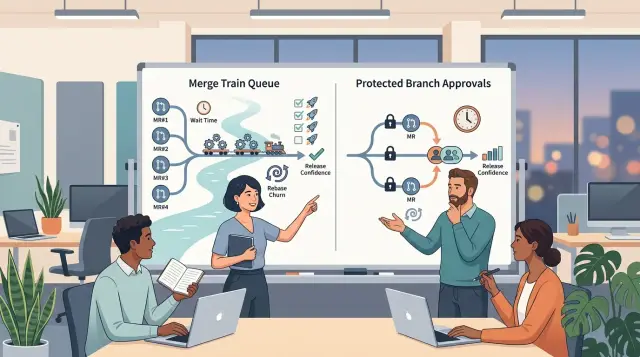
Table of Contents
Why this choice blocks delivery
Teams usually feel this problem before they can name it. A change gets approved, CI passes, nobody objects, and it still sits there. Another pipeline starts. Another branch moves ahead. Someone asks for a rebase. By the time the code reaches main, the team has spent more energy waiting than building.
That is why the choice between merge trains and protected branches matters more than it seems. On paper, both look like safety features. In practice, they shape how fast approved work moves, how often developers have to revisit the same branch, and how much trust the team has in each release.
When delivery slows down, many teams react by adding more review rules. Two approvals become three. A special approver gets added for hot paths. Extra status checks pile up. Sometimes that helps. Often it hides a process problem instead. If work waits because branches keep going stale, or because CI takes 40 minutes, another rule will not fix the bottleneck. It just makes the line longer.
The cost usually shows up in three places:
- Queue time - approved code waits behind other approved code.
- Rebase churn - people keep updating branches just to satisfy branch rules.
- Release risk - the team merges code with less certainty about how it behaves together.
Protected branches mostly control who can push, who can merge, and which checks must pass. They are guardrails. Merge trains do something else. They manage the order of change and test combined results before main moves forward.
So the decision is not about which setup looks stricter. It is about which one protects main without slowing every merge.
For a busy team, that difference is not theoretical. It can mean five small changes land before lunch, or the same five changes bounce between approvals, rebases, and expired pipelines until the day is gone.
What merge trains change day to day
A merge train turns merging into a queue. After approval, a merge request does not go straight into the target branch. GitLab puts it in line and checks it in the same order people joined.
That order matters more than many teams expect. GitLab tests each change as if the earlier approved changes were already merged, so the pipeline reflects the branch state you are about to get, not the branch state from an hour ago.
The daily flow is simple. A developer gets approval, GitLab adds the merge request to the train, CI runs with earlier queued changes included, and GitLab merges items in order if checks pass. If one item fails, later items wait or rerun.
This changes team habits quickly. People stop racing to merge before someone else lands a change. They see fewer last-minute surprises because the train catches many conflicts and combined test failures before code reaches the branch. On a busy product team, that cuts down on a lot of noisy "why did main just break?" moments.
The tradeoff is straightforward: waiting becomes easier to see. A branch that used to accept approved changes right away now makes people sit in line behind other work. During quiet hours, that delay may barely matter. During busy hours, even small merge requests can pile up if each one needs a full pipeline.
This is why merge trains and protected branches feel so different in real life. Protected branches mostly control who can merge and under what rules. Merge trains change the rhythm of the day. They add order, more realistic CI, and better confidence near merge time, but they also make queue time part of shipping.
What protected branches actually control
A protected branch is a gate on the target branch, not a traffic system for changes waiting to land. It tells GitLab who can change that branch and what must happen before a merge goes through.
In practice, protected branches usually stop a few things: direct pushes to the branch, force-pushes that rewrite history, merges without enough approvals, and merges when required checks fail. They can also limit who can bypass those rules.
That matters because it reduces avoidable damage. One rushed direct push can break the default branch for everyone. A protected branch lowers that risk by forcing changes through the same path.
Approvals and status checks do most of the daily work. GitLab can require one or more reviewers, a passed pipeline, resolved discussions, and code owner approval before merge. These rules give teams a clear minimum bar for quality.
The problem starts when teams keep adding more gates every time something goes wrong once. A simple fix that should take ten minutes can end up waiting on two approvals, a long pipeline, a stale branch check, and a manual release step. The branch stays safe, but the merge starts to feel heavy.
That is why protected branches create discipline, but not flow. They control permission and policy. They do not decide merge order, and they do not stop two valid merge requests from colliding when both target the same branch.
If three developers open merge requests at the same time, branch protection alone cannot remove merge timing issues. One request merges, the branch moves, and the other two may need a rebase or another pipeline run. Waiting time grows even though every rule worked exactly as intended.
Protected branches answer one question well: "Should this change be allowed into the branch?" They do not answer the next one: "What is the least painful way to land several safe changes in a row?" That gap is why teams start looking at merge trains.
Where waiting time really comes from
Waiting time does not start in CI. It starts the moment a merge request gets approval and then sits behind some other dependency: another merge, another pipeline, or another rebase.
With protected branches alone, the path from approval to merge can look short on paper. If the branch is current and the pipeline is green, the merge happens fast. The problem is that this setup often hides delay in human work. Someone has to rebase, restart checks, and watch whether the target branch changed again before pressing merge.
With merge trains, the delay is easier to see. After approval, the merge request joins a queue. GitLab tests the result in merge order, so the branch usually does not need repeated manual rebases. That often cuts rework, but it can add obvious queue time when several approved changes wait for their turn.
A better comparison is not "Which one is faster?" but "What part of the wait is real test time, and what part is idle time?"
Real test time is the time your runners spend building, testing, and running release checks. Idle time is everything else: waiting for earlier items in the queue, waiting for a shared runner, waiting for a developer to rebase, or waiting for a fresh pipeline after the base branch moved.
In many teams, idle time is the bigger problem. A 12-minute pipeline feels slow, but three failed rebases can easily turn that into 45 minutes between approval and merge. Merge trains trade some of that messy delay for a cleaner queue. Protected branches can be quicker when the team is small and merges are rare.
Team size changes the math fast. A team with two or three active developers may do fine with protected branches and a short pipeline. A team with ten developers landing changes all afternoon will feel every branch update. The longer the pipeline, the more expensive each restart becomes. That is where merge trains often start to pay off.
Before you change the rules, collect one week of merge request data:
- time from approval to merge
- pipeline runtime per merge request
- minutes spent waiting in queue
- how often developers rebase or rerun pipelines
- how many approved merge requests miss the same-day release window
That week tells you more than a debate ever will. If most delay comes from reruns and branch drift, merge trains will probably help. If most approved changes merge quickly and your queue is nearly empty, stricter branch rules will likely add friction.
How rebase churn shows up
Rebase churn is the repeated work of updating the same merge request just to keep it mergeable. A simple case looks like this: Mia opens a merge request on Monday, two other branches land on Tuesday, and by Wednesday GitLab says her branch is behind main. She rebases, pushes again, waits for CI again, and sometimes fixes a conflict that has nothing to do with her feature.
Once or twice, that feels normal. When it happens every day, it drains time in small, annoying chunks.
The cost does not fall only on the author. Reviewers get pulled back in too. A rebase can rerun pipelines, dismiss approvals, or make people skim the whole diff one more time just to check that nothing odd slipped in. Even if the code barely changed, the review flow breaks.
That is why long-lived merge requests suffer the most. The longer a branch stays open, the more other work lands ahead of it. A small bug fix that would merge cleanly in two hours can turn into three rounds of rebasing after a few days. Teams often blame the developer, but the branch usually stayed open because review, testing, or priority changes slowed it down.
Protected branches often push this pain back to authors. If the branch must be up to date before merge, authors do the rebasing and retry the pipeline until the branch meets the rule. The branch stays clean, but the team pays for that cleanliness with extra interruptions.
Merge trains shift part of that burden away from authors. After approval, GitLab can test changes in queue order against the latest target branch and the items ahead of them. That cuts down on manual rebases in many cases, especially on busy repositories. It does not remove churn completely. If a branch has real conflicts, or if it sits too long before approval, someone still needs to fix it. But the day-to-day noise usually drops, and reviewers spend less time revisiting work they already finished.
How each option affects release confidence
Release confidence starts with a simple question: what exact code path does the pipeline test before you release it?
That matters more than one extra approval or a tighter permission setting. Protected branches give process control. They decide who can push, who can merge, and which checks must pass. That helps prevent careless changes, but it does not always prove that the final code on the target branch is the same code the pipeline just tested.
That gap is easy to miss. Two merge requests can both pass on their own branches, then break once they land together because the target branch changed between runs. A billing fix and a config cleanup may look safe on their own, yet the merged result can still fail on startup.
Merge trains raise confidence in a different way. They test the queued merge result, not just the source branch. That means the pipeline sees code much closer to what users will actually get. You may wait longer for the merge, but the green pipeline means more because it covers the final combined state.
Strict branch rules and queued integration tests answer different questions. Rules ask, "Did the team follow the process?" Merge train testing asks, "Did this exact set of changes work together?" If releases fail after merge, the second question usually matters more.
A quick way to judge the tradeoff:
- If your default branch moves fast, testing the final merge result gives more confidence.
- If changes often touch the same files, protected branches alone leave more room for surprises.
- If your pipeline is flaky, merge trains can still mislead you because random green runs do not prove much.
- If your team ships small isolated changes and the branch stays calm, protected branches may be enough.
Release confidence often drops even when every rule looks strict on paper. That happens when branch pipelines run against an older target branch, when required jobs skip on merge commits, or when reviewers approve code that no one tested in its final form.
If breakage shows up after merge, more review rules rarely fix the problem. Testing the final merge result usually does.
A simple example from a busy team
Imagine nine developers working on the same product while main changes often. Small fixes land every 20 to 30 minutes. By 9:30 a.m., three merge requests are approved and green: Anna has a billing fix, Ben has an API cleanup, and Chloe has a UI patch.
With protected branches alone, the rules look strict. Nobody can push straight to main, CI must pass, and two reviewers must approve. It sounds safe, but the morning still turns messy.
Anna merges first at 9:35. Ben tries to merge at 9:40, but his branch is now behind main. GitLab asks him to rebase. He rebases, pushes again, and starts another pipeline. The team also requires fresh approval after new commits, so a reviewer has to check the merge request again, even though Ben only updated the branch.
While Ben waits, Chloe hits the same problem. Anna's merge changed main, then Ben's rebase changed his commit hash. Chloe now rebases too, reruns tests, and asks for another approval. Nothing is broken, but the team loses time on repeated branch updates. Reviewers start rubber-stamping rebases because they already saw the code once. That lowers trust instead of raising it.
This is where the difference becomes concrete. Protected branches control who can merge and what rules must pass. They do not stop the queue from shifting under everyone's feet.
Now take the same three merge requests and put them on a merge train. Anna enters first, then Ben, then Chloe. Ben and Chloe wait longer up front because GitLab tests them in order against the latest train state. Nobody rushes to hit merge before someone else. Nobody rebases by hand just because another approved change landed a few minutes earlier.
The train adds waiting time, and that can annoy people. Ben may wait 25 minutes instead of 5. Chloe may wait 40. But the team gets something useful back: fewer last-minute surprises on main, fewer fresh approval requests, and a clearer answer to one question - "What exactly did CI test before this reached production?"
On a branch that changes all morning, that trade often beats adding one more review rule.
How to decide step by step
Adding one more review rule feels safe, but it often treats the symptom, not the cause. A better choice starts with a simple check of what slows your team down now.
Write your main pain in one plain sentence. Keep it specific. "Approved merge requests sit for 6 hours before merge" is useful. "Our process feels messy" is not.
Then check recent merge requests and look at numbers, not guesses:
- Measure the time from final approval to actual merge for the last 15 to 20 merge requests.
- Count how many times authors had to rebase after review already started.
- Look at failed releases from the last two weeks and ask one direct question: did they break because separate changes worked alone but failed together?
If that merge-combination problem shows up often, merge trains may help more than stricter protected branches. If releases fail because tests are weak, deploy steps are manual, or approvals take too long, more branch protection will not fix much.
The choice becomes much less abstract once you frame it this way. Merge trains help when the branch changes fast and approved work goes stale before it lands. Protected branches help when the team needs harder limits on who can merge, when they can merge, and what checks must pass first.
A small team can usually start with the smaller change. If rebases pile up and people keep rechecking the same code, try merge trains first. If merges happen too freely and releases go out without the right checks, tighten protected branch rules first.
Give the change two weeks. Then review three numbers: median approval-to-merge time, rebases per merge request, and release failures after merge. If only one number improved, keep digging. Many teams find that waiting time came from slow CI, not from reviews or branch rules.
And that point matters. If the pipeline takes 40 minutes, no policy will make merges feel quick.
Mistakes that make both setups painful
Teams often react to a messy merge queue by adding another approval rule. That feels safe, but it usually hides the real problem. If reviews already take two hours and pipelines take 40 minutes, one more approval will not fix delivery.
Measure the delay before you change the policy. Look at review pickup time, CI runtime, flaky jobs, and how often people rebase the same branch. Most teams guess wrong when they skip that step.
Another common mistake is blaming developers for slow merges when the pipeline design is doing the damage. If every change rebuilds the same images, waits for busy runners, and runs the full test suite, people will sit and wait no matter how careful they are. The process is slow, not the team.
This comes up often in debates about merge trains and protected branches. Teams argue about branch rules while the actual bottleneck is a pipeline that takes too long for small changes.
Slow end-to-end tests are useful when the risk is real. They are painful when you run them on every typo fix, copy update, or tiny refactor. A busy team pays for that choice with longer queues, more rebases, and more stale branches.
Protected branches create a different mistake. They can stop direct pushes and force reviews, but they do not replace integration testing. Two clean, approved changes can still break each other after merge. Branch protection controls who can merge. It does not prove the combined code works.
Old rules are another quiet tax. Teams keep approval counts, branch checks, or naming rules long after the original reason is gone. If nobody can explain a rule in one sentence, that rule probably needs review.
A short audit helps:
- Track median time from ready for review to merge.
- Count rebases per branch.
- Separate flaky failures from real failures.
- List rules that people bypass or complain about.
- Remove one stale rule and compare the next two weeks.
Pain usually starts when a team stacks rules on top of slow CI and calls that release confidence. Clean up the pipeline first, then decide how much control you still need.
Quick checks and next steps
Before you add another review rule, check where your team actually loses time. Some teams wait in long merge queues. Others burn the same hours on rebases, conflict fixes, and rerunning CI after every small change on a busy branch. Track both for one week. The bigger source of delay deserves attention first.
That is usually the fastest way to judge which setup fits your team. If queue time is low but developers keep rebasing all day, merge trains may help. If rebases are rare but changes sit idle waiting for train capacity, more rules will only slow delivery further.
Then look at your pipeline. Does CI test the final merged result, or only each branch on its own? If the pipeline never checks the exact code that will hit the default branch, release confidence is lower than the green checks suggest. Teams miss this all the time, and they often try to fix it by adding approvals instead of fixing the test path.
Keep only rules that block a real failure mode. If one approval catches risky schema changes, keep it. If a rule exists only because nobody wants to remove it, cut it. Process tends to grow on its own, and every extra gate needs a reason.
Check these points before you change the setup:
- Measure queue time and rebase time across recent merge requests.
- Confirm whether CI runs on the merged result before release.
- Remove one rule that no longer prevents a specific failure.
- Write one urgent-fix rule with clear owners and bypass limits.
- Review the flow after the next release week or production incident.
That urgent-fix rule matters more than most teams expect. When something breaks, people will make exceptions anyway. A written rule keeps the exception small, fast, and predictable.
If your team wants an outside review of GitLab flow, CI, and release risk, Oleg Sotnikov at oleg.is does this kind of work as a Fractional CTO and startup advisor. He helps small and medium teams tighten delivery, infrastructure, and automation without piling on process for its own sake.
Frequently Asked Questions
When should I pick merge trains over protected branches?
Use merge trains when approved work often goes stale before it lands. They help most on busy branches where several people merge through the day and CI takes long enough that rebases keep piling up.
Stick with protected branches alone if your team is small, merges are rare, and approved changes usually land without another round of work.
Do merge trains make merges slower?
Usually yes, but in a cleaner way. Merge trains turn hidden delay into visible queue time because GitLab tests changes in order before it moves main.
That wait often replaces a messier delay from manual rebases, rerun pipelines, and fresh approvals after the branch moves.
Why does approved code still sit and wait with protected branches?
Protected branches answer who can merge and which checks must pass. They do not manage the order of approved changes, so one merge can make the next branch stale right away.
That creates idle time after approval even when every rule works exactly as planned.
Will merge trains cut down on rebases?
In many teams, yes. After approval, merge trains test changes against the latest queued state, so authors do less manual branch updating.
They do not remove real conflicts. If two changes clash, someone still needs to fix the code.
Do protected branches alone give me solid release confidence?
Not by themselves. Protected branches stop direct pushes, force reviews, and require green checks, but they can still let two safe-looking changes break once they land together.
If you want more confidence near release, test the merged result, not just each branch on its own.
What kind of team actually benefits from merge trains?
A team of two or three developers can often keep things simple with protected branches and short pipelines. The pain usually starts when many people land changes on the same branch through the day.
If main moves every 20 to 30 minutes, merge trains start to pay for themselves.
Should I add more approvals when main keeps breaking?
No. More approvals help only when review quality or ownership is the problem. If main breaks because separate changes fail together, extra approvals just add more waiting.
Fix the test path first, then keep only the rules that block a real failure.
What should I measure before I change our GitLab rules?
Start with three numbers: time from final approval to merge, rebases per merge request, and release failures after merge. Those numbers show whether your team loses time in queue, in branch churn, or after release.
One week of real data beats a long debate.
Can slow CI make both setups painful?
Absolutely. A 40-minute pipeline makes any merge policy feel heavy. If every tiny change runs the full suite, people will wait no matter how you set branch rules.
Trim unnecessary jobs, fix flaky tests, and shorten runner wait time before you blame the process.
How should we handle urgent hotfixes with these rules?
Write one small rule before you need it. Name who can bypass normal flow, when they can do it, and what follow-up review must happen after the fix lands.
That keeps the exception fast without turning every incident into a process fight.


