Fractional CTO pricing model for setup, support, and AI
A practical look at a fractional CTO pricing model that covers setup work, support load, and AI review costs before thin deals pile up.
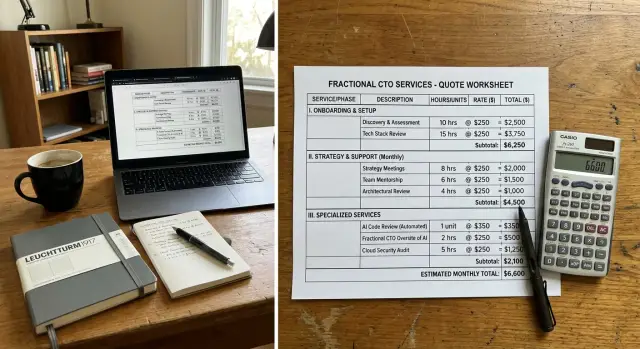
Table of Contents
Why one flat fee causes trouble
A single price looks neat on a sales page, but it often mixes very different jobs into one number. That is where margin problems begin. A fractional CTO pricing model breaks down fast when discovery, setup, support, and AI review all sit inside the same flat fee.
The sales call usually makes setup sound small. Then the real work appears. Access needs sorting out, repositories need cleanup, environments differ, documentation is thin, and someone has to decide what "done" means. A startup may ask for "help with AI development setup," but that can include CI/CD fixes, model access rules, prompt testing, code review flow, error tracking, and team handoffs.
That work does not show up evenly from client to client. One company has a tidy stack and a clear owner. Another has three half-finished tools, no naming rules, and a founder who changes direction every week. If both pay the same setup fee, one deal works and the other quietly loses money.
Support creates the next problem. Clients rarely stop asking questions after the first delivery. They need help with edge cases, small bugs, permissions, retries, model behavior, and team habits. None of those tasks looks big on its own. Together, they can eat hours every week.
AI work adds another layer. The tools save time, but they do not remove review. Someone still has to check generated code, test outputs, catch security issues, and decide when a model made a bad call. If you do serious client work, AI review is a real labor cost even when the software bill looks cheap.
Most hidden work shows up in the same places: custom setup that changes from client to client, support requests after the first handoff, internal review of AI-generated work, and rework caused by unclear scope.
Lean AI operations can reduce waste, but they do not turn messy client work into fixed-cost work. If the scope can move, the price needs room for that. Otherwise, the flat fee only looks simple until your calendar fills up.
What setup work really includes
Setup work sounds small in a proposal. In practice, it spreads fast.
A discovery call often starts with a simple goal, like "set up our product workflow" or "add AI review to the team." Ten minutes later, you are mapping who approves changes, where specs live, how tasks move, which tools the team already uses, and where work gets stuck. That is not admin. It is consulting time.
Old tools add another layer. Many startups carry half-finished systems, duplicate records, old automations, and spreadsheet data that nobody trusts. Before you can improve anything, you usually need to sort naming, clean exports, fix access, and decide which source of truth the team will keep. A client may call this setup. You still have to price the cleanup.
Small requests pile up too. One founder asks for a new board view. Another wants a prompt library for code reviews. Then someone needs user roles changed, a form adjusted, and one more integration checked. Each request looks minor. Added together, they can wipe out a full day.
A good quote separates setup into clear parts. That usually means process mapping, tool and data cleanup, configuration changes during the first feedback round, internal documentation, handoff notes, and founder or team training.
Docs and training get missed all the time. They still take hours. If you record decisions, write a short handoff, and run one live session, the team asks fewer support questions later. If you skip that work, the client comes back with the same confusion next week and your support time grows.
A small example makes the point. A startup asks for "basic setup" for an AI-assisted delivery process. The visible task is a tool configuration. The hidden work is mapping their current steps, cleaning a customer list, fixing permissions, writing usage notes, and answering follow-up questions after launch.
If you sell all of that as one flat starter fee, you lock in thin margins before the work even begins.
How support load grows
Most people price the meeting, the roadmap, and the planned build work. The margin often disappears somewhere smaller: chat replies, bug triage, status notes, and short founder questions that land between calls. Each item feels minor. Together, they can eat a few hours every week.
This happens fast in early-stage teams. A founder sends two product questions on Monday, a developer asks for help with a blocked task on Tuesday, and a bug report shows up right before a demo on Wednesday. None of that was in the original plan, but someone still has to answer.
Track support in small units for two weeks. Count things like:
- chat replies and short calls
- bug triage and reproduction checks
- status updates for founders, hires, or investors
- unplanned questions between meetings
The hidden cost is not only the reply itself. Interruptions break planned work. If you stop an architecture review to answer a message, you lose the answer time and the time it takes to get back into the original task. Ten minutes can easily become thirty.
A fractional CTO pricing model that ignores this can look fine on paper and thin in real life. You may think you sold four hours of leadership a week. In practice, you might spend four more on follow-up, context switching, and small fires.
Founder questions need special attention because they arrive in bursts. During hiring, fundraising, or a release week, message volume often doubles. People want fast judgment, not long analysis, so the requests show up one by one all day. That is support load even if nobody opens a formal ticket.
Urgent help needs its own label too. Normal follow-up can wait for the next check-in or a same-day reply window. Urgent help interrupts the queue. Production issues, failed releases, security concerns, and customer-facing bugs belong in a separate bucket with a higher price or a capped monthly allowance.
A practical rule works well: if the request changes today's plan, treat it as support. If it needs a response within an hour or two, treat it as urgent support. Once you separate those two, quoting gets much easier and you stop giving away time that clients use every week.
Why AI review needs its own budget
AI work looks cheap on a quote because the first draft appears fast. The real bill usually shows up later, when someone has to shape the prompt, rerun weak output, and check whether the result actually fits the business.
A fractional CTO pricing model can go wrong when AI review sits inside a vague delivery fee. Every quote looks fine on day one, then the margin shrinks once the team starts fixing AI mistakes.
Prompt writing is real work. So are retries.
If a startup wants AI to draft support replies, summarize customer calls, or generate code, someone still has to explain the task clearly, test different versions, and reject the outputs that sound right but miss the point. A decent result might take five minutes. It might take forty.
Model fees add up too when you pay per use. One cheap test run is easy to ignore. Hundreds of runs across setup, revisions, and daily support are not.
The bigger cost is human review. Before anything goes live, a person needs to read the output, check facts, catch tone problems, and make sure the model did not miss company context. That review is part of delivery, not a bonus.
A simple budget needs room for prompt design and test runs, model usage fees, human review before release, and rework when the output misses context.
That last part is the one teams skip most often. AI can write a clean answer that still breaks a real process.
Picture a small SaaS company with special refund rules for annual plans. The model drafts a polite support response, but it ignores the edge case in the policy. A team member has to catch it, rewrite it, and often update the prompt so the same mistake does not come back next week.
You do not need to pad every quote to handle this. You just need to price the work honestly. AI can save time, but you still need a review layer that keeps bad output out of production.
When AI review has its own line in the quote, clients can see what they are paying for. That makes scope discussions easier and saves you from giving away hours that never looked expensive until they stacked up.
How to build a quote
Start with the work, not the price. A fractional CTO pricing model usually goes wrong when you pick a monthly number first and then try to squeeze real work into it.
Write the quote in layers. That keeps setup, support, and AI review visible, so you can adjust one part without breaking the whole deal.
- List every setup task you expect in the first phase. Include discovery calls, architecture decisions, repository cleanup, CI/CD changes, access setup, monitoring, handoff notes, and founder or team training.
- Put hours next to each task. If a task often grows, use the higher end of your normal range.
- Estimate monthly support from similar past work. Count bug triage, release help, team questions, vendor calls, and emergency fixes.
- Add AI review as its own line. Count both your review time and direct spend on model usage or related tools.
- Set a margin floor before you send the quote. If the numbers drop below it, cut scope or raise the price.
Support estimates get better when you use real history. Look at two or three recent projects that felt similar in stage, team size, and product mess. If those clients needed six to eight hours a month after launch, quoting three hours is not optimistic. It is wrong.
AI review costs deserve the same treatment. If you use Claude, GPT, or self-hosted models in delivery, someone still has to read outputs, catch bad suggestions, rerun tests, and approve changes. The model bill matters, but your review time matters more in many cases.
Before you publish a new price, test it against two recent deals. Rebuild those quotes with your new method and compare them with the hours you actually spent. If the old deal looked profitable on paper but support ate the margin, fix the template now, not after you sell it again.
A simple example from a small startup
A small SaaS startup brings in a fractional CTO for two things that sound modest at first: onboarding help and product advice. The founders want someone to review their stack, clean up a few rough spots, join planning calls, and help the team use AI tools to ship faster.
The first quote is a single monthly retainer. It bundles setup work, team support, and general CTO guidance into one number, say $4,000 for the month. On paper, that feels simple. The startup likes the price because it looks predictable.
Then the month starts.
Setup takes longer than expected. The codebase needs a proper review. Access is missing in a few systems. The CI pipeline breaks on edge cases. Someone needs to sort deployment steps, basic observability, and handoff notes so the team stops relying on memory. None of that looks huge by itself, but together it eats a lot of hours.
Support shows up faster than most founders expect. The team sends questions after every product call. One developer wants feedback on architecture choices. Another asks for help with a database issue. The founder wants quick input on scope, hiring, and roadmap trade-offs. A single retainer now covers both planned work and constant interruption.
Then AI review costs arrive. The team uses Claude or GPT to draft code, tests, and docs. That saves time, but it does not remove review. Someone still needs to check generated code, catch weak assumptions, tighten prompts, and verify that the output fits the product. Before the first feature ships, the fractional CTO spends several extra hours reviewing AI-assisted work.
By the end of the month, the math is off. What looked like a healthy retainer turns into low-margin custom work.
A better quote splits the work by phase. The startup pays a one-time setup fee for onboarding, stack review, process fixes, and AI workflow design. Then it moves to a smaller monthly retainer for advice and capped support. AI review gets its own budget line, either as a fixed block of hours or a separate add-on.
That second quote usually looks more expensive at first glance. It is more honest. It shows the real cost before margin problems get baked into the deal.
Mistakes that lock in thin margins
Thin margins usually start with one bad assumption: the hard part is delivery, not figuring out what the client actually needs. For a fractional CTO, the early work often includes audits, calls, technical triage, and messy decision-making. If you price that time like sales, you give away some of the most expensive hours in the job.
Another common mistake is quoting a monthly retainer before you map the setup work. A founder may say they need "CTO support," but that can mean very different things. One company needs architecture review. Another needs CI/CD cleanup, cloud cost cuts, hiring help, and an AI workflow plan. Those are not the same job, and they should not start with the same number.
Unlimited support sounds friendly, but it often turns into random Slack messages, urgent call requests, and weekend reviews that nobody counted. Support needs a boundary. Set response windows, channels, and a monthly cap, or the retainer slowly turns into on-call work.
AI creates another pricing trap. Many teams treat AI output as free after the first draft, as if the model did the work and the human cost vanished. It did not. Someone still has to review code, test edge cases, catch security issues, and fix odd behavior. If a client wants AI-assisted delivery, your quote needs room for review time, model usage, and rework.
The same margin killers show up again and again:
- free discovery that turns into technical consulting
- retainers sold before anyone estimates setup effort
- open-ended support with no usage rules
- AI review treated like a bonus instead of billable work
- agency-style pricing copied into senior CTO work
That last one hurts more than people expect. Agency prices often assume repeatable production work. CTO work is more about judgment, risk, trade-offs, and expensive mistakes avoided early. If you are reviewing architecture, cutting cloud waste, or planning an AI-based development process, you are not selling design hours.
A better quote separates setup, ongoing support, and AI review. That simple split makes weak assumptions easier to spot before they become part of your sales process.
A checklist before you publish pricing
A weak price sheet causes trouble later because clients treat it like a promise. If your number looks simple but hides labor, your margin disappears one request at a time. A good fractional CTO pricing model makes the boundaries clear before the first call starts.
Run your pricing through five blunt questions:
- Can a client tell, in one read, what the fee does not cover?
- Do you charge setup work as its own line item instead of burying it in a monthly rate?
- Did you put a cap on support hours, or at least define response times?
- Did you include time to review AI-written code, docs, tests, and prompts?
- If the client sends twice as many requests next month, does the deal still pay well?
The first question matters more than most founders think. If your proposal says "fractional CTO" and leaves everything else fuzzy, clients fill the gaps with their own assumptions. They may expect vendor calls, hiring help, architecture reviews, incident support, and AI tooling advice under one flat fee.
Setup should almost never hide inside ongoing work. Early weeks often include access reviews, repository cleanup, deployment fixes, team process changes, and tool selection. That work is lumpy. If you spread it across a low retainer, you train the client to expect heavy lifting at maintenance prices.
Support needs a limit in plain language. "Slack support included" sounds friendly, but it can turn into daily debugging, urgent pings at odd hours, and lots of context switching. A simple cap, plus a response window, protects both sides.
AI work needs its own budget even when AI saves time. Fast generation still creates review work. Someone has to check logic, security, edge cases, tests, and whether the output matches the product.
One last test is the stress test. Double the incoming requests on paper. If the price breaks, fix it before a client does it in real life.
What to change next
Change the structure before you change the number. If one price covers discovery, setup, support, and AI checks, you are guessing. That guess usually gets expensive once the real work shows up.
A better offer breaks the work into phases. Start with a short setup phase that covers audit, planning, access, and the first implementation tasks. After that, move to a monthly support phase with a clear limit on hours, response time, and meeting load.
Then price AI review as its own line. Prompt testing, output checks, model tuning, and human review all take time. If you hide that work inside a general fee, you train clients to expect it for free.
A simple quote can use four parts: a setup and architecture phase, an implementation or handoff phase, a monthly support block with clear limits, and a separate budget for AI review. If new work appears after kickoff, treat it as a change request and re-quote it instead of quietly absorbing it.
That matters more than most founders expect. Early clients often ask for "one small change" five or six times. With a phase-based offer, you can say yes without letting the project drift.
If you already sell one flat fee, you do not need a full rewrite overnight. Update your proposal first. Split setup, support load, and AI review costs into separate lines, then use that version in the next three deals. You will see fast where your time actually goes.
If you want a second opinion on startup pricing, product architecture, or practical AI adoption, Oleg Sotnikov at oleg.is works with startups and small businesses on Fractional CTO advisory and AI-augmented development workflows. That kind of outside review can catch weak assumptions before they turn into a pricing habit.
One small change to the quote template can fix months of underpriced work. Start there.


