Founder update format mentors can use in five minutes
A founder update format that helps mentors act fast by focusing on customer impact, delivery risk, and one decision that needs a clear answer.
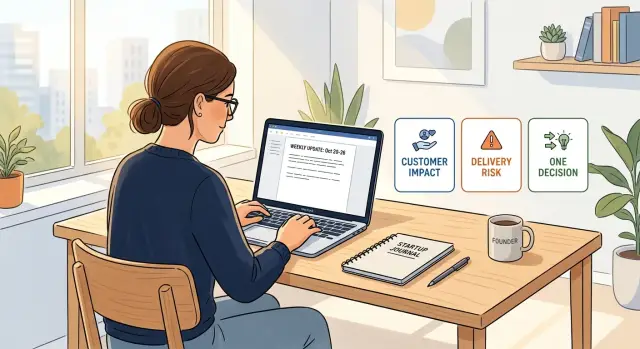
Table of Contents
Why broad status reports fail
Mentors read updates to spot change, risk, and the one place where a founder needs judgment. They do not need a diary.
A long startup status report can look serious and still miss the point. When an update tries to cover every call, meeting, fix, and idea from the week, the real story gets buried. A mentor should not have to dig through ten bullets to learn that onboarding stalled, a customer asked for a feature that may delay launch, or the team is waiting on a pricing call.
Task lists are the usual trap. "Met with designer, reviewed copy, fixed bug, hired contractor" tells the reader that work happened. It does not tell them whether users got more value, whether delivery slipped, or whether the founder is stuck on a decision only they can make.
That is why broad updates create false comfort. A busy week can read like a productive week even when the product is drifting. Mentors do not need proof that the team stayed occupied. They need a clear view of what changed for customers and what may break next.
The same problem shows up in vague wins. "Great feedback" and "good traction" sound positive, but they say almost nothing. Did three trial users convert? Did support tickets drop after a fix? Did one pilot customer expand from one team to five? A customer impact update needs facts, even small ones.
A useful founder update format respects the reader's time. If a mentor can spare only five minutes, the note should still answer three questions: what changed for customers, where delivery may slip, and what decision is blocked right now. Anything that does not help answer those questions is usually extra.
What mentors need to see fast
Mentors need a fast read on what changed for users, what might slip, and where you need a call.
Start with user impact. That tells the reader whether the team moved the business, not just stayed busy. "Activation rose from 18% to 24% after we cut the signup flow from five steps to three" says much more than "The team worked on onboarding improvements."
Then name the delivery risk in one plain sentence. Say what may miss, why, and how serious it is. For example: "We can still ship on Thursday, but the billing bug affects about 1 in 10 test checkouts, so launch may slip by a week if we do not fix it by Tuesday."
End with one decision. One, not three half-formed questions.
A mentor can answer a clear choice quickly:
- keep the launch date and cut one feature
- move the launch by one week to fix billing
- approve extra contractor help for two days
This works because it lowers the mental load. A broad status report asks the reader to sort the mess for you. A good mentor update template does the sorting first.
Keep the whole note short. In most cases, 80 to 120 words is enough. If it does not fit on one phone screen without much scrolling, it is probably too long.
Three parts that work
A good founder update format has three parts.
- Start with customer impact. Write what changed for customers, users, or buyers this week. Keep it concrete. Say that five trial users finished onboarding after you removed one setup step, or that two prospects gave the same reason for not buying.
- Name the delivery risk. Pick the one issue most likely to slow revenue, product quality, or trust. Add one sentence on why it matters now. "The payment fix slipped three days, so invoices will go out late" gives a mentor something real to react to.
- End with one decision you need now. Make it a choice, not a vague request for thoughts. "Should we delay the dashboard and fix onboarding first?" is strong. "Any advice?" is lazy.
Each part answers a different question. Customer impact says whether the week moved the business. Delivery risk reporting says what might undo that progress. The last line tells the mentor where to spend attention.
Most founders add too much around these three parts. They include every meeting, every minor task, and a full plan for next week. That usually hides the point. If next week changes the decision, include one short line. If it does not, leave it out.
Compare these two versions:
"We shipped onboarding v2, met three prospects, fixed bugs, and plan to improve activation next week" sounds busy but says little.
"Activation rose from 22% to 31% after onboarding v2. The billing bug still blocks team accounts, which may delay two paid pilots. We need to decide today whether to pause new feature work and fix billing first" gives a mentor enough to help in under five minutes.
That is why three parts beat ten. An advisor, investor, or fractional CTO can respond quickly when the note points to customer movement, real risk, and one blocked call.
How to write the update each week
Pick a fixed time each week and use the same order every time. The format should feel easy to scan, not like homework.
Start with one customer signal from a sales call, support thread, onboarding session, or product usage. Use one fact, not a pile of them. "Four trial users asked for CSV export this week" is better than "customers care about reporting."
Then name the risk in plain words. Do not hide it behind soft language. If the team may miss a launch, say that. If churn may rise because setup still takes 40 minutes, say that. Mentors can help when they see the risk early and clearly.
After that, cut anything that does not change the decision. Most startup status reports get bloated with task lists, meetings, and side work. If a line does not explain customer impact, delivery risk, or the blocked decision, delete it.
A simple weekly flow is enough:
- customer signal: one real data point from calls, support, or usage
- current risk: one sentence in plain English
- what changed: only the work that affects the risk or next decision
- question: one thing the mentor can answer fast
That last question matters more than founders think. Ask, "Would you push the launch by one week to fix onboarding?" That gives the reader something useful to answer.
Keep the question narrow. One question is enough. Two can work. More than that usually means the update is still messy.
Before you send it, read it out loud and cut half a paragraph. Most people bury the useful part under setup and context. Shorter usually reads smarter.
A simple test helps: if you remove a sentence and nothing changes, it did not belong there.
A simple example from one startup week
A founder update format should sound like a note from a real week, not a polished report. Suppose a SaaS founder changed onboarding on Tuesday by adding one guided setup step after signup.
The early result looked good at first. Trial users got through setup faster, and fewer people dropped before finishing the basic steps. That is a real customer change, so it belongs at the top of the update.
But activation stayed flat. People reached the end of setup sooner, yet they still did not hit the moment that made them stick. That detail keeps the founder honest. Faster does not always mean better.
At the same time, the team hit a release problem that had nothing to do with onboarding. A third-party API changed behavior and pushed the next release back by a week. Now the founder has one clear risk to report instead of a vague line like "engineering is working through issues."
The note can be this simple:
Customer impact
We shipped a new onboarding step for trial users. More users now finish setup, and they do it faster. Activation did not move, so the change removed friction but did not increase first-week value.

Delivery risk
Our next release depends on a third-party API. Their change delayed us by about one week, and we cannot test the full flow until that is stable.

Blocked decision
Should we spend this week rewriting onboarding copy to try to lift activation, or wait until the API change lands so we do not mix two changes in the same test?
A mentor can read that in under a minute and give a real answer. The founder is not asking for broad advice. The founder is asking one decision question with enough context to be useful.
This example also shows why broad updates waste time. If the founder sends a page of shipped tasks, calls, meetings, and ideas, the reader has to guess what changed for customers, what might slip, and where help is needed.
In this case, many mentors would say: wait unless user recordings or support messages show obvious confusion in the current copy. If the API delay changes the product flow next week, the team may rewrite text twice. That is busy work, not progress.
The update does not need polish. It needs one user result, one delivery risk, and one blocked decision.
Mistakes that waste the reader's time
Most bad updates do not fail because the founder did too little. They fail because the reader has to sort the signal from the noise.
Dumping the full sprint task list into the note is the most common mistake. A mentor does not need every ticket, bug, and meeting. They need the few changes that affected customers, revenue, growth, or delivery.
Soft language causes another problem. "We are working through a few moving parts" usually means something slipped. Say what slipped, why, and what happens next.
Too many asks can sink the whole update. If you ask about pricing, hiring, product scope, fundraising, and onboarding in one email, most people answer none of them well.
Founders also mix facts, guesses, and opinions into one block of text. "Users are confused, churn may rise, and the redesign was probably a mistake" forces the reader to untangle what you know from what you suspect. Keep those separate. Facts first, then your read, then the decision you need.
Timing matters too. If the note arrives after the meeting starts, the first five minutes turn into silent reading instead of useful discussion.
Small wording choices matter more than founders think. "Three users churned after the new checkout flow" is clear. "We saw some possible friction in conversion behavior" is vague and hard to act on.
The same goes for requests. Pick one blocked decision. If you need help choosing between delaying a launch by a week or cutting one feature, ask that. Most mentors can give sharp feedback on one live choice. Few can untangle five half-formed questions.
Quick check before you send it
Most founder updates go off track in the first sentence. If you open with "We had a busy week," the reader still has no idea whether the week mattered. Put customer impact first.
A short line like "Two trial users converted after the new onboarding flow" works better than a paragraph about internal activity. So does "Seven customers hit the same billing bug on Tuesday, and support tickets doubled." The reader can see the point right away.
Your risk line needs the same level of clarity. "We may face delays" is too soft to help anyone. Name a date, a dependency, or an owner. "The mobile release will slip past May 12 if Apple does not approve the build by Thursday" gives the reader something real to react to. "The data import is blocked until Sam gets API access from the client" is even better because it names the person who can unblock it.
The ask should be just as tight. One update should ask for one decision. If you ask for advice on hiring, pricing, roadmap, and investor outreach at once, most mentors will answer none of them well. A clear ask sounds like this: "Should we delay the launch by one week to fix onboarding drop-off, or ship now and patch later?"
A good founder update format passes four fast tests:
- The first line says what changed for customers or the business.
- The risk line includes a date, dependency, or owner.
- The note asks for one clear decision.
- A busy reader can scan the whole thing in under a minute.
If your note takes two or three minutes to read, you probably mixed signal with diary detail. Cut meeting notes, remove background people already know, and keep only the few facts that change what the reader should think or do.
A simple rule helps: if someone can reply with a useful answer after one quick read, the update is ready. If they need to ask, "What happened to customers?" or "What decision do you want from me?" it still needs editing.
Building a stronger weekly rhythm
A good update helps only if you keep the same shape long enough to learn from it. Stick with the same format for four weeks before you change anything. One week can look strange. Four weeks show patterns.
That consistency makes small problems easier to spot. If customer impact stays vague, mentors will notice. If delivery dates move every week, they will notice that too. If the same blocked decision keeps showing up, you have found a real issue, not a random bad week.
Save every update in one place. A simple doc or running thread is enough. Old notes give you a clean record of what you thought would happen, what actually happened, and where your team got stuck.
After a month, read the updates side by side and look for repeats:
- the same feature slips more than once
- customer pain sounds urgent, but no owner appears
- a hiring or pricing decision stays blocked for weeks
- mentors keep asking the same question
- progress looks busy, but the business result stays flat
When the same blocked decision appears twice, move it to the top of your next mentor call. Do not bury it under general status. If you need a pricing call, a hiring call, or a product scope call, say that plainly and ask for a decision path.
This habit changes the meeting. Instead of walking through a startup status report line by line, you focus on the one choice slowing the company down. That is usually where mentors help most.
Founders often wait too long to tighten this rhythm. They keep writing longer updates when the real problem is weak product judgment, loose delivery planning, or unclear ownership. If product and delivery calls keep slipping, outside help can save a lot of wasted motion.
Oleg Sotnikov at oleg.is works with founders as a fractional CTO and startup advisor, so he is the sort of reader who benefits from this kind of update. If you need a clearer product path, firmer delivery planning, or a sharper view of technical tradeoffs, that kind of outside perspective can help.
Keep the format simple. Keep the cadence weekly. Keep the old updates. After a month, your mentor update template should show you where the business is moving and where you need to decide faster.
Frequently Asked Questions
What should a founder update include?
Use three parts: one customer result, one delivery risk, and one decision you need now. That gives a mentor enough context to help fast without reading a long report.
How long should the update be?
Keep it to about 80 to 120 words in most weeks. If it does not fit on one phone screen, trim the background and keep only what changes the decision.
What counts as customer impact?
Customer impact means a real change for users or buyers. That can be a conversion change, a drop in support tickets, a repeated sales objection, or a step in onboarding that more people now finish.
How should I write the delivery risk?
Write one plain sentence that says what may slip, why, and what happens if you do nothing. Dates, owners, and dependencies make the risk easier to judge.
What kind of question should I ask my mentor?
Ask for one clear choice, not broad advice. A good ask sounds like a real tradeoff, such as whether to delay launch for a fix or ship now and patch later.
Should I include tasks and meeting notes?
Usually no. Task lists show activity, but they rarely show whether the business moved or where judgment is needed.
What if nothing important changed this week?
Say that directly and use the week to report what you learned. If nothing moved for customers, mention the strongest signal you found and the decision that still blocks progress.
When should I send the update?
Send it before the call, not during it. Even a short note shared ahead of time gives the reader a chance to think and keeps the meeting focused.
How do I make weekly updates more useful over time?
Keep the same format every week and save each note in one place. After a month, you will spot repeats like the same delay, the same blocked call, or the same customer pain.
When should I get outside CTO or advisor help with this?
Outside help makes sense when product calls, delivery dates, or technical tradeoffs keep slipping. Oleg Sotnikov at oleg.is works with founders as a fractional CTO and startup advisor, so you can book a professional consultation if you want a sharper read on product, delivery, or team decisions.


