Founder-led product discovery with technical guardrails
Founder-led product discovery works better when a technical lead sizes risk, dependencies, and build cost before roadmap promises harden.
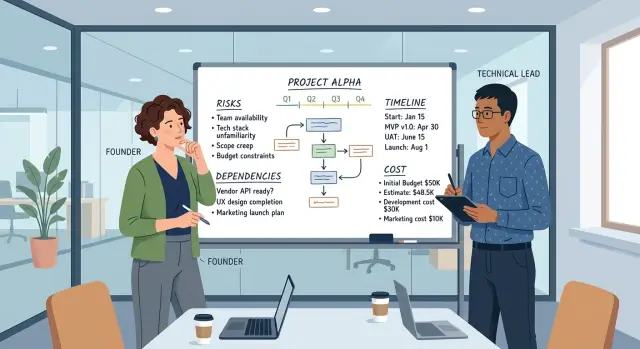
Table of Contents
Why discovery goes wrong without technical input
Discovery often starts with a founder hearing the problem clearly and jumping to the shape of the answer. That speed helps at the start. It also creates blind spots.
A founder sees demand and urgency. A technical lead sees edge cases, old code that will need changes, vendor limits, security checks, and the messy parts users never mention on calls. When nobody brings that view into early discovery, the product idea starts to drift away from what the team can actually build on time and on budget.
This is common in founder-led product discovery. The founder talks to customers, finds a pattern, and wants to move fast. That instinct is often right. The trouble starts when confidence turns into a promise before anyone sizes the work.
Sales can make that worse. A feature that sounded like a small add-on in a demo suddenly becomes "needed for the deal," so the roadmap bends around it. Then the team starts building from the promise backward instead of checking whether the feature fits the product, the stack, and the team.
The expensive part usually shows up later. Discovery ends with a neat idea, but delivery starts with extra API work, data cleanup, access rules, testing, support load, and ongoing maintenance. If the feature depends on another service, costs can jump again through vendor fees, longer setup time, and more failure points.
Small teams feel this fast. One promise can eat two sprints, delay bug fixes, and create a long tail of work that nobody planned for. Founders often think they approved one feature. In practice, they approved the feature, the integration behind it, the support burden around it, and the future updates it will need.
Early technical input keeps discovery honest. A good technical lead does not kill momentum. They ask a few plain questions: what has to change, what this feature depends on, what can break, and what it will cost to carry for the next year.
If you do not have that person in-house, this is where a fractional CTO can help. A short review early can save months of cleanup later, and it keeps customer conversations tied to reality instead of wishful thinking.
What technical guardrails mean in practice
Technical guardrails are simple limits that keep product discovery honest. They do not block ideas. They force each idea to pass a basic test: can the team build it with the time, systems, and people it has right now?
A founder may hear strong user demand and assume the path is clear. That is only half the picture. Users can want something badly, while the actual build hides messy data, brittle integrations, security work, or months of cleanup in old code.
That is why founder-led product discovery works better when a technical lead joins early. The founder brings market context. The technical lead translates that demand into build reality.
Three things need separate labels.
- Risk is the chance that the team learns something painful late.
- Effort is the time and work needed to ship a first usable version.
- Dependency cost is the extra price of relying on tools, vendors, APIs, or internal systems you do not fully control.
Teams often mix these together and make bad calls. A feature can look small in effort, yet carry high risk because nobody knows if the data is clean enough. Another feature can feel safe to build, but cost far more over time because it depends on a paid API, a slow partner approval, or a fragile service that breaks every few weeks.
Guardrails help founders make cleaner bets because they turn vague excitement into tradeoffs. Instead of saying, "customers asked for this," the team can say, "customers want this result, but option A takes two weeks, option B takes six weeks and adds a vendor dependency, and option C needs a data migration first."
That changes the conversation. The founder can still choose the bigger bet, but now the choice is clear.
Oleg Sotnikov uses this kind of thinking in AI-first product and infrastructure work: before teams commit, they size technical unknowns, operating cost, and system dependencies early. That habit saves time later because it cuts off ideas that sound good in a sales call but fall apart once engineers touch the real system.
Good guardrails do not slow discovery down. They stop wishful thinking from driving it.
Questions to ask before you promise a feature
A feature sounds cheap when people talk about screens and buttons. The real cost shows up in the systems it touches, the approvals it needs, and the things your team still has to learn. In founder-led product discovery, a short technical review before any promise can save months of rework.
Start with one sentence: what user problem are you solving? If that sentence gets fuzzy, the feature is still an idea, not a commitment. "Users want better reports" is too loose. "Store managers need yesterday's refund totals by 9 a.m. without exporting CSV files" gives the team something real to test.
Then map the feature's reach. Ask which apps, databases, outside tools, and internal teams it will touch. A simple request can pull in billing rules, permissions, analytics, support work, and legal review. That is where dependency cost planning gets real, even when the first demo looks small.
The next question should be blunt: what could block delivery in week one? Maybe the API does not expose the data. Maybe only one engineer understands the old service. Maybe another company has to approve access first. If you spot a blocker early, you can change the plan while the promise is still cheap.
You also need to ask what happens if the team cuts scope later. Some cuts are harmless. Others remove the only part that makes the feature useful. A trimmed approval flow, for example, can dump manual work on sales, finance, or support. That is feature risk sizing in plain terms: if you cut this piece, what breaks for the user or the business?
One more question matters just as much: what does the team need to learn before it commits? That might mean a two-day spike, one test with real customer data, or a call with a vendor. Oleg Sotnikov often approaches this the right way in Fractional CTO work: learn the risky part first, then estimate.
If your team cannot answer those questions in plain language, do not promise the feature yet. You do not need a full spec. You need enough truth to tell whether you are selling a real path or a polite guess.
A simple way to size risk early
Early sizing works best when you start with the smallest version that can prove demand. If customers say they want a reporting feature, do not size a full reporting suite first. Size one report, one export, or one alert.
That first cut gives the founder a real number. It also gives the team less room to guess.
The goal is not a perfect estimate. You want a rough map. Ask your technical lead for an effort range like "2 to 4 days" or "2 to 3 weeks," plus one sentence on what could push it higher. If you do not have that person in-house, a fractional CTO can do this pass before sales turns a guess into a promise.
Then mark the parts that depend on something outside the feature itself. Risk often hides there, not in the screen the customer sees.
- External services or APIs that may limit access, pricing, or speed
- Internal bottlenecks, like one engineer who knows the billing code
- Data you do not collect yet, or data stored in the wrong shape
- Security, legal, or approval steps that add waiting time
When the team finds an unknown, do not bury it inside the estimate. Split it into a short research task. "Test whether the vendor API supports bulk export" is a task. "Check if our current schema can handle tenant-level permissions" is a task.
Give each task an owner and a small time box, often a few hours or one day. After that, update the estimate with what you learned.
Review the feature one more time before anyone adds dates or pricing to a slide, proposal, or sales call. Many early numbers change after one or two research tasks. That is normal. What hurts is pretending they did not.
In founder-led product discovery, this habit keeps demand testing tied to reality. A founder can still move fast, but the promise stays small enough to ship and clear enough to price. If the team can say, "We can ship a thin version in two weeks, but SSO adds vendor work and another sprint," the product discovery process stays honest.
A realistic example of hidden dependency cost
A customer asks for what sounds like a tiny change: "Can each department on our account pay its own share of the monthly bill?" A founder may hear that and think, "Small billing update, maybe three days."
The technical review often tells a different story. The request is not just about adding a field to the checkout page. It changes how money moves, who can approve changes, and what happens when something goes wrong.
One feature like this can touch several parts of the product:
- billing logic for split charges, failed payments, refunds, and renewals
- role rules for who can add or remove payment methods
- invoices and receipts for finance teams that need clean records
- support workflows for disputes, card updates, and payment errors
Now the first estimate starts to crack. The founder saw one screen and one new option. The technical lead sees edge cases. What if one card fails and the other succeeds? What if a manager can view a department but should not edit payment details? What should support do when two teams both claim they did not approve a charge?
A quick technical review might turn "three days" into something closer to three weeks. Not because the team is slow, but because the feature creates new rules across systems that already exist. It can also add outside costs. Payment providers may charge more for complex billing flows. Support tickets usually rise when money and permissions mix.
A better move is to cut scope early. Instead of true split billing, the team might ship one billing owner per account, plus cost center labels on invoices so finance teams can split charges internally. That solves the customer's main problem without rewriting payments, roles, and support scripts.
This kind of scope cut saves more than build time. It avoids extra QA, extra support training, and months of quiet cleanup later. In founder-led product discovery, that is the difference between a useful promise and sales-backed fiction.
Mistakes that turn discovery into fiction
Discovery stops being useful when a founder promises a launch date before an engineer reviews the scope. That single move changes the whole conversation. The team stops asking what is true, and starts asking how to make the date look possible.
This happens a lot in founder-led product discovery. A feature sounds small in a sales call, so it gets treated like a quick win. Then engineering opens the box and finds edge cases, missing data, auth rules, and third-party limits that nobody priced in.
Integrations are where fantasy often starts. People talk about "just connecting" Stripe, Salesforce, an AI model, or an internal ERP as if it were one task. In real work, each integration has its own login flow, rate limits, bad docs, odd field mapping, retries, and support burden when sync breaks at 2 a.m.
Teams also forget the unglamorous work around the feature. Data migration can take longer than the first version of the UI. Permissions need rules, exceptions, and admin controls. Support needs a way to explain failures, fix records, and answer user questions without pulling an engineer into every ticket.
A prototype can make this worse. A founder sees a demo working with clean sample data and assumes the hard part is done. It is not. Production means messy inputs, permission checks, audit trails, monitoring, recovery steps, and a system that keeps working after the first customer does something weird.
The most damaging mistake is silence around unknowns. If nobody names them, they do not disappear. They just turn into late surprises.
A few warning signs usually show up early:
- Sales promised a date before technical review.
- The team called an integration a small add-on without testing real docs or sample accounts.
- Migration, permissions, and support tasks are missing from the estimate.
- A demo is being used as proof that the feature is ready for customers.
- Unknowns sit under vague notes like "later" or "TBD".
A better habit is simple. Ask the technical lead, or a fractional CTO, to mark unknowns in plain language, put rough cost beside each one, and say what must be tested before anyone commits. That one step keeps discovery tied to reality.
How founders and technical leads should work together
The founder should own the customer problem statement. That means naming the user, the job they need done, what blocks them today, and what that pain costs in time or money. If that part is fuzzy, the team will fill the gap with guesses.
The technical lead owns early sizing. Not a full build plan, and not a perfect estimate. Their job is to say what looks simple, what hides risk, what depends on outside systems, and what could break the current product if the team rushes it.
In founder-led product discovery, this split keeps everyone honest. The founder stays close to the market. The technical lead keeps the team from selling a clean story around a messy build.
A short review before any promise saves a lot of pain later. The technical lead should size a feature early on four points:
- dependency cost, such as third-party tools, vendor limits, or missing APIs
- change depth, meaning whether the team touches one screen or several core systems
- data risk, especially migrations, privacy issues, or weak source data
- operational cost, like support load, monitoring, and failure cases after launch
Product, sales, and engineering should stay in the same loop from the first real customer signal. One shared document often works better than long meetings. Sales adds the customer language, product narrows the workflow, and engineering names the trade-offs in plain English.
A simple rule helps: nobody promises a date until the team agrees on the problem, rough scope, major dependencies, and one technical review. If sales needs an answer sooner, give a range and a confidence level instead of a hard deadline.
For example, a customer asks for "just one integration" with their internal system. The founder hears revenue. The technical lead spots custom auth, rate limits, bad docs, and a data mapping mess. That is not a two-week feature, even if the interface looks small.
If you do not have an in-house technical lead, a fractional CTO can fill this role. The job stays the same: turn early demand into a grounded plan before the roadmap turns into fiction.
Quick checks before you move forward
A 15-minute review can save weeks of rework. Before anyone commits budget, scope, or a launch date, make the team answer a few plain questions out loud.
If people cannot describe the problem in simple words, they do not understand it yet. "Users keep dropping off at checkout because the form asks for data they do not have" is clear. "We need a smarter conversion flow" is vague, and vague ideas turn into expensive builds.
Use a short checklist before any feature moves ahead:
- Ask one person to explain the user problem without product jargon.
- List every dependency outside the main codebase, such as billing tools, vendor APIs, legal review, mobile store rules, or data from another team.
- Ask the technical lead to name the single biggest unknown. Not three. One. That is usually where delays and rewrites start.
- Check if the team can ship a smaller first version that proves demand before building the full idea.
- Stop and remove any promised date that appeared before this review happened.
That last point matters more than most founders want to admit. Once a date lands in a slide deck or sales call, people start defending the date instead of testing the idea. That is how founder-led product discovery slips into fiction.
A smaller first version often tells you enough. If a customer asks for advanced reporting, the first release may only need one export, two filters, and a weekly email. You learn whether people use it before you build custom dashboards, permissions, and data pipelines.
A good technical lead, or a fractional CTO, should make this review feel normal, not dramatic. The goal is not to slow the team down. The goal is to stop fake certainty. If the problem is clear, the outside dependencies are visible, the largest unknown has a name, and the first version is small, you can move with much more confidence.
What to do next
Pick the next three roadmap items and review them before anyone promises dates or scope. This works best when the ideas still feel flexible, not after sales, design, and marketing have already built a story around them.
For each item, keep a short note beside it. One page is enough. Write down the main dependency, the part nobody understands yet, the team or vendor you rely on, and the cost of being wrong. That small habit keeps founder-led product discovery tied to reality instead of optimism.
A simple review can look like this:
- What must already exist for this feature to work?
- Which part of the build feels uncertain or hard to estimate?
- Who outside your team could slow this down?
- What breaks, grows, or gets more expensive if this ships?
- What is the smallest version worth testing first?
Do this in 20 to 30 minutes per item. If nobody in the room can answer two or three of those questions with confidence, the feature is not ready for a commitment.
Keep the note alive after the meeting. If a new dependency appears, add it. If the smallest test changes, update it. Teams usually get into trouble when discovery notes vanish and only the promise survives.
If your team lacks senior technical review, bring in outside CTO help early. A second opinion costs far less than two months spent building the wrong thing or committing to an integration that needs custom work, new infrastructure, and ongoing support.
This is where an experienced advisor can help without taking over the process. Oleg Sotnikov works with startups and smaller companies on product architecture, infrastructure, and AI-first development. He can pressure-test scope, spot hidden dependency cost, and tell you where an idea looks simple but is not.
A good next move is practical: schedule one review session this week, use the same short note for three roadmap items, and see which idea still looks strong after technical pushback. That item usually deserves your attention first.


