Founder knowledge bottleneck and hidden context costs
A founder knowledge bottleneck slows hiring, causes repeat mistakes, and traps decisions in one person's head. Learn what to document first.
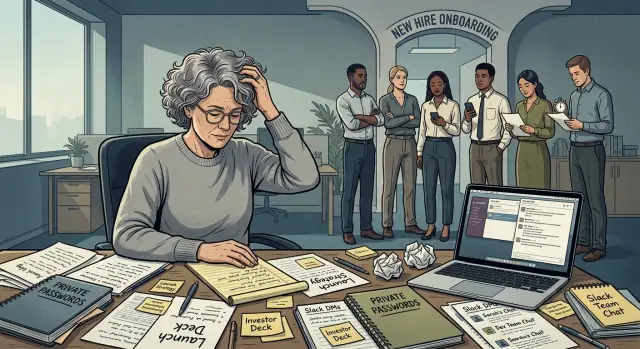
Table of Contents
What this looks like after a few months
At first, a founder holding most of the technical context does not feel like a problem. The team is small, everyone sits in the same chat, and the founder can answer questions in a few minutes. It feels fast.
A few months later, the same habit starts to slow everything down. People ask where production lives, which repo matters, who owns a service, why a shortcut exists, or which account has billing access. The founder answers the same questions again and again, usually between meetings, late at night, or while trying to finish something else.
The delay rarely looks dramatic. It shows up as half-hours lost across the week. A new engineer cannot finish local setup because one API key sits in the founder's password manager. A contractor waits two days for log access. A product change stalls because nobody wrote down why an older workflow behaves in a strange way.
You can see the pattern in small moments. A new hire asks three people where the latest system diagram lives. Someone pings the founder for a login that should have been shared on day one. A simple bug fix pauses because only one person knows which server runs the job. The team debates an old decision because nobody saved the reason behind it.
Once one person goes offline, even small tasks stop. A release waits because only the founder knows which environment variable changed last month. An alert fires, but nobody knows whether it is normal noise or the start of a real problem. Work piles up around missing notes, hidden credentials, and verbal decisions that live only in memory.
Then people start guessing. They recreate scripts that already exist. They use the wrong database copy. They change a config file without knowing why the old value was there. Sometimes the guess works. Sometimes it creates a second round of work a week later.
That is how a founder knowledge bottleneck grows. It does not start with chaos. It starts with convenience. One person knows the answer, so nobody writes it down.
By the time the team reaches four or five people, that habit gets expensive. Hiring still happens, but engineering onboarding gets slower, trust gets weaker, and the founder becomes the unofficial help desk for the company. That job does not scale.
Why every new hire slows down
The first hire usually gets away with asking. They sit with the founder, send a message, or jump on a call and get an answer in two minutes. Because that feels fast, nobody writes much down.
Then the team adds one more person, and the same shortcut starts to cost time. The second hire asks many of the same questions because the answers still live in one person's head. A founder knowledge bottleneck rarely hurts on day one. It shows up when the team tries to move without constant access to the founder.
This is where engineering onboarding gets heavier than it should. A new developer does not just need code access. They need the small facts that explain how the code became what it is. Which service breaks first when traffic jumps. Why one ugly workaround stayed in place. Which customer asked for a special case that nobody wants to touch.
When nobody writes those decisions down, the founder becomes the company's search engine. That pulls them out of product work over and over. A five-minute answer about an old deployment step often turns into thirty minutes of context switching, extra review comments, and a delayed decision somewhere else.
The slowdown spreads everywhere. Code reviews take longer because reviewers do not know the reason behind odd logic. Bug fixes stall when hidden credentials or admin access live with one person. Releases wait because nobody feels safe touching a step they learned once on a call. New hires ask each other, get partial answers, and create fresh confusion.
Each missing note looks small on its own. Together, they add drag to every handoff. One missing environment detail can hold a fix for half a day. One verbal decision that never made it into startup technical documentation can reopen an old debate in the next sprint.
Founders often think hiring will remove pressure. It can, but only if shared context grows with the team. If handoff notes stay thin, every new hire adds another layer of repeated questions, slower reviews, and more interruptions.
A simple startup example
Picture a six-person startup that hires two engineers after its first rush of customer growth. The founder wrote most of the early backend, set up the cloud account, and handled every production issue alone. For a while, that felt efficient. Then the team got bigger, and the gaps started to show.
During the new engineers' first week, they can read the code, run part of it locally, and pick up small tickets. From the outside, that looks fine. But most of the real context still lives in the founder's head. One API key for a billing service exists only on the founder's laptop. Nobody knows that because nobody wrote down where secrets live, who rotates them, or which service breaks without them.
The deploy process has the same problem. Three months earlier, the founder changed it during a late-night incident. A manual step now happens before release because one migration can lock a table if it runs too early. The founder remembers this. The repo does not. There is no note in chat, no short runbook, and no simple checklist for releases.
A bug comes in on Tuesday morning. It looks small. A customer cannot finish checkout after updating a plan, and one engineer thinks the fix will take an hour. Instead, both new hires spend the day tracing logs, comparing environments, and asking each other why staging works while production fails.
By the next day, they find the first issue: production still uses the old API credential in one background worker. Then they hit the second problem. Their deploy skipped the undocumented manual step, so the payment sync job ran against the wrong schema version for part of the release window.
Nothing here is dramatic on its own. A missing note. A hidden credential. One verbal decision that never made it into the docs. Together, they turn a simple bug fix into a two-day chase.
That is the bottleneck in plain form. The team does not slow down because the engineers are weak. They slow down because they cannot see the whole system. Every answer depends on interrupting the founder, waiting for a reply, and hoping the reply includes the one detail nobody knew to ask for.
After a few months, this gets expensive. New hires stop trusting their own changes. Small releases feel risky. The founder keeps getting pulled back into support work that should have left their plate weeks earlier.
Build a basic handoff pack
A handoff pack does not need to be polished. It just needs to answer the questions a new engineer asks on day two, when the founder is busy and nobody remembers the exact setup.
Put it in one place your team already uses. A shared doc folder, internal wiki, or repo folder works fine. The format matters less than the habit of keeping it current.
A simple starter pack has four parts: a systems page, an ownership map, access notes, and a runbook.
The systems page should be boring and complete. List every tool, service, repo, environment, and vendor the product depends on. Include source control, hosting, databases, analytics, billing, email, monitoring, support inboxes, design files, and anything else the team would miss during a normal workday. If a new hire cannot see it on this page, they will discover it the slow way.
The ownership map should name one person for each system. Do not write "team" or "engineering." Write who can approve a production change, who pays the bill, and who gets the alert if something fails. That cuts a lot of waiting.
Access notes should explain steps, not just account names. Write where accounts live, how someone requests access, whether they need MFA, which password manager holds the secret, and which environment they should test in first. Never paste raw credentials into the document.
The runbook should cover deploys, rollbacks, and common support tasks in plain language. Write it for a smart person who joined yesterday. Say what to run, where to check logs, how to confirm success, how to roll back, and when to escalate.
Finish with a short decision log. Note the last few product or architecture choices and why the team made them. "We kept one shared database because splitting it would slow the next three releases" is enough. So is "We chose email login first because enterprise SSO is not part of this quarter." Notes like that stop new hires from reopening old debates and repeating work.
If you build only one document this week, build this one. It pays off almost immediately.
Where verbal decisions create rework
A lot of startup decisions never make it past a call, a Slack thread, or a late-night DM. That feels fast in the moment. A month later, it turns into rework because nobody remembers why the team picked one path and rejected another.
This usually starts with small choices. The founder tells one engineer, "Use this vendor for now." Someone else hears, "Skip that refactor until after launch." Another person gets a message that says, "Keep the old login flow because one big customer still needs it." None of that sounds dangerous. Together, it creates a pile of hidden context.
The damage shows up when a new hire tries to make a reasonable decision with half the story. They see an old workaround in the code and assume it is still the rule. They find two similar tools and pick the wrong one because nobody wrote down why the team changed direction. They ask around, get three different answers, and lose a day on something that should take twenty minutes.
A short note prevents most of this. When the team makes a choice in chat or on a call, copy it into the same place you keep startup technical documentation and handoff notes. Keep it brief, but make it clear enough that a new person can trust it.
A good decision note should say what the team chose, why they chose it, what they rejected, whether the choice is temporary, and who approved it. Dates matter too. They tell a new hire if the note is still current.
Old workarounds need labels. If the team added a shortcut for a customer deadline, say so near the code or in the note. "Temporary fix for March launch" is enough. Without that label, new engineers copy the workaround into new features and spread a decision that should have died months ago.
One common mess looks like this: the founder shares hidden credentials with one developer in a direct message to unblock a demo, then forgets about it. Later, another engineer cannot access the system, creates a second account, and builds around that gap. Now the team has two access paths, unclear ownership, and more cleanup.
Verbal decisions are not the problem by themselves. The problem starts when nobody turns them into a record that survives the week.
Mistakes that keep the founder in the loop
Most teams do not call this a process issue at first. The founder answers every urgent question for months, and everyone gets used to it. By the time the company hires again, nobody knows what is written down, what is still verbal, and what only lives in the founder's memory.
One mistake is waiting for a mess before writing anything. Teams say they will document things after the next launch, after the next hire, or after the next outage. That day rarely comes. Then a new engineer joins, asks how releases work, and gets three different answers from three different people.
Credentials are another trap. If the founder keeps production logins in a personal notes app or in a password manager only they control, the team cannot act without permission. Even simple work slows down. Someone needs access to logs, a cloud account, or the email service, and now a ten-minute task turns into a half-day pause.
Release day often exposes the gap most clearly. Many startups think everyone understands the routine because the same two people have done it for a year. In reality, the steps are often vague. Who checks errors? Who rolls back? Who updates the team? Who watches payments? Who confirms that the mobile build went live? If nobody wrote that down, the founder stays glued to every launch.
Another mistake is treating the first draft of docs as finished. Startup technical documentation ages fast. Tools change. Servers move. A script stops working. A person leaves. If nobody updates the notes, the team stops trusting them. Once that happens, people go back to asking the founder.
Long documents cause their own problems. A twenty-page setup guide sounds serious, but most people will not scan it under pressure. Good handoff notes are short and specific. They answer the questions a new person has on day one and on a bad Friday afternoon.
The usual pattern is simple: access lives with one person, release steps depend on memory, docs explain history but not current practice, new hires ask the same questions twice, and nobody owns updates after the first draft.
That is how the bottleneck survives even as the team grows. The fix is usually smaller than people expect. Write the current release checklist, move hidden credentials into shared access with clear rules, and trim bloated docs into pages people can use during real work.
Quick checks for this week
You do not need a big audit to spot a founder knowledge bottleneck. A few small tests will tell you where work still depends on one person and where hidden context is already costing time.
Run these checks with real people, not assumptions. Ask someone to do the task while you watch. If they stop, ask what they could not find.
Ask a recent hire to set up local work from scratch. Give them the laptop, the repo, and the written notes. Do not let the founder answer questions for one hour. If they get stuck on missing environment variables, unclear steps, or hidden credentials, you found a real delay.
Let someone other than the founder handle a normal deploy. Pick a weekday release, not a staged demo. If the team still needs a private terminal, a saved browser session, or one person who "just knows" the order of steps, your deployment process still lives in someone's head.
Pick one major technical choice from the last six months and ask three people why the team made it. Use something concrete, like choosing one queue, cloud service, or auth flow over another. If product, support, and engineering give different answers, the decision was never written down well enough.
Check access without relying on one person. You do not need to break production. Just confirm that another team member can reach the password manager, cloud account, CI pipeline, logs, and domain settings without asking around in chat. If one lost laptop or one expired token can block the company, fix that now.
Ask support, product, and engineering to read the same note about a recent release or incident. Then ask each person what changed, what broke, and what customers should know. If the answers drift, your notes are acting more like private reminders than shared documentation.
A simple scoring rule helps. Green means someone can finish the task without founder help. Yellow means they can finish, but only after searching chat or asking two people. Red means work stops.
Most teams end up with a mix of green and yellow, plus one or two red spots hiding in places that feel "fine" day to day. Those red spots are expensive. They slow hiring, stretch outages, and keep routine work tied to the founder long after the team should have outgrown that pattern.
Next steps for a team that wants to move faster
You do not fix this by writing a giant manual. You fix it by taking one workflow that still lives in someone's head and making it usable by the next person who joins.
Start with the work that hurts most when it goes wrong. For most teams, that is deploys, incident response, production access, or the steps for rolling back a bad release. If a new hire needs to ask three people before they can do one of those jobs safely, that workflow should go first.
A good first pass can fit on one page. It should answer a few direct questions: what triggers the task, who approves it, where the systems live, what commands or screens people use, and what to do if something fails. That is enough to cut a lot of repeat questions.
Keep the first week small. Document one workflow from start to finish, even if it is rough. Move shared credentials out of private chats, notes apps, and founder laptops. Put them in a team-owned access tool with clear ownership. Then assign one person to update the notes every time the workflow changes.
That last step matters. Notes do not go stale because people are careless. They go stale because nobody owns the update after a deploy script changes, a vendor account moves, or a new approval step appears. Make documentation part of the work itself.
Hidden credentials need the same treatment. Founders often keep cloud logins, DNS access, billing accounts, and alerting tools under personal email accounts because it was faster at the start. A few months later, that shortcut slows every hire. People wait for access, avoid touching risky systems, or create duplicate accounts that nobody tracks.
A small example says a lot: if one engineer handles an incident and changes the restart steps, they should update the handoff notes before the day ends. That takes ten minutes. Without that habit, the next incident costs an hour and a lot more stress.
If the gaps run deep, an outside review helps. Oleg Sotnikov at oleg.is works with startups and small teams as a fractional CTO, helping sort out handoff flow, access setup, and the messy technical context that keeps founders stuck in every loop. The goal is simple: fewer interruptions, faster engineering onboarding, and less rework month after month.
Frequently Asked Questions
What are the first signs of a founder knowledge bottleneck?
Watch for repeat questions, stalled setup, and releases that wait for one person. If the founder still handles logins, deploy details, or old architecture decisions from memory, the team already feels the drag.
When does this start hurting a startup?
Usually around four or five people, the cost becomes hard to ignore. The first hire can ask the founder all day, but each new person adds more interruptions and more repeated answers.
What should I document first?
Start with one handoff pack in one shared place. Put in a systems page, clear ownership, access steps, a deploy and rollback runbook, and a short decision log.
How do hidden credentials slow new hires down?
Move them into a team-owned password manager and write down who owns each account, who can grant access, and when people use it. Do not leave production access in a founder's laptop, notes app, or personal email.
How should we record verbal decisions?
A short note saves a lot of rework. Write what the team chose, why they chose it, what they rejected, whether the choice is temporary, and who approved it.
How do we stop docs from going stale?
Keep docs short and tie updates to the work itself. If someone changes a deploy step, vendor account, or incident fix, they should update the note the same day.
How can we test whether the team can work without the founder?
Ask a recent hire to set up the project without founder help for an hour, and let another engineer run a normal deploy. If they stop to search chat, ask around, or wait for one person, you found a gap.
Do we need a big manual?
No. One page often works better because people can use it under pressure. Write the current steps, current owners, and current access path instead of a long company history.
Which workflow should we fix first?
Take the workflow that causes the most pain when it breaks and write that first. For many teams, that means deploys, rollbacks, incident response, or production access.
When should we ask for outside help?
Bring in someone who can review your setup and turn hidden context into usable process. Oleg Sotnikov helps startups as a fractional CTO with handoff flow, access setup, and the technical gaps that keep founders in every loop.


