Founder approval bottlenecks that slow product delivery
Founder approval bottlenecks slow releases, drain focus, and pull leaders into small calls. Learn how to sort decisions into rules, budgets, and roles.
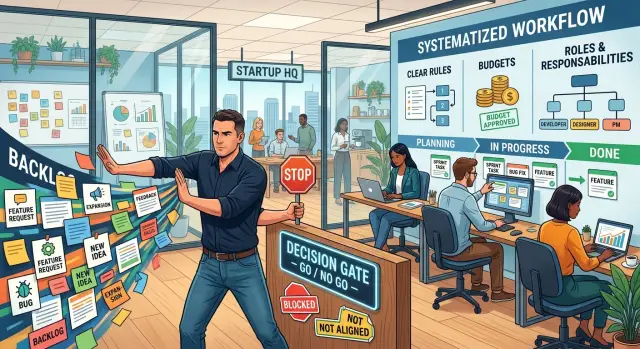
Table of Contents
What the bottleneck looks like in daily work
A founder approval bottleneck usually looks ordinary. A designer waits half a day for an answer on a pricing page. A developer finishes a feature, then leaves it untouched because one product call still needs the founder's yes. Support keeps seeing the same complaint, but nobody offers a refund or workaround until the founder replies.
Soon, very different tasks land in one inbox or one meeting: homepage copy, discount approvals, a contractor hire, a bug fix that changes scope, a customer escalation. None of these calls is huge on its own. The problem is the pileup. They all compete for the same person's attention, and that person is also handling sales, hiring, product direction, and investor updates.
Teams do not ask for permission because they do not care. They ask because they want to avoid rework. If the founder often changes design details, pricing, or priorities late, people learn a simple rule: ask first. That feels safe today. Over a week or two, it slows delivery in ways that are easy to miss.
The founder then spends the day answering small questions. A few chat messages break up the morning. One quick call turns into three follow-ups because nobody knows who can make the next decision without asking again. The calendar fills up, but the hard work does not move much faster.
You can usually spot the pattern in how work moves:
- Tasks sit in review longer than they took to do.
- People wait for meetings instead of deciding.
- Small customer issues jump to the top.
- Projects reopen after late feedback.
This changes how people behave. Designers stop owning design. Managers stop managing. Engineers stop choosing the simplest fix. Everyone protects themselves by sending one more message up the chain.
That is why the team can look busy and careful while delivery keeps slipping. The work does not stop. It just keeps waiting for one person to say, "yes, go ahead."
Why founders end up approving too much
Most founders do not plan to become a gatekeeper. The habit starts early, when the company is tiny and every call really does matter. In a team of two or three people, asking the founder before changing pricing, hiring a freelancer, or shipping a rough feature feels normal.
The problem is that early habits stay in place after the team grows. People keep asking because they always asked. The founder keeps answering because nobody broke the pattern.
Teams also struggle to tell which choices carry real risk. A legal change, a new vendor contract, and a small copy update can all land in the same chat thread. When risk is blurry, people play it safe and ask for approval on everything.
It gets worse when nobody sets clear limits. If a product manager does not know whether they can approve a $300 tool, they ask. If an engineer does not know whether they can change a logging setup, they ask. If a designer is unsure who owns small UX fixes, they wait.
A few missing rules cause a lot of this. Teams need clear spending limits by role, clear ownership of product areas, a short list of changes that still need founder sign-off, and a simple backup plan for when the founder is offline.
Chat tools make it worse. They reward the fastest reply, not the clearest ownership. A founder answers in two minutes, the team moves on, and nobody writes down the rule. That feels efficient for the moment, but it creates the same approval bottleneck again the next day.
Soon the founder becomes the default answer for product, hiring, budget, and vendor decisions. That role feels busy, even useful, but it creates delays almost everywhere. The team stops building judgment because the shortcut is always open.
This is usually an operating problem, not a people problem. The team may be capable. The founder may even want to delegate. But without written decision ownership, simple budget limits, and clear role boundaries, everyone falls back to the same habit: ask the founder first.
Map the decisions the founder still owns
Open the last 30 days of calendars, chat threads, and meeting notes. Write down every decision that paused until the founder answered. Most teams guess here and miss half the problem. A real list shows where time leaks out.
Group each decision into a simple bucket so the pattern is easy to see. Most will fall into a few areas: product changes and scope calls, engineering tradeoffs and release decisions, sales promises and pricing exceptions, hiring and compensation, and spending on tools, contractors, or ads.
This matters because approval delays rarely come from one big issue. They usually come from small daily calls spread across the business.
Next, mark every item by risk: high, medium, or routine. High-risk decisions can change the company in a lasting way, like moving pricing, hiring a senior leader, or committing to a custom feature for a large customer. Routine work is the opposite. It happens often, the downside is limited, and someone on the team already has the context.
A simple question helps: if this choice goes wrong, what breaks, how much money is at stake, and how hard is it to undo? If the answer is "not much" and "easy to fix," the founder probably does not need to own it.
Keep the founder's list short. In most startups, it should be smaller than people expect. Company direction, large budget moves, major hires, and unusual customer commitments usually stay with the founder. A designer can own copy changes. An engineer can choose between two implementation options. A product lead can decide whether a small request makes the next sprint.
Then assign every non-founder decision to the person closest to the work. Use names, not teams. "Engineering" is vague. "Marta approves rollout timing for backend changes under $2,000" is clear.
This map exposes approval bottlenecks fast. It also gives the team something better than permission: ownership.
Turn repeated approvals into rules
Most approval bottlenecks survive because the team has habits, not rules. People know the founder usually answers pricing questions, tool purchases, copy changes, and release calls, so they keep asking. The fix is to turn repeated decisions into a small operating sheet the team can use every day.
Start by naming one owner for each decision type. Product can own scope changes inside the current sprint. Engineering can own technical choices that stay within agreed cost and reliability limits. Customer success can approve goodwill credits up to a set amount. If two people think they own the same call, nobody really owns it.
Budget caps remove a lot of waiting. A team lead might approve a new tool up to $300 a month. A designer might test a user research panel up to $500. Engineering might run a short proof of concept if it fits the sprint budget. Small bets should move fast.
Rules work best when they cover timing, quality, and customer impact. Timing answers who decides whether work lands this sprint or next sprint. Quality sets the bar before release, such as testing, review, or support docs. Customer impact marks which changes can ship without extra approval and which ones could affect trust, billing, or churn.
Write down the few cases that still go to the founder:
- Changes to pricing, contracts, or refund policy
- Hiring, firing, or compensation changes
- Vendor commitments above the agreed cap
- Product changes that affect current customers in a visible way
- Brand or legal risks the team cannot judge alone
Keep the whole thing on one page. If it takes ten minutes to explain, it is too vague. A simple table with decision type, owner, budget limit, and escalation trigger is enough.
This does not remove founder judgment. It saves it for the calls that actually matter.
Set limits people can use without asking
Teams move faster when they know where they can decide on their own. That means real limits on time, money, and risk for each role. Without them, small choices drift back to the founder and the bottleneck shows up in places that should take minutes.
A limit should be plain enough that nobody needs to interpret it. A product manager might approve copy changes, small UI tweaks, and any task that takes less than half a day. An engineering lead might approve bug fixes that stay inside the current sprint, use existing tools, and do not touch billing or security settings.
One simple setup looks like this:
- Product manager: changes under 4 hours of work, no new spend, no customer promise changes
- Engineering lead: fixes and technical choices under 1 day of work, tool spend up to a set monthly cap
- Designer: visual updates that do not change flow, pricing, or legal text
- Founder: pricing, hiring, contracts, brand position, major roadmap changes, and anything with legal or trust risk
Use examples people see every week. Can support offer a one-month credit to fix a mistake? Can an engineer buy a small testing tool? Can the team delay a minor feature to fix a bug affecting active users? Write the answer down once, then reuse it.
Escalation cases need response times too. For a production issue, maybe the founder replies within 30 minutes. For a security concern or customer dispute above a set amount, within 2 hours. Low-risk edge cases can wait for a weekly review instead of interrupting the founder all day.
That weekly review matters. It turns strange cases into new rules. After three or four repeats, stop treating them as exceptions. Update the limits, share the change with the team, and move on. Good rules are not rigid. They get sharper as patterns become obvious.
A realistic example from a small product team
A small SaaS team of seven had a problem that looked harmless at first. The founder wanted to stay close to the product, so she approved almost everything: copy edits, backlog moves, small tool purchases, and the final call on each release.
The team was not slow because people lacked skill. Work slowed because tasks sat in chat waiting for one person to reply. A designer could finish a new onboarding screen by noon and still miss the sprint because the founder had not approved two lines of text.
They changed the setup by sorting decisions into four buckets. The founder kept pricing changes, senior hires, and major roadmap shifts. The product lead got release authority unless a change could hurt billing, security, or a large group of customers. The engineering lead could approve tools up to a monthly spending cap. The team could move backlog items inside the current roadmap without asking each time.
The product lead's rule was simple. If a release bug affected a small number of users and had a safe rollback plan, the product lead could ship or delay it without waiting. If the issue touched payments, customer data, or a major contract, the founder still decided.
The engineering lead got a similar limit. He could buy or renew software as long as the total stayed under the agreed monthly cap and the tool replaced a manual task or solved an active problem. He no longer needed approval for every $20 plugin or test service.
Nothing got loose or messy. The founder still owned the calls that could change the company in a serious way. She just stopped spending time on tiny choices that kept other people blocked.
After a few weeks, the team felt the difference. Fewer tasks waited in Slack. Releases stopped bunching up at the end of the week. A copy tweak, a backlog reorder, or a small software purchase moved in minutes instead of sitting half a day for approval.
That is how approval bottlenecks usually start to fade. Not with a big org chart change, but with a few clear rules that people can actually use.
Mistakes that keep the queue growing
Most founder approval bottlenecks do not come from big strategy calls. They come from small choices that feel risky in the moment, so people send them upward "just to be safe." Once that habit starts, the queue grows faster than the team can clear it.
A common mistake is using emergency rules for normal work. If every pricing tweak, copy change, vendor choice, or bug fix goes through the same urgent path, nothing feels routine anymore. Emergency approval should stay rare. If the team uses it every week, the process is broken.
Another mistake is moving ownership without setting budgets or limits. A founder tells a manager, "You own this now," but leaves out how much that person can spend, what tradeoffs they can make, and when they must escalate. That is not real ownership. It is borrowed responsibility with hidden risk, so people keep asking first.
Titles can make this worse. Someone gets a new role, but everyone knows the founder can still step in and reverse the call at the last minute. The team sees that fast. They stop treating that person as the final decision maker, even if the org chart says otherwise.
Escalation often happens because people feel nervous, not because any rule says they should escalate. That usually points to one of three problems: the rule is vague, the founder reacts badly to mistakes, or the team does not know what level of risk is acceptable. In all three cases, uncertainty travels upward and the queue keeps growing.
Another trap is rewriting the rules after every single mistake. One bad refund, one weak feature launch, one poor hire, and suddenly there is a new approval step for everyone. That feels safe for a day or two. Then the team slows down, avoids judgment calls, and sends more work back to the founder.
A better response is boring, and that is why it works. Keep the rule stable. Fix the gap that caused the mistake. Add a limit only if the same problem repeats. If one miss creates a new checkpoint for the whole team, delays become permanent.
You want fewer exceptions, clear spending room, and one person who can say yes without looking over their shoulder. That is how the queue starts shrinking instead of growing again next week.
A two-week check
You can spot this problem fast if you ask every team lead the same few questions and compare the answers. If people hesitate, give different answers, or wait for the founder to confirm basic calls, the team is still running on memory and habit instead of clear decision ownership.
Do one short review at the start of next week, then repeat it at the end of the second week. The goal is not a perfect org chart. The goal is to see whether work can keep moving for a day or two without piling up in the founder's inbox.
Ask each lead to name three decisions they own today without checking Slack, notes, or the founder. Check whether spending caps exist in writing for tools, contractors, refunds, discounts, or small service purchases. Ask everyone to name the few cases that still need founder approval. If the list changes by person, the rule is not clear. Count how many times the founder answered the same question twice in one week. Repeated answers usually mean nobody turned that answer into a rule. Then pick one release or customer fix and ask whether it could move forward if the founder went offline for one working day.
Small teams often fail this test in a very ordinary way. The product lead thinks engineering can ship minor changes alone. Engineering thinks pricing or customer impact needs founder review. Support waits because nobody knows whether a workaround counts as a product promise. One unclear edge case can delay a release by two days.
Write down what you learn in plain language. "Design lead can approve copy changes." "Engineering manager can ship bug fixes under agreed scope." "Founder approves changes that affect pricing, legal terms, hiring, or roadmap direction." That is enough, as long as people actually use it.
After two weeks, look for one result: fewer repeated questions. If the same approvals still come back, the team does not need another meeting. It needs a written rule, a spending limit, or a clearer owner.
What to do next
Pick one function and fix that first. Product is often the best place to start because delays show up fast in scope changes, release timing, and customer promises. If most waiting happens around technical choices or production changes, start with engineering instead.
Write down every decision in that function that still goes to the founder. Keep the list plain and specific: roadmap changes over a certain size, vendor spend above a set amount, custom work for a large customer, or changes that affect pricing.
Then sort those decisions into four buckets:
- The founder still decides.
- The team decides within a clear budget or limit.
- The team decides by following a written rule.
- The team escalates only when a case falls outside the rule.
Keep the founder on the small set of calls that shape risk, strategy, or cash. Everything else needs a rule, a spending cap, or a named owner. That is how approval bottlenecks start to shrink without the team feeling abandoned.
Do not judge the new setup after two days. Run it for two sprints. During that test, track every moment when someone still waits for approval. Note what they were trying to decide, why they stopped, and what rule was missing or too vague. Most teams learn fast that the problem is not bad people. The problem is fuzzy decision ownership.
A small example helps. If a designer still asks the founder to approve every copy change, set a rule: the product manager signs off on copy unless it changes pricing, legal terms, or brand positioning. That single rule can remove a pile of small delays.
If the team keeps sliding back into the same pattern, outside help can speed things up. This is the kind of operating problem Oleg Sotnikov works on through oleg.is as a Fractional CTO and startup advisor, especially for startups that want clearer decision ownership without adding more management layers.
The first win is usually modest. A team ships one or two decisions faster each week. Then the queue gets shorter, the founder gets fewer interruptions, and delivery starts to feel normal again.
Frequently Asked Questions
What is a founder approval bottleneck?
It happens when work keeps stopping until the founder says yes. The team may finish the task, but release timing, copy, tool spend, refunds, or scope changes still sit in chat or meetings waiting for one person.
How can I tell if approvals are slowing product delivery?
Look at the last two weeks of work. If tasks wait in review longer than they took to do, people save questions for meetings, or the founder answers the same small issue more than once, approvals are slowing the team down.
Why does my team keep asking me about small decisions?
Most teams ask because they want to avoid rework, not because they lack effort. If the founder often changes details late or nobody wrote down spending limits and ownership, asking first feels safer than deciding.
Which decisions should still stay with the founder?
Keep founder approval for choices that can change risk, cash, or company direction. Pricing changes, senior hires, contract terms, major roadmap shifts, and anything tied to legal, billing, security, or customer trust usually stay with the founder.
What should the team decide without the founder?
Give routine calls to the person closest to the work. A product lead can approve small scope changes inside the sprint, an engineering lead can choose implementation details within cost and reliability limits, and support can handle small credits if you set a cap.
How do we set spending and decision limits without losing control?
Set limits that people can use without guessing. For example, a manager can approve tool spend up to a monthly cap or ship a bug fix that stays inside the sprint and does not touch billing or security. When the limit is plain, people stop asking for every minor choice.
What should go into a simple decision rules document?
Write one page with four fields for each decision type: who owns it, what budget or time limit applies, when they must escalate, and how fast escalations need an answer. Use real examples from your week so nobody has to interpret vague rules.
What mistakes make the approval queue keep growing?
Two things usually break it. Teams get ownership without limits, or the founder still reverses calls at the last minute. That teaches people that no one else truly owns the decision, so the queue comes back.
How do we test if the new setup is actually working?
Run a short two-week check. Ask each lead which three decisions they own without asking the founder, then track repeated approval requests, blocked releases, and edge cases that nobody can answer. If the same question shows up twice, turn it into a written rule.
When should we bring in outside help?
Start with the function where waiting hurts most, often product or engineering. If the team still slides back into founder sign-off after you set owners and limits, outside help from a Fractional CTO or startup advisor can tighten the rules and remove the bottleneck faster.


