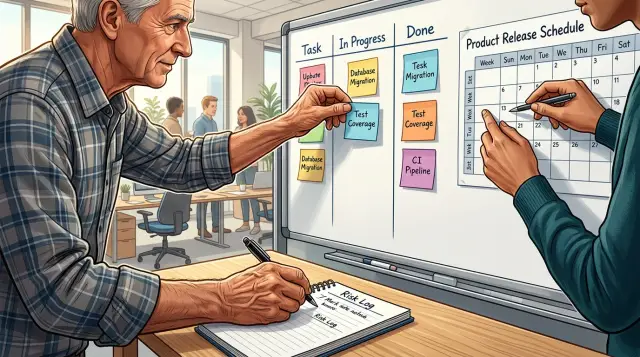
Before you scale the team, fix ownership and release chaos
Before you scale the team, fix ownership gaps, roadmap noise, and release chaos so new hires can ship work without copying confusion.

Table of Contents
Why hiring more people can make the mess bigger
A messy team rarely gets cleaner when you add people. It usually gets louder.
More chats, more handoffs, more opinions, and more places for work to stall. Founders often hire because the team feels overloaded, and that part is real. But overload and disorder are not the same problem. If the team already struggles to decide who owns a feature, what matters this week, or when a release is actually ready, new hires walk into that confusion on day one.
People do not learn how a company works from org charts or onboarding slides. They learn by watching how work moves. If two managers give different answers, they will keep asking both. If roadmap priorities change in the middle of a sprint, they stop trusting the plan. If releases happen late at night with last-minute fixes, they assume that is normal.
Most teams that struggle before they grow have the same three problems. Ownership is blurry, roadmap noise is constant, and releases are chaotic. When you add more people to that setup, the confusion spreads fast. A team of five can survive on memory and hallway conversations. A team of fifteen cannot.
Each new hire adds more handoffs and more chances for work to get lost between product, design, engineering, and support. Hiring does not fix broken coordination. More people increase output only after the basics are clear: who owns what, which work outranks the rest, and how a release goes from "done" to live without drama.
That is why a good fractional CTO usually looks at those basics before talking about headcount. It saves money, cuts frustration, and stops new hires from copying habits you already want to remove.
Where ownership usually breaks
Ownership usually fails in the gaps between jobs. One person writes the spec, another approves scope, a third reviews code, and nobody feels responsible for the result after release. Work keeps moving, but decisions do not.
The signs show up quickly. Two people give different answers to the same product question. Bugs bounce between product, design, and engineering for days. Meetings end with "I'll ask them" instead of a decision. Deadlines slip because approval sits with someone who was never named. A feature ships, then the team argues about who should watch the results and fix the follow-up issues.
A manager, a reviewer, and an owner do different jobs. A manager handles people: staffing, feedback, workload, and team health. A reviewer checks the work and looks for mistakes or weak spots. An owner carries the outcome from idea to release. That person gathers input, makes the call when tradeoffs appear, and stays responsible after launch.
Teams get stuck when they split ownership across roles that can only approve one small part. Product picks scope, design guards user flow, engineering estimates effort, and nobody can close the loop alone. Then even a small change needs three or four handoffs. Questions sit in Slack. Releases move by inches.
Picture a signup flow with a drop in conversion. Product wants fewer fields. Engineering wants to avoid risky changes before the next release. Marketing wants more lead data. If no owner has the authority to choose and take responsibility for the result, the team debates for a week and ships nothing.
If you plan to grow the team, write down one owner for each product area. Keep it simple: signup, billing, onboarding, admin, mobile app, internal tools. Put one name next to each area. Then note who reviews the work and who fills in during time off. Org charts do not fix confusion. Clear names do.
People will still disagree, and that is fine. The difference is that the team can decide, ship, and learn.
How roadmap noise spreads across the team
Roadmap noise starts when the plan carries more work than the team can actually do. A founder adds a new idea, sales asks for one customer request, support pushes an urgent fix, and nobody clears space for any of it. On paper, the roadmap still looks full of progress. In practice, the team feels the clutter right away.
If everything is urgent, the roadmap is fiction.
That noise creates hidden work. A new request rarely takes only the hour someone guessed in a meeting. It also pulls an engineer out of the current task, adds more testing, creates extra chat, and delays decisions that were already half made. Small changes stack up fast.
The damage is not just lost time. It changes behavior. Engineers keep backup plans in their heads because they expect priorities to flip. Product managers stop planning in detail because they assume the next surprise will break it. Team leads start saying "yes" slowly to protect their people, and everyone else reads that as resistance.
After a few rounds, the team stops trusting the roadmap. They trust whoever asked most recently, whoever has the most authority, or whoever is loudest in a release channel. That is when priorities turn into politics.
Most teams work better with a short active list and a separate parking lot. Keep only a handful of items in active work. Give each one a single owner and a clear outcome. Put new requests into a parking lot unless they replace something already in motion, and review that parking lot on a fixed schedule instead of all day.
A parking lot is not a graveyard. It is a visible place for ideas that may matter later but do not deserve attention now. That one change reduces stress more than people expect.
When a fractional CTO joins a busy startup, this is often one of the first fixes: fewer active bets, clearer ownership, and a rule that new work pushes old work out. Without that, new hires copy the same confusion on day one.
What release chaos looks like in practice
Release chaos rarely looks dramatic on Monday. It starts as a normal sprint, then small changes pile up. Sales asks for one promise to be added before Friday. A founder spots a bug in staging and wants a quick fix. Support reports an edge case nobody tested. By Thursday, three people think they own the same release, and nobody is sure what is actually going live.
The pattern is familiar. Developers merge late because scope kept moving. QA checks only the newest change and misses older ones. Product writes release notes after the code is already in production. Support hears about the launch from customers first.
The causes are usually boring, which is why teams ignore them for too long. Someone changes scope at the last minute. The team has no clear checklist for testing, rollback, or sign-off. One person hands work to another with a chat message instead of a real handoff. Each shortcut feels small. Together they turn every release into a scramble.
That scramble burns time twice. Before launch, engineers stop building and start chasing status. They ask which branch is right, whether the database change ran, and who approved the copy update. After launch, the same team spends half a day fixing avoidable problems, answering customer messages, and trying to reconstruct what changed. A release that should take one calm hour can eat two days.
A simple rhythm fixes more than most teams expect. Pick one release day each week. Freeze changes the day before unless something is broken. Use one short checklist for code review, tests, migration steps, release notes, and rollback. Make one person own the release, even if several people contribute. When the release ends, write down what failed while everyone still remembers it.
If you grow the team before fixing this, new hires do not add order. They learn the same rushed habits in their first week. Then the confusion spreads faster because more people touch the same release.
What to fix first, step by step
If you want to grow the team, start by making the current work easy to see. Put every active project, bug, request, and side task into one list. Next to each item, name one owner. Not a group, not "engineering," not "product." One person.
This step feels boring, but it changes a lot quickly. Hidden work shows up. Duplicate work shows up too. The items with no clear owner usually point to the parts of the business that create the most delay.
Once the list is visible, cut hard. Pause anything that nobody can explain in plain words. If someone cannot answer "Why are we doing this now?" in one or two sentences, the work is noise. Leave it out until someone can make the case.
A small team does better with fewer moving parts. Five clear priorities beat fifteen half-started ones every time.
Tighten roadmap decisions
Set one weekly roadmap review and keep it short. Decide what stays, what slips, and what stops.
One person needs final say. That might be the founder, a product lead, or a fractional CTO, but the team should know who makes the call. When nobody owns the decision, every loud request sneaks back onto the roadmap.
After that, fix the release process. Write a short checklist that covers the things people forget under pressure: who approves the change, who tests it, when customers hear about it, and how the team rolls it back if something breaks. Keep it on one page. If the checklist needs a meeting to explain it, it is too long.
Prove it before you hire
Run this setup with the current team for a few weeks before adding headcount. Watch where work still stalls. See whether owners actually decide, whether the roadmap review removes noise, and whether releases feel calmer.
A growing startup often thinks it needs more engineers when the real problem is decision traffic. One founder asks for a feature, sales asks for a demo tweak, support asks for an urgent fix, and all three land in the same sprint. New hires do not solve that. They copy it.
When the current team can explain who owns each job, why it matters, and how it ships, hiring starts to help instead of multiply the mess.
A simple example from a growing startup
A B2B SaaS startup had four people on the product side: a founder, one product designer, and two engineers. Revenue started to climb, customers asked for more features, and the founder decided to hire two more engineers right away.
The problem was not speed. It was ownership. Nobody had written down who owned billing, onboarding, internal admin tools, or bug triage, so the new engineers copied the habits they saw.
Within two weeks, two people worked on the same onboarding flow without knowing it. One changed the UI and the other changed the backend rules. Both thought they were helping, and both pushed code that made sense on its own.
The overlap wasted about a week, but the bigger cost came later. Support started to get more tickets because rushed releases kept breaking small things. A welcome email stopped sending, trial accounts got the wrong limits, and an admin page showed old data.
None of those bugs looked huge on their own. Together, they told customers the team shipped too fast and checked too little. The founder felt pressure and asked for another hire when the team really needed a reset.
A fractional CTO stepped in for a month and put a few plain rules in place. Each product area got one owner. The roadmap dropped side requests that had no customer or revenue reason. Releases moved to a simple weekly schedule with one person approving the final checklist. Support issues went into the same planning view as feature work.
That month did not feel dramatic, but it changed the next hire. The team wrote cleaner tickets, stopped building the same thing twice, and caught more release issues before customers saw them.
When the fifth engineer joined after that cleanup, onboarding was easier. They knew what they owned in the first week, which roadmap items mattered, and how code moved into production. The hire added output instead of noise.
That is the difference between hiring into confusion and hiring into a team that can absorb new people. Headcount helps when the work is clear. If the work is blurry, new engineers just spread the blur.
Mistakes that keep the team stuck
Founders often try to grow the team while work still moves through guesswork. That choice usually makes the mess spread faster. New people do not fix blurry ownership, noisy priorities, or a shaky release process. They copy what the current team already does.
One common mistake starts before the first offer goes out. No one defines who owns product decisions, who approves technical changes, and who decides when work is done. Then a new engineer joins and hears three different answers to the same question. That person does not move faster. They wait, ask around, and learn politics instead of the product.
Urgency causes the next pileup. If every task is "urgent," nothing has a clear place. The team jumps from bug to feature to customer request, then back again. Work starts, stops, and restarts all week. Deadlines lose meaning because the target keeps moving.
Release week often makes the problem worse. A founder spots one more request, sales promises another change, and product slips in a last-minute tweak. Now QA tests one version while developers push another. The release turns into a scramble, and the team learns a bad habit: no plan stays still long enough to finish.
Reporting lines can get just as messy. New hires should not answer to the founder, the product lead, and an engineer at the same time. Three managers means three directions. People spend their day choosing whose message sounds most urgent instead of doing solid work.
Tools create another trap. One update lives in chat, another in a ticket board, a third in a spreadsheet, and release notes sit somewhere else. Nobody sees the same picture. Progress looks busy, but the team still argues about what is ready, what changed, and who owns the next step.
A good fix is usually simple. Give each area one owner. Cut active priorities to a short list. Freeze scope near release day. Give each person one direct manager. Track work in one main system.
A team can survive some mess for a while. It cannot grow well on top of it.
Quick checks before you add headcount
Before you hire, ask a few blunt questions. If the current team cannot answer them quickly and in the same way, more hiring will spread the mess.
Start with ownership. Each product area should have one person who can say, "I decide, I follow up, and I close the loop." That does not mean one person does all the work. It means everyone knows who breaks ties and who answers when work stalls. If a bug or feature can sit for days because product, design, and engineering each think someone else owns it, ownership is already weak.
Then test the roadmap. Ask five people what matters most this month. If you get five different answers, the roadmap is too noisy. A team usually works better when most people can name the same three priorities without opening a document.
The release process should also live in the team, not in one tired senior engineer's head. Pick a normal release and ask someone to explain the steps from memory. They should know how code moves, who approves it, what gets checked, and what happens if something goes wrong. If the answer is, "Ask Sam, he knows the steps," you do not have a real process.
Decision paths matter too. New hires should know where product calls happen, where technical decisions happen, and where urgent issues go. If decisions move through private messages or side calls, new people will miss context and repeat old debates.
One last test is simple: can the team finish work without rescue missions? Look at the last few releases. If work ships only because one person jumps in late at night, patches gaps, and chases missing approvals, hiring more people will not fix the pattern.
These checks cost little, and they expose the real bottlenecks fast.
What to do next
Do one cleanup move this week. Pick the single problem that wastes the most time right now: unclear ownership, noisy roadmap priorities, or a release process that breaks every cycle.
Give one person the job of fixing that area for the next seven days. Keep the scope small. If ownership is messy, write down who decides, who reviews, and who does the work. If the roadmap changes every day, freeze new requests and rank the current work. If releases feel chaotic, assign one release owner and use one short checklist.
Keep the plan simple:
- Choose one broken area.
- Name one owner.
- Write the rule in one page or less.
- Test it in one real sprint.
After that week, look at what changed. Did the team ask fewer repeat questions? Did fewer tasks bounce between people? Did the release go out with less last-minute panic? Those answers tell you more than another hiring plan will.
If the team gets faster and calmer, you probably need process fixes before you grow headcount. If nothing improves, the problem may sit deeper in leadership, role design, or product direction. Either way, you now have evidence instead of guesswork.
An outside CTO view helps when the team keeps arguing about basics. It should stay practical. You do not need a slide deck or a long audit. You need someone to look at ownership, roadmap priorities, and release flow, then tell you what to change first.
Oleg Sotnikov does this kind of work through oleg.is. He works as a Fractional CTO and startup advisor, with experience across software engineering, startup leadership, infrastructure, and AI-first operations, so the advice stays close to daily execution.
Before you add headcount, get the current team to ship cleanly. Then hiring starts to multiply good habits instead of bad ones.
Frequently Asked Questions
How do I know we need process fixes before hiring more people?
If your team gives different answers about who owns a feature, what matters this week, or when a release is ready, fix that before you hire. New hires will learn the same confusion and add more handoffs.
What should we fix first: ownership, roadmap, or releases?
Start with the problem that wastes the most time right now. In many teams, ownership comes first because roadmap fights and messy releases get worse when nobody can make the final call.
What does clear ownership actually look like?
Clear ownership means one person owns the result for each product area from idea to launch and follow up. Other people can review or contribute, but everyone knows who decides and who answers when work stalls.
How many active priorities should a small team have?
Keep only a few active priorities at a time, usually the work your team can truly finish in the current cycle. Put the rest in a visible parking lot so new requests do not pile onto work that already started.
Why does our roadmap keep changing every week?
Most teams let people add work without removing anything. That teaches everyone to ignore the roadmap and react to the latest request instead of the agreed plan.
What usually causes release chaos?
Late scope changes, weak handoffs, and no simple checklist cause most release problems. One release owner, one release day, and a short check for tests, notes, and rollback steps can calm things down fast.
Should bugs and support work sit in the same planning system as features?
Yes. If the team spends time on it, put it in the same planning view. That shows the real workload and forces honest tradeoffs between bugs, support work, and new features.
When does hiring actually start helping instead of creating more mess?
Hiring starts to help when the team can explain who owns each area, what outranks the rest, and how code reaches production. Then new people add output instead of copying bad habits.
Do we need a full time CTO to fix these problems?
Not always. A fractional CTO can often clean up ownership, roadmap rules, and release flow in a short engagement, then help the team keep those rules simple and useful.
What can we do this week without a big reorg?
Pick one broken area and give one person the job of fixing it for the next sprint. Write the rule on one page, test it in real work, and keep the parts that cut repeat questions and late rescue work.