First technical hire after launch: builder, manager, or CTO?
Your first technical hire after launch should match the work ahead. Learn when a builder, manager, or CTO makes the most sense.
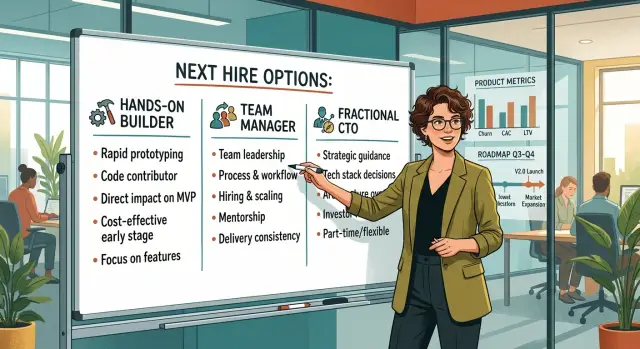
Table of Contents
Why this gets confusing after launch
A launch answers one hard question: will anyone care enough to use the product? If the answer is yes, the work changes fast. Last month, the team pushed to get something live. This month, they fix bugs, answer customer requests, clean up rushed code, and commit to dates they now have to meet.
That shift is why the first technical hire often feels harder than the launch itself. The title sounds simple, but the job usually is not. A founder may say, "we need engineering help," while the business actually needs one of three things: someone to build faster, someone to organize delivery, or someone to make higher-level technical decisions.
Founders also judge the need through the stress of the last sprint. If they spent nights coding, they look for a senior engineer. If tasks slipped and nobody knew who owned what, they look for a manager. If customers ask about security, scale, or reliability, they start thinking about a CTO. Each reaction makes sense. Each can still be wrong.
Your calendar gives a better answer than any job title. Look at what keeps eating the week. It might be production bugs, customer-specific changes that interrupt planned work, missed handoffs between product and engineering, or architecture choices that nobody wants to own.
A vague startup engineering hire usually fixes only one piece of that mess. Then the founder feels disappointed, even when the new person is good. The problem was not the person. The role was blurry.
After launch, the business needs a match for the work in front of it now, not the work that got the product out the door. If the team still needs raw output, hire for output. If work keeps dropping between people, hire for coordination. If nobody can set technical direction, get that level of help first, sometimes with a fractional CTO before making a full-time executive bet.
The wrong hire can cost six months. A clear role can save them.
What work now fills the week
After launch, the mess usually looks bigger than it is. A few bugs, a few customer requests, and a growing backlog can make every problem feel the same. They are not.
Before you choose your first technical hire, track where the team actually spends time for two normal weeks. Do not guess from memory. Write it down.
A simple split often tells the story. How many hours go to shipping new features? How many go to bug fixes, support, and small fires? How much time disappears into customer calls, demos, and feedback review? How many hours go to telling contractors what to do next? And how much time goes to work nobody owns, like hiring, roadmap decisions, architecture, and delivery?
That last category matters more than founders expect. If product work moves but no one owns architecture, the code starts bending in random directions. If no one owns delivery, deadlines slip for small reasons that pile up. If no one owns hiring, the team stays stuck in the same shape for months.
Look closely at technical decisions too. When a tradeoff shows up, who decides? Someone has to choose between speed and cleanup, custom work and standardization, quick fixes and longer-term stability. If the founder makes every call, that can work for a while. It breaks once decisions start stacking up every day.
Contractors often make this even clearer. A good contractor can build fast, but many need steady direction to stay aligned. If they wait for answers every day, the missing piece is not more coding hours. It is ownership.
A small example makes this easier to see. Say a startup has one founder, two freelancers, and 200 active users. The freelancers ship features well, but the founder spends 12 hours a week answering product questions, sorting priorities, and checking release details. Bugs still get fixed. Features still ship. But planning, architecture, and team direction all sit on one tired person.
That weekly pattern tells you more than any job title. Count the hours, name the decision-maker, and list the work nobody owns. The answer usually shows up there.
When a builder makes the most sense
A builder fits best when the product is still moving every week. Customers ask for changes, edge cases keep showing up, and the founder still learns what the product should become. In that stage, the first technical hire should usually be someone who can open the codebase, make decisions, and ship.
This person does not need much setup. They can work from rough notes, short calls, and direct customer feedback. If a signup flow breaks, they fix it. If users keep asking for one missing feature, they build it. Speed matters more than perfect process.
This is common when the team has zero engineers or just one. There is no real engineering org yet, so hiring a manager too early often creates a strange job. A manager without a team will either end up coding anyway or spend time making process for work that still changes tomorrow.
A good builder also works well when the founders can still set direction. You do not need someone to define company-wide technical strategy yet. You need more output than the founders can produce on their own. That usually means a senior engineer or product-minded builder, not an executive.
A simple test helps. If your weekly work is mostly bug fixes, small features, customer requests, and product cleanup, hire the person who likes doing exactly that. If your backlog changes after every five customer calls, hire the person who stays calm in that mess.
Do not confuse "fast" with "sloppy." The right builder still writes clean enough code, leaves notes, and makes choices that will not trap you in three months. Some founders also pair a strong builder with a few hours a week of senior guidance from a fractional CTO. That can work well when you need speed day to day but still want experienced judgment on architecture and priorities.
If your biggest problem is "we know what to build, but we are not building enough of it," a builder is usually the right hire.
When a manager solves the real problem
A manager is the right hire when coding still happens, but progress keeps breaking between people. This often starts when the team reaches two to six engineers. Work does not stop because people lack skill. It stops because nobody owns planning, scope, and follow-through.
At that stage, many founders hire another senior engineer and hope output goes up. Sometimes it does for a week or two. Then the same delays return. Tickets slip, reviews pile up, and small decisions wait until the founder jumps in.
That is a management problem, not a coding problem.
A good engineering manager fixes the week, not just the codebase. They break work into smaller pieces, make sure each task has a clear owner, and keep the team finishing what it started. They stop priorities from changing every afternoon. They also spot trouble early, before a deadline turns into an apology.
Junior engineers usually make this need obvious. They need regular reviews, pairing, and clear standards. If nobody gives them that support, they guess. Quality starts swinging from one person to the next, and founders end up correcting the same issues again and again.
You probably need a manager if the founder spends too much time unblocking the team, tickets stay open because nobody checks progress closely, junior engineers wait too long for review or direction, scope keeps growing during the week, or delivery feels messy even when everyone is busy.
The best hire here is often a technical manager, not a pure people manager. In a small startup, they should read code, understand tradeoffs, and know when a shortcut will hurt later. But their main job is delivery. Four engineers with strong planning often beat five engineers with weak coordination.
Some companies still do not need a full-time executive at this point. They need someone who can bring order, coach the team, and give the founder time back. Sometimes that is an engineering manager. Sometimes a fractional CTO can set the process, mentor a lead, and keep the team moving until the next growth stage.
When you need an executive, not another coder
A senior coder helps you ship more work. An executive decides what work matters, what can wait, and what risk the company should accept. That shift usually starts when the business needs technical strategy, not just more output.
You feel it when product plans, hiring needs, budget limits, and customer demands all start pulling in different directions. One team wants new features. Another needs stability. Sales promises deadlines. Finance wants lower cloud spend. A strong engineer can help with parts of this, but someone still has to make the tradeoffs and own the result.
The clearest sign is simple: people now expect one technical owner. Investors ask about roadmap risk. Clients ask who will back security, uptime, and integration choices. Partners want clear answers on what your system can support in six months, not just what the team can build this week.
A good executive does four jobs at once. They choose the systems worth keeping, set priorities across teams, build a hiring plan, and keep the company from drifting into expensive mistakes. That is different from writing more code.
You likely need this kind of hire when the founder still approves technical decisions one by one, engineers disagree on architecture and nobody closes the debate, hiring slows down because nobody can judge senior candidates well, and customer or investor questions move past features into risk, scale, and reliability.
At that point, the first technical hire should not always be another builder. It may be an executive who can create order and make fewer, better decisions.
A full-time CTO is not the only option. A fractional CTO can work well when you need senior judgment before the budget supports a permanent executive. That setup often gives you enough experience to pick a stack, shape the team, control infrastructure costs, and set clear ownership. Oleg Sotnikov does this sort of founder-side work through oleg.is, usually for teams that need senior technical direction without rushing into a full executive salary.
How to decide in five steps
After launch, founders often hire the person they wish they had six months ago. That usually creates a mismatch. The right first technical hire depends on the work that blocks growth now, not on the title that sounds impressive.
A simple test works better than a long debate.
- Write the three problems hurting growth today in plain language. "Customers wait too long for fixes," "new features miss every date," or "nobody owns technical decisions" gives you something real to solve.
- Match each problem to the type of work it needs. Bugs, integrations, and shipping features usually need a builder. Missed handoffs, weak planning, and unclear ownership point to management. Architecture, hiring plans, budget control, and technical direction point to executive work.
- Decide what the founder will keep. Some founders can still own product, hiring, and technical direction for another six months. Some cannot. If the founder can guide the team but needs more output, hire a senior builder. If the founder is stuck in technical decisions every day, a fractional CTO may be the better move before a full-time executive makes sense.
- Define the first 90 days in simple results. Do not write vague goals like "improve engineering." Write outcomes such as "cut bug backlog from 40 to 15," "ship onboarding revamp by June," or "set up a weekly planning process and hire two developers."
- Hire the role that closes the biggest gap, even if the title feels smaller. A startup engineering hire should remove the most expensive bottleneck.
One quick example: a startup has paying users, one founder, and two contractors. Features keep slipping because nobody reviews work, plans sprints, or decides what gets cut. That company does not need a third coder first. It needs someone to lead decisions. Sometimes that is a full-time CTO. Sometimes it is part-time executive help until the team grows.
That is usually the cleanest way to answer the "engineering manager or senior engineer" question. Look at the bottleneck, name the work, and hire for that gap.
A simple example from a growing startup
A founder launches a SaaS tool and signs 40 paying customers in the first few months. That sounds good, but the work changes fast. Support emails start landing every day. A few small bugs keep coming back. New features take longer because the founder keeps switching between customer calls, bug fixes, and product decisions.
At that point, the first technical hire should usually be a strong builder. The company needs someone who can fix rough edges, ship missing features, and clean up the parts of the code that now break under real customer use. A first-time manager may sound safer, but management does not remove the bottleneck if nobody strong is doing the work.
In this startup, the founder hires one senior engineer instead of an engineering manager. The choice pays off quickly. The new hire fixes the bugs customers hit most, tightens the release process, and ships two small features users already asked for. Support volume drops. Customers get answers faster. The founder gets time back to sell, talk to users, and plan the next step.
That is the right hire for that stage. The team does not need weekly process meetings or someone managing one or two people. It needs one person who can own code, debugging, support issues, and day-to-day product tradeoffs without drama.
Six months later, the problem changes. The startup has more engineers, more requests, and more work moving at once. People start waiting on each other. Priorities get fuzzy. Reviews slow down. Now the drag comes from coordination, not raw building speed.
That is when a manager or a fractional CTO starts to make more sense. Early after launch, one senior builder can move the product forward faster than a new manager. Later, once the team grows, coordination becomes the next hiring problem.
Mistakes that push the hire off track
After a strong launch, founders often hire for stress, not for the actual gap. The product is live, customers ask for changes, and bugs start to pile up. A CTO title can feel like the safe answer. But if the team mostly needs more code shipped and faster fixes, that hire will spend more time planning than building.
Another mistake is giving a senior engineer a manager title without real backing. If that person cannot set priorities, help hire, review work, or say no to random requests, the title changes nothing. They still code all day and carry team problems after hours. That is how good engineers burn out.
Job posts cause trouble too. A broad startup engineering hire often asks one person to write code, run the team, plan architecture, recruit future hires, handle infrastructure, and join sales calls. Most strong candidates read that and move on. The few who stay may want status more than fit. If you cannot tell whether you need an engineering manager or senior engineer, the market will not guess for you.
Big company titles create their own mess. A 10-person startup does not need the same org chart as a 300-person company. Copying "CTO" or "VP Engineering" from larger teams usually hides a simpler need. Sometimes a hands-on builder is enough. Sometimes a fractional CTO helps set direction while the team keeps shipping.
The last trap is expecting one person to fix product, hiring, delivery, infrastructure, and founder communication at once. No first technical hire can carry five jobs for long.
Before you make an offer, answer three plain questions. What work slips every week? Does this role need daily coding, people management, or company-level direction? What decisions can this person make without founder approval?
If those answers feel muddy, rewrite the role before you hire.
A short checklist before you make the offer
A first technical hire goes wrong when the role is still fuzzy. Before you send an offer, write the job down in plain words. If you cannot explain what this person will do in week one, you are still hiring a hope, not a person.
Use five checks:
- Write the first week's work as real tasks, not broad goals.
- Decide who makes technical calls on day one.
- Match the budget to the level you want.
- Be honest about management.
- Set a day-90 result that anyone can judge.
A small example makes this easier. Say your app just launched, customers are coming in, and the founder still reviews every deploy at night. That company likely needs someone who can ship and steady the product fast. It probably does not need a people manager yet.
If these answers still feel messy, pause the offer. A short session with an experienced founder-side advisor or a fractional CTO can clear up the role before you spend months on the wrong hire.
What to do next
Start with the work, not the title. Look at the last eight weeks and sort every technical task into three buckets: build work, management work, and leadership work.
Build work is shipping features, fixing bugs, and handling integrations. Management work is planning, code review, assigning work, and unblocking people. Leadership work is making architecture calls, setting technical priorities, and controlling cost and risk.
One bucket is usually much heavier than the others. That is the gap you need to hire for.
Then rewrite the role around that gap. If most of the pain sits in unfinished product work, your first technical hire is probably a strong builder. If work keeps bouncing between people and nobody owns pace or quality, you need a manager. If product, hiring, infrastructure spend, and technical direction now affect the whole business, bring in executive help.
A fancy title often creates a bad hire. A startup engineering hire should solve the mess you already have, not the company you hope to become in a year.
It also helps to name the founder bottleneck in plain words. Maybe the founder still writes specs at midnight, answers every technical question, or approves every deploy. Your hire should remove that weekly drag. If they cannot take that load off, the role still is not defined well enough.
Sometimes the right next move is a part-time executive, not a full-time one. A fractional CTO can scope the role, set the first systems, and help interview candidates before you commit to a permanent hire. That is often cheaper than hiring a senior person into the wrong job.
If you want a second opinion before making an offer, Oleg Sotnikov at oleg.is works with startups on this exact decision: role design, technical direction, and fractional CTO support. That kind of outside read is often cheaper than spending months correcting a mismatch.
Done right, the first technical hire after launch does two things: it frees the founder and makes the next stage easier to run. Spend one focused hour on the last eight weeks, rewrite the role, and hire for the gap that keeps showing up.
Frequently Asked Questions
How do I know if I need a builder first?
Hire a builder when the main problem is simple: you know what to build, but nobody has enough time to ship it. That usually shows up as bug fixes, small features, customer requests, and product cleanup piling up every week.
A strong senior engineer fits best when the founder can still set direction and the team needs more output, not more meetings or org design.
When should I hire an engineering manager instead?
Bring in a manager when work keeps stalling between people. You will see open tickets sit too long, reviews pile up, scope drift during the week, and the founder jump in just to keep things moving.
In a small startup, pick someone technical enough to read code and judge tradeoffs. Their job is to make the team finish work, not just stay busy.
What signs mean I need a CTO or fractional CTO?
You need executive help when technical choices start affecting hiring, budget, customer trust, and product direction at the same time. That is the point where somebody must own architecture, risk, priorities, and team shape.
A CTO or fractional CTO makes sense when the founder still approves too many technical decisions or when investors and customers want one person to answer for scale, security, and reliability.
Should my first technical hire be full-time or fractional?
Start with fractional help when you need senior judgment now but do not have enough work or budget for a full-time executive. That often works well after launch, when the company needs direction, hiring help, and better technical decisions more than daily executive presence.
Go full-time when the role already fills the week with planning, hiring, architecture, budget calls, and cross-team decisions.
How can I tell what work really fills the week?
Track two normal weeks and write down where the hours go. Count time spent on shipping, bug fixes, customer requests, contractor direction, planning, hiring, architecture, and work nobody owns.
That record tells the truth faster than memory. The heaviest bucket usually points to the role you need next.
What should I expect in the first 90 days?
Set outcomes you can judge without guessing. A builder might cut the bug backlog, ship one overdue feature, and steady releases. A manager might create a weekly planning rhythm, tighten reviews, and stop work from slipping. An executive might settle the stack, define ownership, and make a hiring plan.
If you cannot name day-90 results in plain language, the role still is not clear enough.
Is it too early to hire a manager for a team of one or two engineers?
Yes, often it is too early. A manager with one or two engineers usually ends up coding anyway or creating process around work that still changes every week.
Most teams at that stage get more value from a strong builder, with some senior guidance on the side if architecture or priorities need more care.
Can contractors cover this instead of a full-time hire?
Contractors can help a lot when the work is clear and somebody strong sets direction every day. They usually struggle when priorities change often, product questions pile up, or nobody owns technical decisions.
If contractors wait for answers and the founder spends hours unblocking them, you do not just need more hands. You need ownership.
What mistakes lead to the wrong first technical hire?
Founders often hire for recent stress instead of the real bottleneck. A hard sprint can push you toward a CTO title when the team actually needs one strong builder. Another common mistake is giving someone a manager title without authority to set priorities, review work, or help hire.
Broad job posts also cause trouble. If one role asks for coding, team management, architecture, recruiting, infrastructure, and sales calls, strong candidates will skip it.
How do I write a clear job description for this role?
Write the role around the work that slips every week. Name the problems in plain words, decide what this person owns on day one, and spell out what they should finish in the first month and by day 90.
Keep the title honest. If you need someone to ship features and fix bugs, say that. If you need someone to own planning or technical direction, say that too.