First architecture meeting: what founders should bring
First architecture meeting prep for nontechnical founders: bring user journeys, limits, deal risks, and open questions so the team can make clear tradeoffs.
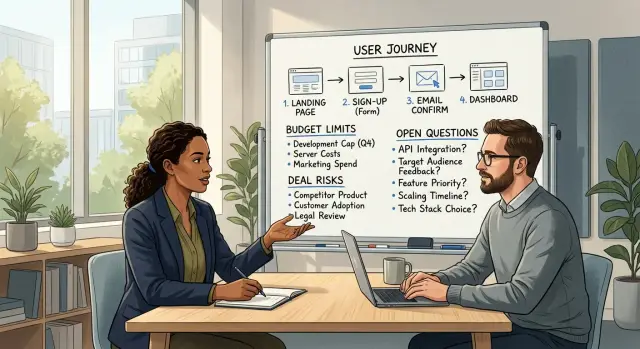
Table of Contents
Why the first meeting stalls
A first architecture meeting usually stalls for a simple reason: people talk about tools before they talk about work. Someone asks, "Should we use React, Python, or an AI agent?" That sounds practical, but it skips the harder question. What must the product do for a real customer on a real day?
Founders often arrive with a pile of features, a market story, and the investor pitch. What the room really needs is the action that starts the process, the step where users get stuck, and the result the business needs at the end.
"We need a dashboard, alerts, and AI summaries" still leaves too much open. "A sales rep uploads a client file, checks contract risk in under 10 minutes, and sends a quote before the call ends" gives the team something they can design around.
Meetings also drift when nobody says the limits out loud. Budget changes the shape of the system. So does a deadline tied to a pilot, a launch date, or a sales deal that depends on one feature this quarter. If those pressures stay hidden, everyone fills the gaps with guesses.
That is how teams leave with vague plans and quiet disagreement. One person imagines a fast prototype. Another imagines something ready for thousands of users. The founder thinks the team will support an enterprise buyer next month. Engineering thinks it is building a test version for ten users.
A good first meeting starts with user journeys, limits, and deal risk. Then the room can make real tradeoffs: speed versus scope, cost versus flexibility, revenue now versus cleanup later. Without that, people mostly trade opinions.
Bring a user journey, not a feature dump
A feature list feels useful, but it rarely helps in a first architecture meeting. "Dashboard," "admin panel," and "notifications" do not tell the team what must happen first, what can wait, or where failure hurts the business.
A user journey does. It shows the path from a real problem to a real result.
Start with the first moment the user feels pain. Maybe a sales manager cannot see which leads need attention. Maybe a client waits two days for a report that should take 10 minutes. That moment matters more than a long wish list because it explains why the product exists.
Then write the steps from sign up to the first useful outcome in plain language. Who starts? What do they enter? What do they need to see next? Where do they stop if something is missing?
This usually answers architecture questions faster than a stack of mockups. It shows where identity, permissions, data storage, and alerts matter instead of making every feature look urgent.
Mark the moments where money or responsibility changes hands. That may be a payment, an approval, a handoff between teams, or the first result a customer would actually pay for.
That last point gets missed all the time. Every product needs one action that proves it works. For one company, it may be "the lead imports and routes to a rep." For another, "the report generates without manual edits." If you cannot name that action, the meeting drifts toward optional features.
Bring one page with the main flow, the handoff points, and the first proof of value. It is far more useful than twenty feature ideas.
Put your limits on paper
Vague limits lead to vague advice. If you walk into the meeting with only a product idea, the team fills the gaps with guesses. That usually leads to the wrong scope, the wrong stack, or a plan your budget cannot carry.
Write down the limits that already exist, even if the numbers are rough. A budget range matters more than a perfect estimate. So does a real launch date and the number of people who can keep the product running after release.
A short note is enough:
- Budget: $30k to $50k for the first version
- Launch: before the September sales event
- Team: one founder, one contractor, no ops hire yet
- Existing systems: must work with the CRM and payment provider already in use
This changes the discussion fast. A small team with a short deadline should not plan the same system as a funded company with six engineers and a year to build.
Name outside limits early too. If a customer deal depends on SSO, a vendor approval, Salesforce sync, or data staying in one region, say that before anyone debates design ideas. The same goes for privacy rules, audit logs, contract terms, or regulated data. Even an incomplete note helps. People ask better questions when they know the walls.
Keep fixed limits separate from wishes. "Must launch in eight weeks" is a fixed limit. "Native mobile apps on day one would be nice" is a wish.
This sounds obvious, but it saves time. Plain business pressure is much more useful than asking, "What stack should we use?"
Name the risks tied to deals and delivery
A lot of architecture decisions start before anyone picks a stack. They start in sales calls, draft contracts, and buyer questions that seemed small at the time. If you leave those out, the team may design for the wrong problem.
Bring a short list of promises you already made, even informal ones. "We can support SSO in phase one" or "your team will get weekly compliance reports" can change scope, timeline, and cost.
Put contract terms in plain language. The team needs to know if a deal depends on uptime targets, response times, data location, audit logs, or a launch date tied to a customer event. These are not side notes. They often decide how much work the system needs before it feels ready.
A short checklist helps:
- promises made in calls or demos
- contract terms that affect scope or operations
- custom requests likely to need special code
- support or reporting commitments after launch
- asks that could kill the deal if you miss them
Custom work needs extra care. Founders often treat a buyer request as "one small change," but custom exports, role rules, approval flows, or branded portals can pull the product off course fast. If one customer wants it and three more will ask next month, say that clearly.
Also say which requests are real deal blockers. There is a big difference between "nice later" and "the buyer will not sign without this." If a pilot depends on SOC 2 work, if procurement needs logs, or if an enterprise client needs weekend support during rollout, the team should hear that early.
Say what you do not know yet
Founders often think they need polished answers before the first architecture meeting. They do not. Early on, some parts of the business are still guesses. The problem starts when those guesses get presented like settled facts.
Say where the picture is still blurry. Maybe you are not sure which user group will adopt first. Maybe pricing is still a test. Maybe rollout depends on one large prospect saying yes. Those details change technical choices quickly.
A few notes are enough: which user group is still an assumption, what part of pricing still needs proof, which rollout plan depends on sales feedback, and which product decision you want the team to challenge.
This helps more than many founders expect. If the team thinks your buyer, pricing, and launch plan are fixed, it may design for complexity too early. That can mean extra roles, billing logic, approval steps, or onboarding flows you may never need.
Keep unknowns visible in plain language. Write "assumption" next to anything you have not proven with customers. Write "needs challenge" next to any decision you feel attached to but want the team to test.
A sentence like "We think operations managers will buy first, but we only heard that in three calls" is useful. It tells the team to avoid deep role logic until you learn more. It may also change how much time they spend on permissions, reporting, or integrations.
Clear uncertainty leads to better architecture. The team can keep options open where you need flexibility and avoid expensive rebuilds where you do not.
Prep it in 30 minutes
For a first architecture meeting, one page beats a slide deck. Open a doc, note, or sheet of paper and split it into four parts: users, limits, risks, and questions.
Under users, write the main journeys people need to complete. Keep them plain. "A new customer signs up, imports a CSV, and invites a teammate" is better than a long paragraph about the whole product. Two or three journeys usually cover most of the pressure.
Under limits, write anything that boxes the team in: budget, deadline, team size, existing tools, and requirements like SSO before contract signature.
Under risks, focus on what could block revenue or delivery. A promised integration, a security review, a buyer asking for compliance work, or one large customer whose contract depends on a feature all belong here.
Under questions, add the unknowns you cannot answer yet. "We do not know if users need mobile first" is useful. Pretending you know usually wastes more time than saying you do not.
Then rank everything by business impact. Ask which item would cost money, delay launch, or put a deal at risk if the team got it wrong. Circle the top three and start the meeting there.
A simple half hour works well: 10 minutes to fill the page, 10 minutes to cut vague items, and 10 minutes to rank the list.
Right before you join, do one last check. Say the main user path out loud in under two minutes. Then write one decision you want from the meeting, such as whether the admin panel can wait until after the pilot. That keeps the room practical.
If you want a second opinion, Oleg Sotnikov at oleg.is works as a Fractional CTO and startup advisor. This kind of one page prep gives him, or any technical lead, enough context to spot tradeoffs quickly.
A simple example from a sales driven startup
A founder sells software to medium sized clinics. One clinic group is close to signing, but the buyer wants a pilot in six weeks. Staff cannot invite coworkers on their own because a manager must approve each invite. The contract also asks for data export on day one, so the buyer can leave with its data if the pilot fails.
Those facts matter more than a long debate about frameworks. They tell the team what must work first, what can wait, and where a bad choice will hurt the deal.
A technical lead will hear three things right away. The six week pilot pushes the team toward tools it already knows well. Manager approval means roles, permissions, and invite flow need early design. Data export on day one means the data model must stay clean and easy to map.
Notice what does not need to lead the meeting: mobile apps, future AI ideas, or a long wish list. The buyer is already telling you where the pressure is. Miss the approval step and clinic staff get blocked. Make export messy and legal slows the deal or kills trust. Miss the pilot date and sales loses momentum.
A short story like "clinic manager approves staff access, staff uses the product, admin exports data if needed" gives the architect something concrete to work with. One real path beats twenty half formed requests.
Mistakes that waste the meeting
Most bad meetings go off track in the first 10 minutes. The founder starts with a wish list, the technical side starts asking system questions, and nobody has a clear picture of what must happen for a user or a deal to succeed.
The most common mistake is a long feature list. "Login, dashboard, notifications, AI assistant, admin panel" sounds busy, but it does not tell anyone what the user is trying to do. Start with one path instead: who the user is, what they want, what they do first, and where they get stuck.
Hiding the budget wastes a different kind of time. If you can spend $20,000, say $20,000. If you need a launch in six weeks because money gets tight after that, say that too. Teams make very different architecture choices when cost and time are real.
Another trap is treating one loud customer like the whole market. One buyer asks for SSO, custom reporting, and five approval steps, and suddenly the whole product bends around a single sales call. Sometimes that request matters. Sometimes it is just one prospect with unusual needs.
Asking for exact estimates too early hurts the meeting as well. If you want precise numbers before you share risks, dependencies, or open questions, you force people to guess. Honest uncertainty is better than a confident guess built on missing facts.
Then there is tool talk. Debating React versus Next.js, monolith versus microservices, or which AI model to use can sound serious. It is still the wrong order. Those choices only make sense after the team understands the business pressure first.
What to do right after the meeting
The meeting only helps if you turn it into a few clear decisions while the details are fresh. Do it the same day. A short record today is better than a polished document next week.
Start a decision log that fits on one page. Write down what the group agreed to do, what it ruled out, and what still needs proof. If someone said a choice affects a sales deal, hiring plan, launch date, or compliance need, capture that too. This keeps the next meeting from reopening the same debate.
Give every open question a real owner. Avoid labels like "engineering" or "the team." One person should own each follow up, and each item should have a date. The founder can confirm customer promises and contract dates. The product lead can tighten the user flow and edge cases. An engineer or advisor can test the hard technical choices. Sales can ask buyers about unclear requirements.
Book the next session before people scatter. A short follow up within a few days usually works better than a longer meeting later. People still remember why each choice mattered, and open questions have not gone stale.
Keep that next meeting tight. Decide whether a requirement is truly needed for the next deal, whether a manual step is fine for now, or whether a risky integration needs a backup plan. Do not spend half the call comparing stacks if nobody has answered the business question first.
If you leave with a decision log, named owners, and the next meeting on the calendar, the session did its job.


