Explain AI risk to customers with controls and checks
Explain AI risk to customers by focusing on controls, human review, fallback steps, and honest limits instead of model scores or hype.
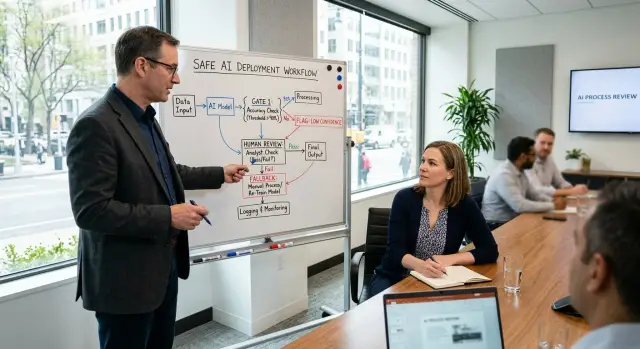
Table of Contents
Why this talk feels hard
Most customers are not afraid of AI as an idea. They are afraid of a quiet mistake that slips through, reaches a real user, and leaves no obvious trace. A wrong refund, a false support answer, a summary that drops one important detail. People can live with ordinary software bugs. They get much more nervous when a system sounds sure of itself and still gets the answer wrong.
That fear usually comes from experience. Many buyers have already seen a polished demo work for ten minutes and then fail in normal use. The sample questions were clean. Real work was not. Names were misspelled, requests were vague, and odd cases showed up fast. After a couple of those moments, customers stop caring about smooth examples.
Benchmark scores do not close that gap. A score can tell you a model did well on a test set, but it does not answer the question that comes up in real meetings: what happens on a bad day? If the model is wrong, who catches it? If nobody catches it right away, who owns the outcome?
There is also a political problem inside the customer team. The product lead wants speed. Legal wants accountability. Support wants a way to correct mistakes without creating more work. Brand wants to know who approves customer-facing text and what happens if the tone slips. Each group hears the word "AI" and imagines a different failure.
This is harder than a normal product pitch. You are answering a trust question for several teams at once. Customers need to hear that mistakes are expected, watched, and contained. If they do not hear that, they assume the risk will land on them.
The hard part is not proving the model can work. It is proving your team has thought through what happens when it does not.
Start with one business task
Most customers get uneasy when the conversation starts with "our AI program." It sounds broad, expensive, and hard to control. Start with one narrow task that already exists in daily work, such as sorting support tickets, drafting internal summaries, or checking incoming invoices for missing fields.
That choice does two useful things. It keeps the risk small, and it gives the customer something concrete to react to. People judge a bounded task much better than a big promise.
Define the job in plain language. Say exactly what the model does, and say exactly what people still do. For example, the model reads a support ticket and suggests a category plus a draft reply. A support lead reviews the draft, edits it if needed, and sends the final message. The model does not issue refunds, change account data, or contact anyone by itself.
Before the meeting, write down three basics:
- The input: what the model receives, such as a ticket, transcript, invoice, or form
- The output: what it produces, such as a label, summary, draft, or score
- The owner: which team checks the result, fixes mistakes, and decides whether the task should expand
This sounds simple, but it changes the tone of the discussion. Once the customer sees the input, output, and owner, the work stops feeling like a black box.
Tie the task to a real business problem, not to excitement about AI. If the team loses 90 minutes a day routing tickets by hand, say that. If account managers miss details because they copy notes between systems, say that. A careful customer usually trusts a small fix for a visible problem more than a broad plan for company-wide change.
Oleg Sotnikov often uses this approach in Fractional CTO work: start with one workflow, set clear boundaries, and give one team direct ownership. That makes the risk easier to explain because everyone can see where the model starts, where human judgment stays in place, and who owns the result.
Explain the controls step by step
Customers relax when they can picture where control sits. A benchmark score feels abstract. A clear flow feels real.
Start at the first touch point. Say what enters the system, who sends it, and what the system keeps out. A support ticket, contract, or invoice may arrive through a form or API. The tool should accept only allowed file types, log the source, strip hidden metadata when possible, and reject requests that contain secrets, malware, or data outside the agreed scope.
Then describe the limits around the model itself. Keep this part concrete:
- Fixed prompt templates instead of open instructions
- Rules that block banned topics, unsafe actions, or missing fields
- Output checks for format, confidence, and policy fit
- Audit logs that record the prompt version, model used, and result
That matters because it turns AI into one controlled step in a process. Customers do not need every technical detail. They need to hear that the system cannot improvise past the limits you set.
Next, name the people who can stop the process. Customers want to know that AI does not act alone after launch. A product owner can approve use for a specific workflow. Operations can pause jobs if results drift. Engineering can roll back to the last stable version quickly.
End with the release gate. No team should ship an AI feature because the demo looked good. Ship it only after test cases pass, the rules match the business task, and one named person approves the rollout. A department is not enough. Customers want to know who that person is.
When they hear who approves access, who watches the logs, and who can shut it off, the risk stops feeling vague. The conversation gets simpler. It is no longer about whether AI is magic. It is about whether the controls fit the job.
Put human checks in the flow
Human review is what most buyers care about. Model scores are interesting, but they are not what makes a customer feel safe. People want to know who checks the result before the system sends a message, changes a record, approves spend, or affects a customer decision.
Put review right before any action that can cause real damage. Let the AI draft, sort, or suggest. Ask a person to approve anything that touches money, contracts, access, pricing, compliance records, or public communication.
Unclear cases should never drift through the system on their own. Send them to a person by rule, not by instinct. Keep the rules simple enough to explain in a minute: missing data, conflicting inputs, low confidence, unusual amounts, or requests outside normal patterns.
A short review rubric helps. Without it, one reviewer rewrites everything and another waves everything through. Reviewers should check whether the output matches the source material, follows the playbook, and is actually ready to send. If they changed it, they should note what changed and why.
That last part matters more than it seems. It creates a trail you can learn from. If reviewers keep fixing the same mistake, the team can tighten the prompt, add a rule, or block that case from automation.
Track how often people correct the output. This tells a better story than a benchmark slide. If reviewers edit 2 out of 100 replies, the workflow is probably in good shape. If they edit 30 out of 100, a person is still in control, but the scope is too wide.
This is how a cautious customer starts to settle. They hear a plain process: the AI makes a first pass, a person checks risky or unclear cases, and the team measures every override. Oleg Sotnikov uses this kind of structure in AI-augmented operations because it keeps the speed gains without asking a business to accept blind risk.
Show the failure path
Abstract promises do not help much here. Name the mistakes the system is most likely to make in daily work. People relax when they hear a simple sentence like: the AI may sort the wrong invoice, draft a reply with the wrong tone, or miss a required field.
Then match each mistake with a fallback. If the AI cannot read a document well enough, the case goes to a manual queue. If it drafts a message that breaks a rule, the message stays as a draft. If it cannot find enough source data, the system returns "needs review" instead of guessing.
You can explain the same idea even more directly. Wrong classification means a staff member checks it before any action. Missing or weak data means the system stops and asks for review. A rule breach means the output is blocked and logged. Repeated bad results mean the feature pauses until someone checks it.
Customers also want to know who hears about a problem first. Do not say "the team" in a vague way. Say which role gets the alert: the account owner, support lead, operations manager, or engineer on duty. That answer tells the customer you have an actual process, not just a hope.
Set the handoff point before launch. Decide when staff take over by hand. For example, if the AI shows low certainty, if the same task fails twice, or if the action touches money, contracts, or customer records, a person steps in. That line should be simple enough that nobody argues about it during a bad day.
Start small. A careful rollout keeps one mistake from spreading everywhere. Oleg Sotnikov often frames this at the architecture level: limit AI to drafts, internal triage, or a small batch of requests first, then widen the scope only after the team has seen real failure patterns in use.
Trust comes from this, not from the claim that failure is rare. Customers want proof that when failure happens, it stays contained and someone owns the next step.
A simple customer scenario
A support inbox is a good place to explain all of this because the work is easy to picture and the controls are easy to see.
Imagine a support team that answers common questions about shipping, billing, account access, and refunds. The team adds AI to draft replies, but the AI does not send anything on its own. A support agent reads each draft, fixes it if needed, and then sends the final message.
That one design choice changes the whole conversation. The customer is no longer being asked to trust an invisible system. They can see the flow: AI writes a first draft, a person checks it, and the company keeps control over the final answer.
The team adds a second check for higher-risk cases. If a message includes a refund, a complaint that could escalate, or wording that touches legal or sensitive topics, a supervisor reviews it before it goes out. Routine questions move faster. Riskier messages get more scrutiny.
The fallback plan matters just as much. If the team starts seeing too many bad drafts, too many agent edits, or repeated mistakes in tone or facts, they stop using AI for that part of the queue and go back to standard templates. Customers usually relax when they hear this because there is a clear failure path instead of a vague promise that the system will "keep learning."
After two weeks, the team looks at a few plain numbers: how much agents had to rewrite, how many errors slipped through review, and whether reply time actually improved. If edits stay high, the process needs work. If errors rise, the scope is too wide. If reply time drops without more mistakes, the team can keep going.
This kind of example works because it is modest. Nobody claims the AI can replace the support team. It handles the first draft, while people keep judgment, approvals, and the stop button.
What makes customers pull back
Customers get uneasy fast when the talk starts with benchmark charts, model names, and lab scores. Most buyers are not asking which model won a test last month. They want to know what the system will do in their workflow, what can go wrong, and who catches it before it causes damage.
Overstating accuracy is another quick way to lose trust. If you promise near-perfect results in the first few minutes, cautious customers stop listening for benefits and start hunting for the catch. A better claim is narrower and more honest: what task the AI handles well, what input quality it needs, and where people still step in.
Trouble also starts when edge cases appear late in the conversation. If the customer has to ask, "What happens with messy data, unusual requests, or a wrong answer sent to a client?" they will assume you hoped those cases would stay hidden. Bring up awkward cases early. It usually lowers tension because it shows you have already thought about failure.
Approval and incident ownership need names, not vague language. Customers pull back when nobody can say who approves output, who can stop the process, and who responds if the AI makes a bad call. If three teams share responsibility, many customers hear that as nobody really owning it.
Human review can also sound weak if you treat it like a box to tick. Saying "a person reviews it" is not enough. Customers want to know who reviews the output, what they check before approval, how often results are sampled or audited, when they reject or edit the answer, and who records mistakes and updates the rules.
A simple example makes the difference clear. If AI drafts support replies, do not stop at "an agent reviews them." Say that the agent must approve every refund message, the system blocks messages above a set risk level, and the team logs bad drafts for weekly review. That sounds safer because it is specific.
People trust controls they can picture. They do not trust confidence without boundaries.
A short checklist before the meeting
A careful customer does not want a speech about model scores. They want proof that you have thought through the boring parts: where the AI fits, who checks it, and how you stop it when it acts up. One clear page often does more work than ten slides.
- Bring a one-page workflow sketch. Show the input, the AI step, the human review step, and the final action.
- Name the first three ways it can fail in plain language.
- Write down who checks each output and who can stop the process.
- Prepare one short rollback sentence, such as "If this step gives poor output, we switch it back to the current manual process the same day."
- Propose a small pilot with limits on users, data, actions, and time window.
This prep changes the tone of the meeting. The customer stops arguing about AI in general and starts talking about a real process they already know.
That is a much better conversation. It is also how experienced technical leaders, including Fractional CTO advisors, keep customer trust steady: clear flow, named reviewers, known failure cases, and an easy way back to the old method if needed.
What to do after the first conversation
A good first meeting does not close the trust gap. The follow-up does. Send a short written summary within a day. Keep it plain. Name the task, where AI will help, what checks people will do, and what happens if the output looks wrong.
A short summary works better than a polished slide deck. Customers want something they can reread, share with legal or operations, and question line by line. The note should cover the exact task in scope, the controls around the model, the human review step, and the fallback if the system fails or produces doubtful output.
After that, suggest a narrow pilot. Pick one task, one team, and one success measure. Keep the first run small enough that people can inspect every result. A cautious customer usually relaxes when they see that the plan has stop rules, not just success goals.
Write those stop rules down. For example, pause the pilot if review time goes up instead of down, if error rates pass an agreed limit, or if customer complaints rise. Clear limits make the project feel governed instead of improvised.
Then set a weekly review. Do not wait for the end of the month. Look at what staff edited, which cases got kicked out as exceptions, and whether any customer complaints point to the same pattern. Those meetings should end with a simple decision: keep going, tighten a control, or stop and fix the process.
If the customer wants an outside review, Oleg Sotnikov at oleg.is can review the plan, the control points, and the rollout as a Fractional CTO before the pilot expands. That can help when a company wants an experienced technical voice without hiring a full-time leader first.
Customers rarely expect perfection. They want to see that you can limit damage, catch mistakes early, and stop fast when the system drifts.
Frequently Asked Questions
What is the best way to start an AI risk conversation with a customer?
Start with one small business task, not with an AI strategy pitch. Describe the input, the output, and who checks the result. That makes the risk feel bounded and gives the customer something real to react to.
Why do benchmark scores fail to reassure cautious customers?
Buyers care less about test scores and more about failure in daily work. A benchmark does not tell them who catches a wrong answer, who owns the outcome, or what happens when messy real data shows up.
How small should the first AI use case be?
Keep the first use case narrow enough that one team can review every result. Drafting support replies, sorting tickets, or flagging missing invoice fields usually works better than anything customer-facing and fully automated.
Which controls should I explain first?
Begin with the control points people can picture. Explain what enters the system, what the model can and cannot do, what rules block bad output, and who can pause or roll back the feature.
Where should human review sit in the workflow?
Put human review right before any action that could hurt a customer or the business. Let the model draft or suggest, then have a person approve anything tied to money, contracts, access, compliance, or public messages.
What should happen when the AI is unsure or gets something wrong?
If the model looks unsure, lacks enough data, or breaks a rule, stop the flow and send the case to a person. Do not let the system guess its way through an unclear case. A manual queue is safer than a confident bad answer.
Who should own approval, monitoring, and the stop button?
One named person should approve rollout for the workflow, and specific roles should own monitoring and shutdown. Customers trust that setup more than vague phrases like "the team will handle it."
What metrics matter most in an early AI pilot?
For a pilot, track rewrite rate, error rate after review, turnaround time, and customer complaints. Those numbers show whether the tool saves time without adding more mistakes.
What makes customers lose trust quickly?
Trust drops fast when you oversell accuracy, hide edge cases, or speak in model names instead of business risks. Customers also pull back when nobody can say who reviews output and who steps in on a bad day.
What should I send after the first meeting?
After the call, send a short written summary with the task in scope, the review step, the stop rules, and the fallback to the manual process. Then suggest a small pilot with limits so the customer can inspect real results before widening the scope.


