Enterprise isolation requirements: what fits and what doesn't
Learn how to sort enterprise isolation requirements into configuration changes, real architecture work, or a clear no without derailing delivery.
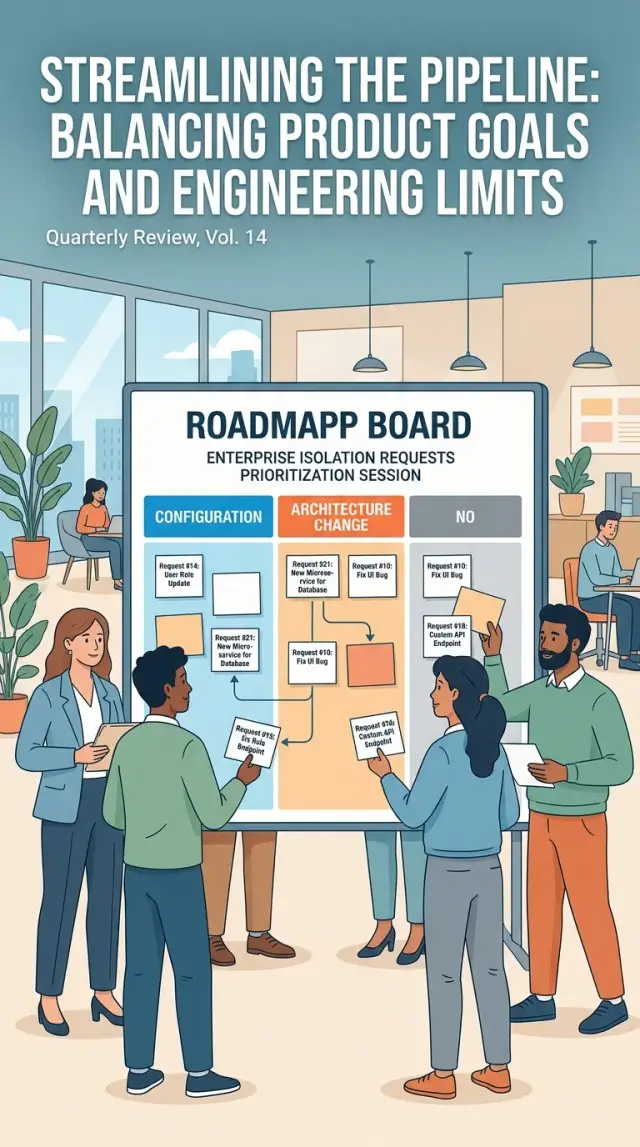
Table of Contents
Why isolation requests create friction
Sales and engineering usually hear the same request in different ways. A buyer says, "We need isolation," and sales hears urgency, budget, and a deal that might close soon. Engineering hears risk, hidden scope, and a promise that could turn into months of work.
The trouble starts because isolation sounds simple while it is still vague. One short request can mean separate data storage, dedicated compute, a private network path, customer-specific encryption keys, stricter admin rules, region limits, or a full single-tenant deployment. Those are very different choices. They change cost, support, release speed, and sometimes the shape of the product itself.
Teams lose time when nobody names the real constraint. Some buyers want legal separation. Some want to reduce blast radius. Some just need a clean answer for a security checklist. If the team does not ask which problem the buyer is trying to solve, everyone argues about the wrong thing.
A familiar example looks like this: the prospect asks for an "isolated environment," sales says yes, and engineering later learns the buyer also expects separate encryption keys, private networking, and a custom deployment process. What looked like a configuration choice becomes an architecture change.
That is why enterprise isolation requirements create so much heat. The request arrives late, pressure is high, and the words are fuzzy. Each group fills in the blanks with its own assumptions.
Roadmaps slip when promises come before technical review. A team says yes to win one deal, then pulls engineers off planned work to handle exceptions, rework, and security reviews. The hard part is rarely the first request. The hard part is supporting that choice every week after the contract is signed.
What enterprise buyers usually ask for
Enterprise buyers rarely ask for "better isolation" as a broad idea. They usually ask for a specific control that needs to pass security review, legal review, or internal policy.
The most common request is separate data storage. A buyer may want its own database, object storage, backups, or retention rules so its records do not sit beside another tenant's data. Sometimes that request is technical. Sometimes it is mostly for compliance teams that want a simple answer.
The next layer is traffic and runtime separation. Some companies want dedicated compute, a private network path, fixed outbound IPs, or stricter rules about where workloads run. This is where single tenant vs multi tenant becomes a real product question. A shared app with stricter settings is one thing. A separate environment is another.
Security teams also ask for tighter access control. They may want separate encryption keys, narrower admin permissions, approval steps for support access, and logs that show exactly who touched what. Audit logs come up often. So does the question of whether your team can see production data during support work.
Contracts make this harder. Procurement language often asks for "full isolation" or "no shared infrastructure" even when the real need is narrower, such as separate storage plus tighter admin controls. If you accept broad words before you test the actual need, you can promise a full architecture change when the buyer only needed two specific controls.
Put each request into one of three buckets
Most enterprise security requests sound technical, but the first cut is usually simple. Sort each ask before anyone estimates it, promises it, or adds it to the roadmap.
- Configuration change. The product already supports the outcome, and the team only needs to turn on an existing option, tighten a default, or choose a different service setting.
- Architecture change. Engineers must create a new boundary in data, compute, networking, or operations. The system itself changes.
- Policy or commercial exception. The hard part is not code. It is ownership, support, pricing, contract terms, or risk approval.
Write one plain sentence under every request: why does it belong in this bucket? If the team cannot explain that in one sentence, the ask is still too vague.
A good sentence looks like this: "Dedicated database is an architecture change because we need a separate persistence boundary, monitoring, backup flow, and recovery process for this customer." That kind of wording clears up confusion early.
A tenant isolation strategy gets much easier once everyone uses the same three buckets. Sales knows what it can promise. Engineering knows what it must build. Leadership sees where the real cost sits.
Requests that usually fit configuration
Some isolation requests sound big but do not need new architecture. If your team can meet the ask by changing existing settings, policies, or service options, it usually belongs in the configuration bucket.
Region choice for data storage is a good example. If your cloud setup already supports separate regions and your app can pin a customer to one without changing how data flows, that is usually a settings decision, not a rebuild.
The same is true for role and access rules when the product already supports account-level permissions, admin roles, or group-based access. Audit log retention often fits here too. If logs already exist and your stack lets you keep them for 30 days, 180 days, or a year, you are changing retention policy, not redesigning the product.
Backup rules can fall into the same category. If your current tools already support different schedules, retention windows, or restore points per environment, the work is mostly operational.
Dedicated encryption keys also fit configuration when the platform already supports them. That last condition matters. If your infrastructure can assign a separate key per tenant with tools you already run, the request is manageable. If the team must rewrite data handling, it is no longer a simple ask.
A good test is intentionally boring: can the team deliver the request with current cloud controls, IAM rules, logging policies, and backup tooling? If yes, price it clearly and keep the roadmap intact. If the ask creates a new code path, a new deployment model, or a custom support process, move it to another bucket.
Requests that usually need architecture work
Some isolation asks sound small in a sales call but change how the product runs every day. If a customer wants its own database, its own cluster, or a private network path, the team is not flipping a setting. The team is taking on a different operating model.
A dedicated database usually means separate backups, migrations, monitoring, access control, and recovery plans. A dedicated cluster creates the same split at the compute layer. One enterprise customer may justify that work. Five or ten can turn one product into a stack of parallel environments.
Network isolation often goes further than buyers first describe. Private connectivity, fixed IP rules, customer VPNs, or restrictions on where traffic may travel can force new routing, new certificates, extra logging, and different incident steps. The system changes shape. That is architecture work.
Separate deployment pipelines create the same kind of break. A shared release process becomes many release processes. One customer may freeze on an older version for months while another wants quick updates. Support gets harder too, because engineers must track which code, config, and runbook belongs to which environment.
The biggest shift happens when the request changes the tenancy model. Moving from multi-tenant design toward single-tenant delivery raises costs in several places at once. Release planning changes. Monitoring changes. Support coverage changes. On-call often changes too, because isolated environments create isolated incidents.
This is usually where a fractional CTO earns their keep. Oleg Sotnikov at oleg.is works with startups and smaller companies on exactly this kind of tradeoff: deciding when an enterprise ask is still a product option and when it becomes a new architecture and operations burden.
Requests that deserve a clear no
Some isolation requests sound serious but really ask you to carry one customer's cost forever. If the change helps only one buyer, adds support work every month, and does nothing for the rest of the product, saying yes is usually a bad decision.
A common trap is the one-off enterprise branch. The buyer wants a custom auth flow, a separate deployment pattern, or a hosting setup that no other customer will use. Six months later, your team is maintaining two products instead of one.
Another hard no is promising "full isolation" while the system still shares databases, queues, workers, or admin tooling. That does not build trust. It creates risk. If the architecture stays shared, say that it stays shared.
Watch for security language that nobody can test. Phrases like "complete separation," "bank-grade," or "zero exposure" sound strong, but they mean nothing unless the team can define them in technical terms and verify them in production. If nobody can measure the claim, nobody should sell it.
Custom hosting deserves extra skepticism. A buyer may ask for its own cloud account, its own region, special VPN rules, or a private toolchain. Sometimes that is fair. Sometimes it breaks your support model for every other customer. If your team can no longer patch, monitor, or troubleshoot the product in a standard way, the deal carries a permanent tax.
Revenue matters, but a large logo can still be a bad deal. If the contract will not pay for the build, the extra operations work, the compliance burden, and the upgrade pain that follows, walk away.
A short gut check helps. Will this request create a permanent fork in product or infrastructure? Can the team describe and measure the promise clearly? Will support get harder for everyone else? Will the deal still make sense a year from now? If those answers go the wrong way, a clean no is the better decision.
How to review an isolation ask
Most isolation requests sound bigger than they are because buyers often describe a fix, not the underlying problem. A simple review process keeps the conversation grounded.
First, rewrite the request in plain language. Take a vague line such as "we need full enterprise isolation before launch" and turn it into something the product team can test: "This buyer does not want its data stored with other customers, and it wants admin access limited to named staff." That version is specific enough to review.
Next, ask what risk the buyer wants to reduce. In most cases it is data leakage, noisy neighbors, admin access, compliance friction, or support staff seeing too much. If you skip this question, teams often build far more than the buyer actually needs.
Then map the request to the parts of the product it touches: data storage, compute and job execution, network boundaries, user and admin access, and support operations. This is where a small ask often grows. A separate database may be manageable. Separate background workers, alerting, and incident response are another story.
After that, check the current product before promising custom work. Many teams already have more isolation than sales realizes: role-based access, per-tenant encryption, region controls, audit logs, or restricted support access. Use what exists first.
Then price the full cost. Include build time, testing, deployment changes, monitoring, incident response, and the extra work the team will carry every month. A one-week feature can turn into a permanent operations cost.
End with a direct answer. Yes now, if configuration covers the risk. Yes later, if the buyer needs architecture work and the deal justifies it. No, if the ask breaks the product model or creates a support burden you should not own.
A simple sales example
A mid-sized SaaS company was close to signing an enterprise customer when the buyer added three requests during security review: a separate database, VPN access to the app, and custom audit logs for its compliance team.
The logs were the easy part. The product already captured enough events, so the team only had to expose a customer-specific export and extend retention rules. That fit configuration. It needed testing, but it did not change the product for everyone else.
The separate database looked simple in the sales call and much harder in engineering review. A new database meant new provisioning, backups, migration rules, monitoring, and incident runbooks. The team could support it, but only if it treated the request as design work with a setup fee and extra delivery time. In practice, it pushed part of a multi-tenant product toward single-tenant operations.
VPN access sounded safe to the buyer, but it created the worst long-term cost. Support would have to manage network rules, troubleshoot the customer's side, and explain connection issues that had nothing to do with the app. For a web product that already had SSO, IP allowlisting, and audit controls, the VPN removed little risk and added a lot of support work.
The final answer was simple. Yes to custom logs within the current plan. Yes to a separate database as a paid add-on with extra lead time. No to VPN access. The team offered IP allowlisting instead.
The customer accepted the logic because each answer matched the real cost behind the request. That is usually how enterprise isolation requirements get resolved without blowing up the roadmap.
Mistakes that turn one request into months of work
Teams usually get into trouble before anyone writes code. A sales call goes well, a buyer asks for stricter separation, and someone says yes before engineering reads the contract. That early yes locks the team into work nobody priced, planned, or fully understood.
Legal language causes the next mess. Contracts often use broad terms like "dedicated," "isolated," or "segregated," but those words do not map cleanly to technical scope. One lawyer may mean separate data storage. Another may expect separate networking, logging, backups, and support access. If the team treats legal wording as settled engineering scope, the estimate will be wrong from day one.
Teams also miss the long tail. They count build time and forget support time. A custom isolation setup can change deployments, monitoring, incident response, audits, and upgrade work for years. What looks like ten days of engineering can become extra checks on every release.
Another expensive mistake is copying one enterprise promise into the main product for everyone. A buyer asks for a special control, and the team bakes it into the default architecture. Now every customer pays for that choice through more complexity, slower delivery, and extra testing. In many cases, a narrow exception is better than a product-wide change.
Write the decision down while the discussion is fresh. Note what the buyer asked for, what the team agreed to, what stays out of scope, and who approved the tradeoff. Without a written record, people remember the promise they wanted, not the one the team actually made.
Quick checks before you commit
A fast yes can create a slow, expensive mess. Before you accept any isolation request, check whether it fits the product you already run or whether it quietly turns you into a custom service company.
Ask a few blunt questions. Can your current stack handle it without forking the product? Will it raise uptime or support risk? Can sales explain the limit in one sentence? Does the price cover setup and long-term care? Will the next five enterprise buyers ask for the same thing?
Those questions take about 15 minutes when the team knows the system well. They can save months of cleanup later.
A good rule is simple: if the request adds permanent complexity but only closes one deal, say no or turn it into a standard paid option with clear limits.
What to do next
Most teams improve once they stop treating every isolation request as a fresh debate. Take the last 10 or 15 asks you saw and turn them into a one-page decision matrix. Note what the buyer wanted, which bucket it fell into, who approved it, how long it took, and whether it changed the roadmap. That record is often more useful than a long security memo.
Sales also needs fixed answers. If every rep explains isolation differently, you will end up selling work you never meant to take on. Give them three approved responses: yes, this works in the current product with configuration; yes, but this needs a scoped project and a new estimate; no, we do not support this because it changes the product too much.
Set approval rules before the next deal arrives. A product or delivery lead can approve requests that stay inside current configuration. A CTO or architecture owner should approve anything that changes data boundaries, deployment model, or operations. If the request adds real cost, a founder or finance owner should sign off too.
Then check the roadmap before you promise dates. Teams get into trouble when they estimate the feature and forget the follow-on work: testing, support, migrations, and documentation.
If the team is split, bring in a neutral review. Oleg Sotnikov at oleg.is works as a fractional CTO and startup advisor, and this kind of review is a big part of the job: sorting requests into clear buckets, pressure-testing the cost, and spotting where a "small exception" is really months of product work.


