Engineering team rules that reduce chaos as you grow
Engineering team rules give growing teams clear ownership, review habits, escalation paths, and release expectations without a heavy handbook.
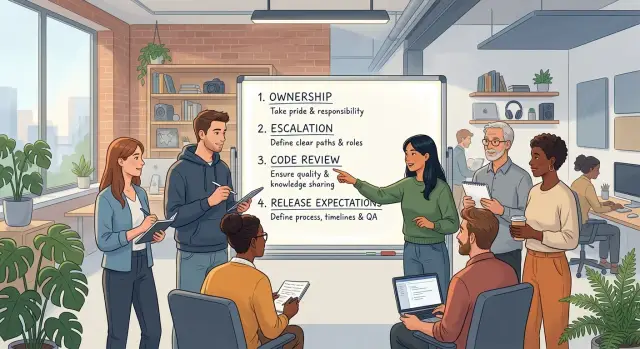
Table of Contents
Why growth creates daily confusion
A small team can run on memory and hallway talk. Five people hear the same decisions, watch the same pull requests, and know who usually steps in when something goes wrong.
That stops working once the team grows. New engineers join, people spread across time zones, and work starts moving faster than conversations can keep up. What felt obvious last month now depends on who you ask.
The same questions start eating the day. Who owns a bug if two teams touched the code? When should someone escalate instead of trying one more fix? How long can a pull request sit before it blocks other work? Who can ship a release late in the week?
None of these questions is hard on its own. The problem is repetition. If three engineers ask the same thing every week, the team loses hours to interruptions, delayed decisions, and quiet frustration.
Verbal norms break first. One person remembers that "the backend team handles it." Another remembers that "the last person who changed it owns it." A new hire knows neither rule because nobody wrote it down. Reviews start to feel random, ownership gets fuzzy, and releases depend on who is online instead of what the team agreed to.
This is why engineering team rules matter early. You do not need a huge handbook. You need a few written defaults that remove guesswork from normal days.
Good rules do not add process for its own sake. They cut down on pings, reduce avoidable waiting, and make it easier for people to act without second-guessing. Daily work feels calmer. Engineers spend less time decoding team habits and more time finishing what is in front of them.
The four rules to write first
Most teams do not need a 30-page handbook when they hit 8 or 12 engineers. They need a few written decisions that stop the same argument from showing up every week.
Start with four areas: ownership, escalation, reviews, and releases. Each repo, service, or product area needs one person who makes the final call. Blocked work needs a clear path and a time limit before someone asks for help. Pull requests need simple expectations for size, response time, and who can approve them. Releases need a clear default for what must happen before code goes live and who takes over if something breaks.
These rules matter first because they shape daily work. When ownership is fuzzy, two people assume someone else is handling the issue. When escalation is unclear, a blocker sits in chat for half a day. When reviews drag on, branches pile up. When release expectations change from person to person, teams ship with stress instead of confidence.
Keep the draft short enough that people can read it in one sitting. One page is often enough. Use plain language, name the default action, and skip long explanations.
Leave edge cases for later. You do not need a special rule for every rare event on day one. Start with the common path, then add detail only after the team hits the same exception more than once.
A startup team can write this in an afternoon. One team might decide that every service has one owner, blockers older than 30 minutes go to the tech lead, reviews happen within four work hours, and releases need passing tests plus one approval. That is already more useful than a thick document nobody opens.
Set ownership without org chart fights
When a team grows from four people to 12, confusion rarely starts with code. It starts when nobody knows who decides, who approves, or who fixes a broken service at 6 p.m. Good rules solve that by naming owners for visible work instead of arguing over titles.
Write down ownership at three levels: systems, repos, and decisions. One person might own the billing service, the mobile app repo, and the final call on database schema changes. Another might own incident response for infrastructure and the release checklist for the API. This ties ownership to work people can see every day.
A simple owner list usually needs only four fields: area, primary owner, backup owner, and handoff point.
The backup owner matters more than many teams expect. People take time off, get sick, or spend a week buried in another project. Without a backup, work stops or someone makes a risky change without enough context.
Handoffs need the same level of clarity. Mark where one team stops and another starts. The product team writes the request, the platform team prepares the service, and the feature team ships the change. If that boundary stays fuzzy, bugs and questions bounce around for days.
Keep the owner list in one place people already check, such as your engineering docs, a pinned internal page, or a file in the main repo. If people need to ask where the list lives, the document is already failing. A plain table that stays current beats a polished handbook nobody opens.
Make escalation paths easy to follow
People wait too long to escalate when "blocked" means different things to different people. Define it in plain words. Work is blocked when someone cannot move for more than 30 minutes, needs a decision from another owner, hits a release risk, or sees a problem that could affect users.
Then name the first contact for each kind of blocker. If the issue is a product decision, go to the product owner. If the problem is in code, build, or deploy steps, go to the engineer who owns that area or the team lead. If users are already affected, contact the service owner first and pull in the manager if the issue stays open.
The path should be easy to remember. Ask in the team channel first if the blocker is small and local. Contact the named owner when work fully stops. Wait a set amount of time for a reply, such as 15 minutes during work hours, then move to the next person if nobody answers. If security, customer data, revenue, or a live release is at risk, escalate at once.
Skipping a level should feel normal, not rude. Write down when people should do it: no response in time, a repeated blocker, a release delay, a security concern, or production trouble. That removes guesswork and cuts hours of quiet waiting.
Urgent escalation also needs a no-blame rule. People hide bad news when they expect the first question to be "who caused this?" Ask better questions: what broke, who is affected, what changed, and who needs to help now?
This works only if everyone can remember it without opening a giant handbook. If a new engineer can read the rule once and know who to call, the rule is clear enough.
Keep code reviews short and predictable
A code review process breaks down when nobody knows whether feedback will arrive in 20 minutes or two days. Pick a normal response time and write it down. Routine changes should get a first review within one working day.
Urgent fixes need a different path. A production bug or broken checkout flow should not sit in the same queue as a small cleanup. Write that urgent changes need a direct ping in team chat and a named backup reviewer if the first person is away.
Reviewers also need a narrow job. If every pull request turns into a design meeting, people stop trusting the process. A reviewer should check that the change solves the stated problem, that another teammate can read it without extra explanation, that tests or monitoring were updated when the risk is real, and that the change does not create an obvious release or rollback problem.
That keeps reviews practical. It also helps authors know what "done" means before they ask for approval. On a small startup team, this alone can save hours each week because people stop guessing what each reviewer cares about.
Side debates need a different place. If a thread moves from "this name is unclear" to "should we rewrite this service," stop the review and move that topic to a short meeting or a separate decision note. Then let the pull request move again.
Simple rules work better than long review rituals. People will still disagree, but routine changes stop getting stuck behind unrelated debates.
Set release expectations in plain words
Release rules stop the same argument from happening every Friday afternoon. One person thinks a change is small, another wants more testing, and nobody knows who makes the call.
Write down who can ship. On a small team, any engineer can release a low-risk change after review and passing checks. For larger or riskier work, assign one release owner for the day or week so the team has a clear decision-maker.
Keep the default path short. A normal release should move only when a few checks are done and easy to verify: the review is complete, tests pass, the change note says what changed and where it may break, and the person shipping knows how to undo it.
Then spell out which changes need more care. Database migrations, billing logic, login flows, permissions, and anything that touches customer data should not follow the same path as a text fix or a small UI tweak. Ask for a second reviewer, a planned release window, or a quick manual check in production.
A simple rule works better than a long approval chain. If a release changes money, access, or stored data, slow down. If it changes copy or a small layout detail, keep moving.
Rollback rules should be even simpler. If the release causes errors, breaks a main flow, or creates doubt about data safety, revert first and investigate after. Do not turn a bad deploy into a group debate.
A short example helps. A startup shipping every day might let one engineer release normal app changes but require a second person for payment code or schema changes. That fits on half a page, and people actually follow it.
Write the first version step by step
Pull three people into the same room: one engineering lead, one engineer, and one product partner. That mix is enough to cover daily delivery, technical tradeoffs, and the promises made to customers. Invite eight people and you will get debate instead of a usable draft.
Keep the session short. Give yourselves one sitting and one page. A tight limit forces plain language, and that is exactly what early rules need. If a rule takes a full paragraph to explain, it is probably too fuzzy to follow.
Write only the parts that remove the most friction right now. Who owns a service when something breaks? When should a person escalate instead of trying one more fix alone? How long can a pull request sit before someone reviews it? What must happen before a release goes out? Put simple answers on the page, even if they are not perfect.
Then test the draft against two recent problems. Use real incidents from the last few weeks, not made-up examples. Maybe a bug sat in review for three days, or a release went out without product knowing. Read the draft and ask one blunt question: would this rule have changed what happened?
If the answer is no, rewrite it. If people can read the rule and still argue about what to do next, rewrite it again.
When the page feels clear enough, publish version 1. Do not wait for everyone to agree on every word. A short document people use beats a polished handbook nobody opens.
Set a review date after a few weeks of real use. Teams learn fast once the rules meet real deadlines, real bugs, and real people.
A simple example from a growing startup
A startup added 10 engineers in about six months. The team went from five people who talked all day to 15 people spread across product, backend, frontend, and infrastructure. Work still moved fast, but small questions started to pile up.
One feature showed the problem. The team wanted to add usage limits to a customer dashboard. Product thought backend owned the logic, backend thought infrastructure should handle rate limits, and no one felt responsible for the last 10 percent of polish. The feature sat half-finished for nine days because people kept asking the same question in different channels: "Who is actually driving this?"
The next problem hit during review. Two engineers opened large pull requests late in the week, then waited for feedback from the same senior developer. He was in meetings, then fixing a production issue, then reviewing only parts of each change. By Monday, the release was blocked. Nothing was badly broken. The team just had no clear review process, no backup reviewer, and no shared rule for how fast review should happen.
They did not fix this with a big handbook. They wrote a one-page set of rules.
It said each feature needs one owner, even if several people contribute. It said when a task stalls for more than a day, the owner escalates it to the engineering lead in the team channel. It said reviews should stay small enough to read in under 30 minutes, and if the first reviewer is unavailable for four working hours, a second reviewer steps in. It also said releases need a short checklist: tests pass, rollback is clear, and support knows what changed.
That page did not solve every management problem. It did cut repeat questions fast. Fewer messages asked who should decide. Reviews moved sooner. Releases stopped slipping for vague reasons. Simple rules beat unwritten habits once the team gets bigger.
Mistakes that make the rules useless
The fastest way to waste everyone's time is to write rules that sound neat but do not tell anyone what to do when something goes wrong. "Own your work," "communicate early," and "ship carefully" are not rules. A real rule names a person, a trigger, and an action. "If a release breaks checkout for more than 10 minutes, the on-call engineer posts in the incident channel and pulls in the tech lead" is clear. Nobody has to guess.
Another common mistake is adding exceptions too early. Teams do this because they want to cover every case before anyone asks a hard question. That usually turns a one-page guide into a messy pile of caveats. Start with the normal path. If the same special case shows up more than once, add a short exception and move on.
Rules also fail when they live in five places at once. Ownership sits in one doc, review steps hide in chat, release notes sit in an old ticket, and nobody knows which version is current. People will not stop to investigate during a busy day. Put the rules in one shared place and keep that copy current.
The hardest failure is social, not technical. If managers or founders ignore the rules, the rest of the team will ignore them too. A review policy means nothing if the most senior person keeps merging "just this one urgent fix" without review. In small startups, that happens all the time.
Weak rules usually show the same symptoms. People ask the same process question every week. Urgent work gets a free pass every time. Two leads give different answers. Nobody knows where the current rule lives.
Good rules feel a little boring. That is a good sign. People can find them fast, follow them under stress, and trust that the same standard applies to everyone.
A quick check before you share it
A short rules document should answer common questions in under a minute. If people still need to ask team chat who owns a service, when a review will happen, or whether they can ship on Friday, the draft is still too vague.
A simple test works well. Give the document to the newest engineer on the team, or to someone outside the project. Ask them to solve a few normal work problems using only the written rules. If they get stuck, the team will get stuck too.
Use a few direct checks. Pick any service or repo and see whether the reader can tell who owns it and who steps in if that person is away. Give them a blocked task and see whether they can spot the next action right away, including when to ask a lead or page someone. Show them an open pull request and ask whether review should happen in an hour, today, or later in the week. Ask the on-call engineer to explain how a release happens and what they do if it fails. If they need to guess, the rule is not clear enough.
Concrete wording beats polite wording. "Frontend team reviews UI changes within one business day" works. "Please review promptly" does not. "Rollback by redeploying the last stable build" works. "Use normal rollback procedure" does not.
One more test matters: can people follow the rules when they are tired? Releases fail late, incidents happen early, and new hires forget context. Good rules still make sense at 2 a.m. and on day three.
If the document passes these checks, share it. If it fails even one, trim it, rewrite the fuzzy lines, and test it again.
What to do next week
Start with the friction people feel every day. If two engineers both think they own the same service, or nobody knows who makes the release call, write that down first. Good rules fix repeated arguments, not rare edge cases.
A simple way to choose the first four rules is to look at the last two weeks and ask where decisions got stuck because ownership was fuzzy, where an issue sat too long before someone raised it, when a review waited longer than it should, and what confused people during the last release.
Keep the page short. One screen is often enough for a first draft. If a rule needs a long explanation, it is probably too vague.
After the next two releases, review the page with the team. Look for proof, not opinions. Did people follow the rule when pressure went up? Did anyone skip it because the wording was unclear? Change the lines that caused hesitation, and delete anything nobody used.
Team leads need to follow the rules where everyone can see it. If a lead uses the escalation path early, reviews pull requests on time, and states release expectations in plain words, the rest of the team usually copies that behavior. If leads ignore the page, the team will ignore it too.
If the same problems keep coming back, outside input can help. Oleg Sotnikov at oleg.is works as a Fractional CTO and startup advisor, and his work includes helping small teams tighten architecture, delivery habits, and practical AI-first development without adding unnecessary process.
By the end of next week, aim for one short page, four clear rules, and one owner who keeps that page current. That is enough to cut a surprising amount of noise.


