Engineering cost of manual sales promises in deals
The engineering cost of manual sales promises shows up in discount rules, approval flows, and messy reports. Learn where it starts and how to stop repeat work.
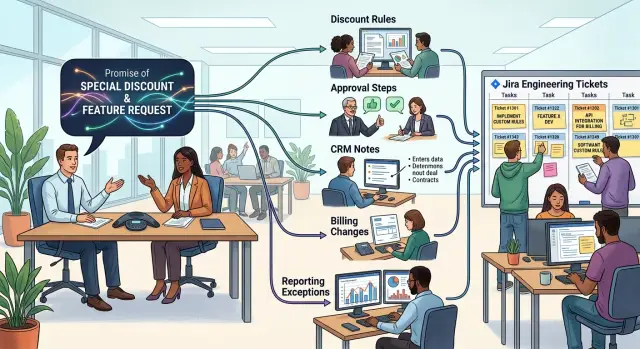
Table of Contents
What the problem looks like day to day
A deal closes. Everyone moves on. Then the questions start.
Why does this customer have a different renewal price? Why do they get a feature that is not in their plan? Why does support see one rule in the CRM and another in the product?
The trouble usually starts with a promise made outside the normal process. A sales rep offers a custom discount, an unusual billing date, extra seats, priority support, or a feature that "will be ready soon." In the moment, it feels minor. Nobody treats it like product or engineering work.
Then the promise gets buried. It lives in a call summary, a Slack thread, a CRM note, or someone's memory after a late demo. By the time the deal reaches engineering, the original wording is already fuzzy. "Give them enterprise pricing for six months" can mean several different things, and each team hears something different.
Engineering then gets asked to make it work fast. A developer adds a one-off rule, hardcodes a discount, skips a check, or puts a special case into billing logic. The ticket looks small. The cost shows up later.
The pattern is easy to spot. Sales says the customer was promised one thing. Engineering says the system was never built for that case. Finance sees invoices that do not match the contract. Support learns the rule only after the first complaint. Reporting starts producing numbers nobody fully trusts.
That is the hidden engineering cost of manual sales promises. One exception touches pricing, permissions, billing, renewals, support, and internal reporting. A promise that took two minutes to make can cost hours of cleanup across the company.
Small teams feel it first. One custom rule can take half a day from a developer, another hour from finance, and a week of confusion for support. The customer sees a simple promise. The company inherits hidden work.
Where the promise starts
Most problems do not start in the contract. They start earlier, in scattered notes that nobody treats as engineering work yet.
When a deal gets serious, gather every place where a promise may have slipped in: deal notes, quote comments, call summaries, email recaps, and CRM fields. One line in a quote comment can create weeks of cleanup later.
Most promises fall into a few plain categories. They usually involve price changes or billing terms, onboarding beyond the normal process, feature behavior or integrations, and delivery dates or support expectations.
Those promises do not all carry the same weight. A signed term, an approved discount, and a salesperson saying "we should be able to do that" are not the same thing. Teams blur those lines all the time, and that is where the trouble starts to grow.
It helps to separate approved terms from casual statements. If legal, finance, product, or engineering never approved something, mark it as unapproved even if the customer heard it on a call. That feels strict, but it prevents rework later.
Write each promise down in one shared note with four details: what was promised, where it appeared, who agreed to it, and when. Names matter. Dates matter too. "Sales said yes sometime last month" is useless once delivery starts.
A small SaaS deal can show the pattern fast. An account executive writes "priority onboarding included" in quote comments, mentions a two-week launch on a call, and offers a custom export if the buyer signs this quarter. None of that looks large on its own. Together, it changes workload, staffing, and reporting.
If a promise has no owner and no date, treat it as a loose statement, not a deal term. That one habit makes the sales to engineering handoff much cleaner.
Trace the path from deal to delivery
Start with the exact promise sales made. Write it in one plain sentence, then follow that sentence through every system that touches it: CRM, contract, billing setup, and the product itself. If the wording changes at each step, the cost is already creeping in.
Then mark every handoff between teams. Sales enters a note in the CRM. Legal rewrites it in the contract. Finance copies part of it into billing. Product or engineering turns it into flags, pricing rules, or one-off logic. Each handoff adds risk, especially when nobody checks whether the next team received the same rule.
A short map usually exposes the problem quickly. Where did the promise first appear? Who copied or approved it? Which system stores the current version? Who acts on it during delivery? Who fixes it when it breaks?
Retyped rules create most of the drift. A promise like "15% off for the first year unless usage passes a set limit" might show up as a CRM note, a contract clause, a billing exception, and a product setting. If four people enter the same rule in four places, those versions will stop matching.
Watch for steps with no clear owner. That is where teams start asking engineering to "just handle it manually." In practice, that often means custom billing scripts, hidden admin settings, support notes, and spreadsheet reports that never line up with finance numbers.
A clean trace should answer four simple questions: who promised it, where the final rule lives, who can change it, and how delivery knows which version is real. If any answer is fuzzy, the deal is not fully ready, even if sales already marked it closed.
Map discount logic before it turns into invoice fixes
Start with the discounts sales can actually promise, not the ones finance assumes exist. Most teams have a short official list and a second, hidden list buried in old quotes, chat messages, and one-off approvals. That gap creates a lot of avoidable work.
Write down every discount type in plain language. Keep the names simple. "New customer discount" is clearer than a label only two people understand.
For each discount, record the limit, who can approve it, when it expires, whether it applies only to year one, and whether it can combine with another offer. Small differences matter. A 10% discount for six months creates very different work from a permanent 10% discount that also changes renewal pricing.
Then ask one question for every rule: where does this rule actually run?
Sometimes the answer is the CRM or a CPQ tool. Sometimes it is the contract template, the billing system, a finance spreadsheet, or manual review by a manager. If the answer is "in somebody's head" or "in email somewhere," the rule is broken already.
That is how discount logic mapping turns into invoice fixes, refund requests, and reporting exceptions. Sales offers 20% off for the first three months to close a slow deal. The quote shows it, but billing only supports yearly discounts. Finance creates a manual credit. Support sees the lower price and assumes renewal should stay low. Reporting marks the account as discounted for the full year. One promise becomes four separate patches.
A shared table is enough if the team actually uses it. Each row should show the discount name, the rule, the owner, the approval path, and the system that enforces it. If a rule has no owner or no system, remove it before the next deal closes.
Clean up approval flows before they spread
Approval mess usually starts with one deal that feels small enough to handle by hand. A sales rep asks for a special discount, finance says yes in a private email, ops agrees to a custom billing step in chat, and nobody records the full path. Three months later, the team treats that one-off promise like a standard option.
At that point, engineering is not building one feature. The team is supporting a chain of hidden decisions, each with its own rule, exception, and person who said yes once.
Start by finding every approval step for nonstandard deals. Do not stop at the signed quote. Check where pricing changed, where payment terms changed, where service levels changed, and where someone allowed a manual workaround. If the deal passed through sales, finance, customer success, and ops, map all four stops.
Most reviews uncover the same types of drift. Sales asks for a one-time exception. Finance approves a margin or billing change. Ops accepts manual handling to keep the deal moving. Someone confirms the whole thing in chat or private email.
Then compare those approvals with the rules each team already follows. Sales may approve a discount that finance would never allow at renewal. Ops may accept a custom process that breaks monthly reporting. Nobody is trying to cause trouble. Each team sees only one slice of the deal.
Side approvals do the most damage because they leave no clean record. People copy old promises into new deals and leave out one condition. Then engineering gets a ticket that looks simple and turns into two weeks of cleanup.
One person needs to own edge cases. That owner does not need to approve everything alone, but they do need to collect the final decision, record the reason, and make sure finance, ops, and delivery teams work from the same version.
If you cannot point to one place that shows who approved what, when, and under which limit, the approval flow is already drifting.
Why reporting exceptions keep piling up
Reporting problems usually start long before anyone opens a dashboard. They start when a deal gets special treatment, but nobody turns that promise into a clear rule in the right system.
The first place to look is hand-filled sales data. Sales reps often type custom discount notes, billing terms, start dates, or package names into free-text fields because the CRM does not give them a better option. That feels harmless during the deal. A month later, finance exports the data and finds five versions of the same promise written five different ways.
That is how monthly cleanup becomes normal work. Someone fixes account names in a spreadsheet. Someone else removes a one-time credit by hand. Then another person explains why booked revenue does not match billed revenue. If the same report needs human repair every month, the report is not the real problem. The deal record is.
A useful habit is to trace every strange row back to the promise that created it. What did sales promise? Where did they record it? Which team had to interpret it later? Which report changed because of that promise?
The pattern shows up fast. One promise creates a custom discount formula. Another creates a special approval path. A third creates an exception in revenue reporting because the contract start date and billing start date do not match.
Take a simple example. Sales closes a deal with "10% off for six months, invoiced quarterly, with the first invoice delayed until onboarding ends." If nobody stores those terms in structured fields, billing invents one workaround, finance invents another, and reporting adds a filter so monthly numbers look right. Now one promise lives in three places, and each team reads it differently.
The fix is usually less dramatic than teams expect. Put customer attributes and contract terms in the CRM. Put price calculation, invoice timing, and credits in billing. Use reporting to group, filter, and explain results, not to hide business rules.
When teams ignore that split, reporting exceptions keep growing because reports become a dumping ground for unresolved deal logic.
One deal can create months of overhead
Picture a common end-of-quarter push. A sales rep wants the signature before month end, so she offers a 20% discount and custom onboarding to get the deal over the line. She adds a short note in the CRM and tells the customer the team will "take care of setup." The quote captures the lower price, but it does not spell out how onboarding works, how long it lasts, or what happens when the contract renews.
The first problem shows up when finance sends the invoice. The customer expects the 20% discount to apply to everything. Finance applies it only to the subscription and bills onboarding at full price. Sales says that is not what the customer heard. Finance says the quote never said otherwise.
Now engineering gets pulled in. To avoid a fight at renewal, a developer adds a flag in billing: discounted first term, standard renewal price unless someone overrides it. That sounds small, but the flag now has to appear in the admin panel, the invoice export, the renewal job, and the support notes.
One deal has created extra branches in code and extra chances for someone to make a mistake. QA has another case to test. Support has to remember which customers have special rules. Customer success has to explain why the first invoice and the renewal terms do not match cleanly.
A few weeks later, finance notices the monthly report is off. The sales report shows one contract value. Billing shows another. Revenue reporting pulls list price in one place and discounted price in another, so a finance manager opens a spreadsheet and fixes that account by hand. Then she does it again next month, and again after that, because nobody wants to touch billing logic during an active release.
That is where the cost lands. Sales spent a few minutes making the promise. Engineering spends hours adding and maintaining a one-off rule. Finance loses time every month. The customer hears mixed messages, and the handoff gets worse with each exception.
Mistakes teams make when they patch around promises
The cost usually does not show up on the day the promise gets made. It shows up later, when someone adds a quick rule in code, a filter in a report, or a hidden step in an approval flow just to keep one deal moving.
The first mistake is writing the exception before writing the policy. A salesperson says, "This customer gets a different discount if they buy this quarter," and engineering builds a rule around that sentence. Nobody defines when the rule applies, who can approve it, or when it expires. The code becomes the policy by accident.
The second mistake is treating urgent deals as temporary when they are really permanent. Teams add a bypass because the deal feels too urgent to slow down. Six months later, the bypass still sits in production. New deals start using it because it already exists, and nobody wants to remove it.
The third mistake is storing terms in side channels. Chat, email, and meeting notes feel convenient, but they make every handoff worse. Finance reads one version. Support hears another. Engineering works from memory or screenshots. Then people argue about what was promised instead of shipping the right behavior.
Teams also waste time fixing reports without fixing the source. If revenue reports need a special formula for three accounts, the pricing setup is already wrong upstream. Patching the dashboard may calm things down for a week, but it locks the mess in place.
Renewals and upgrades are where these shortcuts get expensive. The original rep may be gone. The customer still expects the old exception. Now the team has to reverse-engineer a promise from scattered notes and old invoices.
The safer rule is boring, which is exactly why it works: if a promise changes price, scope, approval, or renewal terms, put it in the deal record before anyone touches code.
Checks to run before the next deal closes
A deal is not ready when sales feels done. It is ready when operations, billing, and engineering can read the same terms and do the work without guessing.
Before the quote goes out, pressure-test the deal like an operator.
Write the terms so another team can use them cold. If finance or engineering needs a meeting to decode "special pricing," "custom onboarding," or "same exception as last quarter," the deal is still fuzzy.
Keep discounts and approvals in one system. If the CRM shows one number, billing has another, and a spreadsheet holds the real rule, drift is guaranteed.
Ask billing to apply the deal before close. Billing teams catch problems early: split invoices, odd renewal dates, credits, caps, and hand-entered line items. If they need manual work to make the invoice match the promise, the promise is more complex than it looks.
Run a reporting check. Revenue, margin, commission, renewal, and churn reports should treat the deal like any other. If someone needs a filter, a manual note, or an exception table, you are planting future reporting exceptions.
A simple test works well: if a new deal depends on memory, side messages, or one person who "knows how it works," the process is already broken.
This matters even more in smaller teams, where one unusual promise can spread into code, billing rules, approval cleanup, and month-end reporting. If one of these checks fails, do one of two things: remove the exception or price the extra work openly. Teams rarely regret a cleaner deal. They often regret the clever one that nobody else can run.
What to fix first next week
Start small and make it concrete. The fastest way to cut this cost is to inspect one real deal from end to end.
Pick a recent deal that needed special pricing, a custom approval, or a reporting workaround. Trace every promise sales made, then mark where each one turned into extra work for product, engineering, finance, or support. Most teams find the same breakpoints in three places: the CRM note, the handoff message, and the billing or reporting setup.
A simple plan works better than a large cleanup project. Choose one deal from the last 30 to 60 days. List every manual promise in plain words. Match each promise to the system, person, or spreadsheet that carries it. Remove one repeat exception that keeps coming back. Put one owner in charge of the rule after the deal closes.
That last step matters more than most teams expect. If sales owns the promise, product owns the feature, finance owns the invoice rule, and nobody owns the gap between them, the same exception comes back in the next deal. One person should keep sales, product, and finance aligned and decide where the rule lives.
Write each rule once, in plain language. Skip vague notes like "special handling" or "approved discount." Write the actual rule instead: who gets the discount, when it applies, who approves it, and where it appears in reporting. That alone makes discount logic mapping and approval flow cleanup much easier.
Then remove one exception that repeats every week. It might be a manual discount approval in chat, a custom invoice edit, or a spreadsheet fix before monthly reporting. One small removal is better than ten new patches.
If this work keeps bouncing across teams, an outside review can help. Oleg Sotnikov at oleg.is works as a Fractional CTO and startup advisor, and this kind of sales-to-delivery cleanup is exactly where an experienced operator can save a team from building permanent overhead into pricing, billing, and reporting.
Frequently Asked Questions
What counts as a manual sales promise?
Any promise that changes price, billing, scope, timing, support, or product behavior counts. If sales says yes to something outside the normal plan, treat it like real delivery work right away.
Why do these promises turn into engineering work later?
Because the promise rarely stays in one place. Sales writes one version, finance bills another, engineering builds a third, and support learns the rule after the customer complains.
How should we document a special deal term?
Put each promise in one shared record with the exact wording, the source, the owner, and the date. If nobody approved it and no system stores it, treat it as a loose statement, not a deal term.
How do we stop discount rules from drifting?
Start with plain limits. Write who can offer the discount, how long it lasts, whether it changes renewal pricing, and where the billing system applies it. If finance has to fix invoices by hand, the rule does not exist in the right place yet.
Who should own approval for edge-case deals?
Map every approval step across sales, finance, ops, and delivery. Then give one person the job of collecting the final decision and making sure every team uses the same version.
Why do reporting exceptions keep piling up?
They turn reports into cleanup tools instead of reporting tools. Once teams hide deal logic in spreadsheets and dashboard filters, month-end work grows and nobody trusts the numbers.
Why do renewals get messy after custom promises?
Renewals expose every fuzzy promise from the first deal. The original rep may be gone, the customer still expects the old terms, and the team has to dig through notes and invoices to figure out what to honor.
What should we check before a deal closes?
Ask whether billing, finance, support, and engineering can all act on the same written terms without a meeting. If the deal depends on memory, chat messages, or one person who knows the backstory, do not close it yet.
Do small teams suffer more from these exceptions?
Small teams feel it faster because one exception pulls the same few people into every fix. A short promise in sales can steal half a day from engineering, add manual invoice work, and create support confusion for weeks.
When should we ask an outside expert to review this process?
Bring in outside help when the same deal problems keep bouncing between sales, finance, and engineering. A Fractional CTO or advisor can trace where the rule breaks, clean up the handoff, and remove repeat exceptions before they turn into permanent overhead.


