Domain rules for billing: keep pricing and invoices apart
Learn domain rules for billing in plain language: separate pricing, invoicing, discounts, and entitlements so small changes stay small.
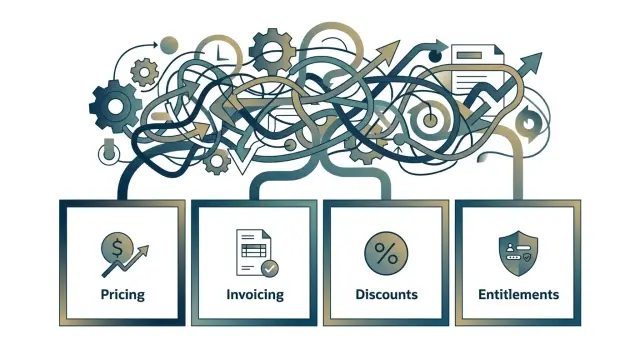
Table of Contents
Why billing grows into a mess
Billing usually breaks in a very ordinary way. A team adds one pricing rule, then lets that same rule decide what appears on an invoice and what the customer can use in the product. It feels efficient for a while. A few months later, one piece of business logic quietly controls money, paperwork, and access.
That is when billing rules start to drift. A discount for annual prepay turns into invoice text. Invoice status starts deciding whether a feature is locked. A coupon created for a sales campaign changes renewal behavior by accident. Nobody sets out to build a giant billing system. It grows from a series of small shortcuts.
After that, small product changes stop being small. Add a cheaper plan for smaller teams and suddenly someone has to update checkout pricing, tax handling, invoice labels, proration math, entitlement checks, upgrade paths, support replies, and reporting. One plan change touches too many places, so every release feels risky.
Support usually feels it first. A customer asks, "Why was I charged this amount if my plan changed last week?" If pricing rules, invoice rules, and access rules live in different corners of the code and depend on each other in odd ways, support cannot answer with confidence. They guess, escalate, or send the case to finance or engineering. That slows everyone down and makes a correct charge look suspicious.
Language makes it worse. Finance talks about credits, posted invoices, payment terms, and revenue timing. Product talks about upgrades, seat limits, grace periods, and trial access. Sales may call the same thing a special offer. Once those terms get mixed inside the same code path, people stop agreeing on what the system should do.
This is not mainly a scale problem. A five-person startup can create a billing mess just as easily as a larger company. The pattern is simple: one rule starts reaching into three jobs, then every new exception sticks to it. Billing stops being a set of clear decisions and becomes a pile of side effects.
Split billing into four jobs
Billing gets messy when one piece of code tries to answer every question at once. A cleaner model gives each rule one job, so a pricing change does not spill into invoices or product access.
A practical split starts with four simple questions:
- What is the list price, and what term does the plan use?
- Does this customer qualify for a discount?
- What bill should we send, and when is it due?
- What can the customer use right now?
If each question has its own home, the system stays much easier to change.
Pricing answers the first question. It defines the base amount, billing period, currency, trial terms, renewal rules, and plan structure. Think of pricing as the catalog. A Pro plan might cost $49 per month or $490 per year. That rule should exist even if nobody ever gets a discount.
Discounts answer the second question. They adjust the price only when a clear condition matches. That might be a launch coupon, a nonprofit rate, or 20% off for the first three months. Discount logic should not decide access, generate invoices, or rewrite plan terms. Its job is narrow: this price changes because this rule applies.
Invoicing handles the third question. It turns approved charges into actual bills with line items, taxes, issue dates, due dates, and payment status. It should not guess what a customer can use. It should record what the customer owes and when.
Entitlements answer the fourth question. They control access: seats, API limits, projects, storage, or premium features. A customer may have an unpaid invoice and still keep access during a grace period. Another customer may pay for a lower plan and lose a feature right away. That is why entitlements need their own model.
Why this split pays off
When teams keep these boundaries, change stays local. You can add a seasonal discount without touching invoice timing. You can change seat limits without editing tax logic. That is the real value of clean domain rules for billing.
Take a simple example. A customer moves from monthly to annual billing. Pricing picks the annual term. Discounts check whether any annual offer applies. Invoicing creates the new bill. Entitlements decide whether access changes immediately or on renewal. Four jobs, four answers, much less confusion.
Put each rule in one home
When one billing rule lives in two places, teams stop trusting the system. A plan change looks small, then someone finds backup price logic in the UI, coupon checks in access code, and billing dates buried in an invoice job.
The fix is ownership. For each rule, ask one question first: who makes the final decision? One part of the system owns that answer. The rest of the system uses the result and moves on.
A clean split usually looks like this:
- Pricing decides the base amount for a plan, seat, or usage.
- Discounts decide whether a coupon or promotion applies and how much it changes the amount.
- Invoicing decides when to bill, what period to include, and which line items to show.
- Entitlements decide what the customer can use, and for how long.
That boundary matters more than most teams expect. If you change invoice timing from the first day of the month to the customer signup date, price math should stay untouched. If marketing adds a 20% discount for three months, access rules should not change at all.
Entitlements need extra discipline because teams often stuff business exceptions into them. A coupon should not unlock premium features. A late invoice should not force pricing code to guess access. Entitlements should read clear facts such as plan name, term dates, payment state, and trial state. Then they should decide access from those facts.
The handoff between parts should stay boring. Pricing returns an amount. Discounts return an adjusted amount and a reason. Invoicing turns that into a document and due date. Entitlements read plan and billing state, then grant or remove access. No part should recompute another part's rule just because the data is nearby.
It helps to write this down in one short note for each rule. Name the owner, inputs, output, and storage location. Even a sentence like "Coupon validity belongs to discounts. Invoice code never checks campaign dates" can save hours of confusion later.
If a rule has two owners, it has no owner. That is usually where the billing monster starts.
Let the parts talk without merging
Good billing boundaries depend on clear handoffs. Each part should send the next part only the facts it needs, not its whole rulebook.
Pricing should decide the final charge amount. Invoicing should receive that amount, plus the tax result if tax is calculated elsewhere, and turn it into a bill. It should not rerun coupon logic or guess which plan rule changed the price.
Entitlements need even less. They usually do not care about line items, promo codes, or invoice numbers. They care about access dates and feature scope. If a customer is paid through May 31, send that paid-through date and the feature set it unlocks. That keeps pricing and invoicing separation real instead of cosmetic.
Use plain messages
Names matter more than most teams think. If your events are vague, people end up reading code just to understand basic billing behavior. Plain names reduce that pain and make system boundaries easier to keep.
A few examples work well:
price_calculateddiscount_appliedinvoice_createdpayment_capturedaccess_extended_until
Each message should say what happened, not what another service is supposed to infer. discount_applied is better than promotion_updated if the discount actually changed the charge.
Record the reason behind every discount. Support will need it later. "Spring sale" is useful. "Manual retention credit approved after late delivery" is even better. When a customer asks why one invoice was lower than the next, your team should find the answer in seconds.
Keep a readable history, not just a pile of raw events. A support person should be able to open one customer record and see a short timeline: price calculated, discount applied with reason, invoice issued, payment received, access extended until a date. That is far better than asking support to compare database rows across three tools.
A simple rule helps: every handoff should answer one question. Invoicing answers "what do we bill?" Entitlements answer "what can the customer use, and until when?" If a message tries to answer both, the split is already starting to collapse.
Build the split step by step
Do not rewrite your whole billing system at once. That is how a cleanup turns into a second mess. A safer path is deliberately boring: map the rules, sort them, move one family, test it, then repeat.
Start with a full rule inventory. Pull rules from code, admin panels, old specs, support notes, finance spreadsheets, and the heads of the people who keep the system alive. Billing logic often hides in odd places, especially in coupon settings, manual credits, and plan migration scripts.
A simple worksheet is enough. Write each rule on one line. Add one owner tag: pricing, discount, invoice, or entitlement. Mark where the rule lives today. Add one real example that shows the expected result. Then flag any rule that mixes money and access in the same decision.
That last flag matters. If a rule says "premium users pay less and get more seats," you probably have two rules glued together. One belongs to pricing or discount logic. The other belongs to entitlements.
After you sort the list, pick one rule family and move only that family. Discounts are often a good first move because teams can test them without rewriting invoice generation or account access. Leave everything else alone for the moment.
Before each move, lock down the common cases with tests. Use scenarios that support and finance already know: a new monthly signup, an annual renewal, an expired coupon, a mid-cycle upgrade, a failed payment, a manual credit. If the tests do not describe real customer situations, they will miss the bugs people actually notice.
Ask finance and support to review the edge cases before you call the move done. Engineers know where the code is fragile. Finance knows what has to match the books. Support knows which exceptions keep coming back. Put those three views together and changes stay smaller.
A realistic example: one plan change
A SaaS team decides to raise its Pro plan from $29 to $39 per month, starting on June 1. This is where a clean billing model pays off. The change sounds simple, but it can cause real damage if pricing, discounts, invoicing, and access control all live in one tangled block of logic.
Pricing handles only the price change. It stores that Pro costs $29 until May 31, then $39 from June 1. New signups after that date get the new amount. A customer who renews before June 1 still gets the old price because the new rate is not active yet.
Discounts stay in their own lane. Say some users have a coupon for 20% off that remains valid until August 31. That coupon should keep working until it expires, even after the base price changes. Pricing rules should not care about coupon expiry, and invoice logic should not decide whether a discount still applies.
Invoicing keeps the normal billing cycle. If a customer renews on the 14th of each month, the system should bill them on June 14, not on June 1 when the new price starts. If another customer already paid on May 28, they should not get a surprise extra charge in the middle of the month. Their next invoice should pick up the new price on their usual renewal date.
Entitlements stay tied to the paid period, not to the latest price table. If someone paid for Pro on May 28, they keep Pro access until June 28. The plan price can change in the background without cutting off access early or creating angry support tickets.
One customer timeline might look like this:
- May 28: pays $29 for Pro
- June 1: Pro price changes to $39
- June 14: another customer renews and pays $39
- June 28: the first customer renews at $39, with any still-valid coupon applied
That is one plan change, but each part does one job. The code stays calmer, finance gets clean invoices, and customers get predictable behavior.
Mistakes that create a billing monster
Billing turns ugly when one service tries to answer every money question at once. It sets the price, creates the invoice, charges the card, and decides who gets access. That feels fast at first. Then a simple price update breaks renewals, or a payment retry changes access by accident. One edit now touches sales, support, finance, and product logic in the same place.
Copied discount logic causes a quieter mess. A team adds a promotion in checkout, then pastes the same rule into invoice code, admin tools, and refund flows. A month later, two customers with the same deal get different totals, and nobody can tell which rule is the real one.
History gets damaged when old invoices pull data from the current plan. Teams often mean to change future pricing, but they end up editing the past. Finance needs the exact amount, tax, discount, and currency that applied on that date, not whatever the plan says today.
Plan names also fool people. "Pro" or "Growth" looks neat on a screen, but a name does not tell staff what the customer actually bought. They need fields that spell it out: billing period, seats, included features, usage limits, renewal date, and trial status. Without those fields, support starts guessing and engineers get dragged into routine questions.
Manual exceptions need a reason, not just a changed number. If someone waives a setup fee, extends access for seven days, or applies a one-time credit, the system should store who did it and why. Without that note, the next person cannot tell whether the change came from a contract promise, a support recovery, or a simple mistake.
A billing monster usually grows from these small shortcuts. If one change can alter tomorrow's quote and last month's invoice at the same time, the split is still wrong.
Quick checks before you ship a billing change
A billing change is ready when the team can explain it without a diagram and test it without guesswork. If a simple change still feels risky, the rules probably live in too many places.
One short review catches most problems early.
Start with ownership. Someone on the team should be able to point to the exact place where each rule lives. If nobody can say whether a promo belongs to pricing, invoicing, or access, the design is already drifting.
Then look at support. A support agent should be able to explain a charge in about a minute using plain language. If they need a developer to decode hidden credits, line items, or plan logic, customers will struggle too.
Check the scope of the change next. You should be able to adjust a discount without touching entitlements or access checks. A price rule and an access rule are different rules. If one edit changes both, you still have coupling.
Reruns matter more than teams expect. Generate the same invoice twice from the same inputs and compare the result. Totals, taxes, and line items should match exactly. If they do not, disputes, refunds, and month-end reporting get much harder.
Last, check the history. Your system should show what changed, when it changed, and who changed it. That does not require a giant audit product. A clean event log or a versioned record is often enough.
A quick checklist helps:
- Every rule has one clear owner.
- Support can explain the charge in plain English.
- Discount edits do not change customer access.
- Invoice reruns produce the same output.
- Change history is easy to read.
A small example makes this concrete. Say you add a 15% discount for annual prepaid customers. Pricing should calculate that discount. Invoicing should show it. Entitlements should stay the same unless the plan itself changes. If one promo edit changes who can use a feature, stop and fix the boundary first.
Teams that run lean do better with boring billing rules. Boring is good here. It means fewer surprises, faster support replies, and changes that stay small.
What to do next
Start with the rule that creates the most support tickets, refunds, or manual fixes. Maybe a discount works at checkout but disappears on renewal. Maybe a paid invoice unlocks access, but a draft invoice does too by mistake. Pick one painful rule, write down the event that triggers it, and name the part of the system that should own it.
A short glossary helps more than another big diagram. Keep it plain and shared. Pricing decides what something costs. Discounts change that cost under stated conditions. Invoices record what the customer owes. Entitlements decide what the customer can use.
When people use the same word in different ways, billing bugs multiply fast. A simple glossary gives product, engineering, support, and finance one language.
Then clean up the noisiest boundary before you plan any rewrite. If invoice code recalculates prices, stop that first. If access depends on invoice states that finance can edit by hand, separate those rules next. This kind of repair is not glamorous, but it usually cuts repeat work right away.
A useful sanity check has only two questions: can you change a price without editing invoice logic, and can you add a discount without touching access rules? If the answer is no, your billing boundaries still overlap.
Keep the first pass small. One rule, one owner, one boundary fix. That is enough to expose the real shape of the problem. Teams that try to clean up everything at once usually rebuild the same confusion with nicer code.
If the split still feels fuzzy, an outside review can help. Oleg Sotnikov at oleg.is works as a Fractional CTO and startup advisor, and this kind of boundary cleanup is often where an experienced second set of eyes saves time. The goal is not a grand billing rewrite. It is a system where pricing, discounts, invoices, and entitlements each do one job and stay out of each other's way.
Frequently Asked Questions
Why shouldn’t pricing and invoices share the same rules?
Because those rules answer different questions. Pricing decides what something costs, while invoicing records what the customer owes and when. If one rule does both jobs, a small price change can also alter invoice timing, tax handling, or renewal behavior.
What’s the difference between pricing and discounts?
Pricing sets the base amount, term, currency, and plan structure. Discounts change that amount only when a clear condition matches, like a coupon or a nonprofit rate. Keep them separate so a promo does not rewrite plan terms or access rules.
What are entitlements in a billing system?
Entitlements control what the customer can use right now. They cover things like seats, features, storage, or API limits, and they should read clear facts such as plan, paid-through date, and trial state instead of guessing from invoice details.
Should an unpaid invoice always lock the account?
No. Many teams keep access during a grace period, while others remove a feature right away for a downgrade. Put that decision in entitlements so finance rules do not accidentally control product access.
How do I start cleaning up a messy billing system?
Start with a rule inventory. Write down every billing rule you can find, tag each one as pricing, discount, invoice, or entitlement, and note where it lives today. Then move one rule family at a time and cover real customer cases with tests before you touch the next area.
What should support see when a customer asks about a charge?
Support needs a short, readable timeline. They should see the price, any discount and its reason, the invoice that went out, the payment result, and the date access runs through. That lets them explain a charge quickly without pulling in engineering.
How should a plan price increase work for existing customers?
Keep the price change in pricing and leave the rest alone. Existing customers keep the amount for the period they already paid for, and the new price applies on their normal renewal date unless a contract or discount says otherwise.
Where should coupon logic live?
Put coupon logic in the discount layer and nowhere else. Checkout, invoicing, and admin tools should use the same discount result instead of copying the rule, or you will end up with different totals for the same offer.
What mistakes create billing problems fast?
Teams run into trouble when one service sets the price, creates the invoice, retries payment, and decides access. Trouble also starts when they copy discount rules into several places or let old invoices pull data from today’s plan instead of the original record.
How can I tell if a billing change is safe to ship?
A change is usually safe when one owner controls each rule, support can explain the result in plain English, and the same invoice rerun gives the same output from the same inputs. You should also see a clear history that shows what changed, when it changed, and who changed it.


