Streamline delivery process with five clear owners
Learn how to streamline delivery process work by cutting approval loops, merging tools, and assigning one final owner to each workflow.
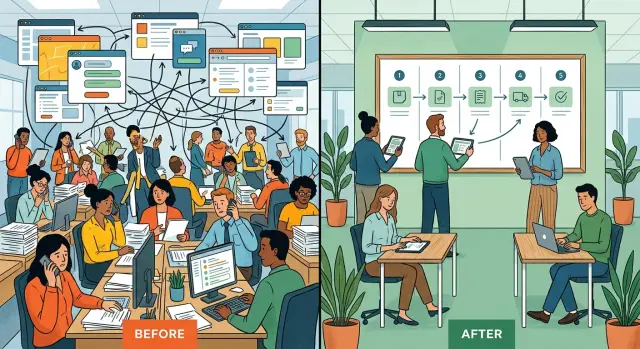
Table of Contents
Why 20 people slow one delivery flow
A delivery flow rarely drags because the work itself is hard. It drags because the work keeps changing hands.
Every handoff adds waiting. It creates another chat thread, another place to check, and another moment where someone says, "I thought they had it." Put 20 people around one flow and responsibility starts to blur. Plenty of people can comment. Plenty can block. Very few feel responsible for the final yes or no.
That usually starts with good intentions. One manager wants visibility. Another team wants a review. Finance wants a quick check. Support wants notice before release. Each request sounds reasonable on its own. Stack them together and one small task turns into a relay race.
Tool sprawl makes the problem worse. A simple product update can live in a ticket, a chat thread, a spreadsheet, a planning board, and an email chain all at once. People stop trusting any single place, so they check all of them. The work slows before anyone does the work.
Meetings fill the gaps. Instead of one owner making a call in ten minutes, five people join a status meeting to confirm the same detail. The meeting looks productive, but the decision still waits for someone else.
Take a small product change like updating a checkout button label. Product writes the request. Design reviews the wording. Marketing comments on tone. Engineering checks effort. QA asks about test cases. Support wants a note for users. Then a manager asks for one more approval. The change takes 15 minutes. The waiting takes a week.
Smaller owner groups move faster for a simple reason: they create fewer handoffs, fewer places to look, and fewer chances for work to stall between teams. Speed does not come from pressure. It comes from clear ownership and fewer decisions in the chain.
Find where work actually waits
Start with one real request, not an ideal process diagram. Pick something recent, like a small product change that touched design, engineering, QA, and release. Trace it from the first message to the moment users got it.
As you map it, write down every handoff. Note who received the request, who changed it, who approved it, who sent it back, and where it moved between chat, tickets, docs, and email. Teams often assume work slows during execution. In practice, it usually sits between people.
A simple timeline is enough:
- when the request entered the process
- who touched it next
- how long it waited before someone acted
- what question blocked it
- which tool held the latest version
That usually exposes the real delay. A team may spend two hours doing the work and four days waiting for someone to answer a small question, reopen a ticket, or confirm a detail that was already written down.
Be specific when you mark delays. Instead of "waiting for approval," write "waited 19 hours for product sign-off" or "sat for two days because engineering and QA asked for the same acceptance detail in different tools."
That level of detail matters. When people ask the same question twice, the process has a gap. Maybe the request started with missing information. Maybe two teams use different templates. Maybe nobody knows who gives the final answer, so each team checks again to protect itself.
If you want to speed up delivery, measure wait time, not just work time. A short task with three approval loops is slower than a larger task with one clear owner. The map should make that plain.
You do not need special software for this. A shared doc or spreadsheet works for the first pass. Once you can point to three or four exact wait states with timestamps, the conversation changes. People stop arguing about impressions and start fixing the places where work actually stalls.
Cut approvals that add no real decision
Most approval chains grow from habit, not risk. One person checks the work, then two more people repeat the same review because that is how the team has always done it. It feels safe. It usually just adds delay.
Separate real control points from comfort checks. A real control point changes the outcome. If security can block a release because customer data is involved, keep that review. If a manager reads the same summary the tech lead already approved, remove that sign-off.
A simple test helps. Ask four direct questions. Can this person say no for a clear reason? Will they see something earlier reviewers could not see? Does their decision change cost, risk, or customer impact? If they are out for a week, does work stop for no good reason? If most answers are no, the approval is probably an echo.
Repeated reviews often hide in small steps. Product approves the request, delivery approves the same scope, and operations approves the same timing. A better approach is to collect comments in one place, early, before one named owner makes the call. People still give input. They stop taking turns pretending to decide.
Keep a clock on the approvals you keep
Every approval that stays needs a deadline. Without one, the queue fills up again. For low-risk work, give reviewers 24 hours. For larger changes, maybe 48. If they miss the window, the owner moves forward unless a defined risk rule says otherwise.
That rule matters. Silence should not block routine work.
A product change request shows how this should work. QA can comment on test impact. Security can comment on data exposure. Support can flag customer timing. After that, one owner, usually the product lead or engineering lead, makes the final call. Three teams gave input. One person decided.
This is one of the fastest ways to speed up delivery without hiring more people. Fewer approvals do not mean less control. They mean each review has a reason, a deadline, and a person who owns the final answer.
Consolidate tools by job
Most delivery teams do not have a people problem. They have three task boards, two chat threads, and a spreadsheet nobody fully trusts.
When work lives in too many places, people stop deciding and start hunting for updates. That search tax piles up every day.
Start with a plain inventory. Write down every tool the workflow touches, including the small ones people "just use for now." Include project boards, chat apps, docs, spreadsheets, forms, design files, and shared inboxes.
Then make each tool justify its place. A simple setup works better than a clever one: one place for tasks, one place for discussion, and one place for docs. If a tool does not own a clear job, remove it.
The test is simple. Where does new work start? Where do people discuss it? Where does the final decision or spec live? Where does the team check current status? If two tools answer the same question, pick one and close the other.
Duplicate boards cause more damage than most teams expect. Side spreadsheets are worse, because they often turn into private control panels that only one person updates.
Status needs one home. Pick the place the whole team already uses to track delivery and make that the source of truth. Chat can explain why something changed, but chat should not hold official status. Docs can describe the work, but docs should not replace the task board.
A small example makes this obvious. A product change request starts in a form, gets copied into a spreadsheet, then moved into a project board while updates happen in chat. That is four handoffs before anyone ships anything. A cleaner version creates a task once, keeps discussion in one thread, and stores the approved scope in one doc attached to that task.
Name one final owner for each workflow
If three people can approve a release, nobody owns the release. Work slows because people wait for cover, not because the work is hard.
Give each recurring workflow one person who makes the final call and carries the outcome. Keep the scope tight enough to use. "Own delivery" is too broad. "Own production releases for customer-facing web changes" works. "Own bug priority for live incidents" works.
A few rules keep this clean:
- Give each workflow one final owner.
- Name one backup for holidays or sick days.
- Write down the owner's limits on spend, risk, and timing.
- List the few cases where the owner must ask for input.
That last point matters. Owners should not ask everyone, every time. They should ask only when a decision crosses a known line, such as a security change, a legal promise to a customer, or a cost jump above an agreed amount. Outside those cases, the owner decides and moves.
Make decisions visible in one shared place. A short log is enough: date, workflow, owner, decision, short reason, and next step. That keeps people informed without dragging them into another meeting. It also stops old approval loops from sneaking back in through chat threads and side calls.
One release owner, one incident owner, one roadmap owner, one budget owner, and one customer escalation owner can cover far more than most teams expect. Small teams usually do this better because the lines stay sharp. Bigger teams need the same rule, just written down with more care.
When a release slips, nobody should have to ask, "Who had the final call?" The team should know the answer in ten seconds.
How to move from 20 people to five owners
Do not redesign everything at once. Pick the five workflows that create most of the delay, cost, or risk. Focus on the work that repeats every week and touches customers or revenue.
For many teams, that set looks something like incoming requests, scope and priority changes, development handoff, release approval, and production incidents.
Once you have the workflows, stop grouping people by department. Group them by decision type. One person decides priority. Another decides technical approach. Another decides release timing. That cuts the usual mess where three managers join because they sit in different boxes on the org chart.
For each workflow, name one owner who makes the final call. Then name one backup who can step in without asking for permission. Keep the review circle small, usually two or three people, and make their role clear. They give input quickly. They do not become extra approvers.
Write down what each owner can decide alone. If the release owner can ship low-risk fixes without a committee, say that plainly. If the scope owner can reject late feature requests, put that in writing too. Clear limits stop old habits from slipping back in.
Run the new setup for two weeks. That is long enough to catch friction and short enough that people will actually try it. Track a few simple signals: how many handoffs happened, how long work sat waiting, and how often someone asked for approval from the old group.
After the test, clean up the system around it. Remove old approval steps from process docs, project boards, forms, templates, and chat routines. If an outdated checklist still asks for six sign-offs, people will follow it. Teams keep bad process alive through old paperwork more often than through active choice.
A simple example from a product change request
A sales rep asks for one change: add a CSV export to monthly reports because a prospect says manual copying is too slow. In many teams, that request bounces through sales, account management, product, design, engineering, security, QA, release, support, and back again. Nobody owns the full path, so the request sits in inboxes.
A cleaner flow starts with one intake form. The salesperson fills in the customer problem, the expected value, and the deadline. The request goes into one queue. No side chats, no duplicate tickets, no separate email thread.
The product owner makes the first real call. They decide whether the request fits the roadmap, whether it solves a wider customer problem, and whether it should move now, later, or not at all. If the answer is no, the process stops there.
If the answer is yes, the engineering owner checks effort and risk. They do not ask three other managers for permission. They give a rough size, point out any data or security concern, and say whether the team can ship it safely in the current cycle.
After that, the operations owner picks the release window. They look at planned deployments, customer traffic, and support load, then choose the safest time to ship. That avoids the common mess where product says "ready," engineering says "done," and operations still has no slot.
The customer lead closes the loop. One clear message goes back to sales and the customer: approved or declined, what happens next, and when to expect the next update. The team does not send five slightly different answers.
This flow cuts waiting more than it cuts work. One person submits the request, four people make decisions, and everyone else stays informed instead of becoming another approval step.
Mistakes that bring the loops back
Most process cleanups fail for a boring reason: the chart changes, but daily habits do not. A team removes steps on paper, then quietly keeps the same approval loops, the same side tools, and the same meetings.
One common mistake is leaving every manager in the path "just for visibility." Visibility is fine. Approval is different. If a product change still waits for three leads, a director, and someone from operations, the delay is still there. It just has a new name.
Another mistake is keeping old tools open in case the new flow misses something. That sounds safe, but it creates double work. People update the project tool, then copy the same note into chat, email, and a spreadsheet because one person still trusts the old system more. After two weeks, nobody knows which version is real.
Naming a team instead of one person creates the same mess. "Engineering owns it" is not ownership. It is shared responsibility with no final decision maker. When a deadline slips or two people disagree, the work stalls because nobody has the last word.
Many teams also change the flow but keep the same meetings. The weekly review call survives out of habit, even when the new workflow already gives the owner enough context to decide. The meeting becomes a shadow approval step. People wait for Thursday instead of moving work on Tuesday.
A few warning signs catch most of this. Work still pauses for someone who is not the owner. Two tools show different status for the same task. A team name appears where one person should be listed. A recurring meeting decides work that the workflow should handle. Nobody can say whether cycle time got shorter.
That last point matters more than teams admit. If nobody checks cycle time after the change, the loops come back quietly. A request that used to take 14 days might drop to 10 for a month, then drift back to 13 because extra reviews return one by one.
Quick checks before you lock the new process
If the process works only when the usual people are online, it is not ready. A lean setup should be easy to explain, easy to follow, and easy to inspect when something stalls.
Start with the simplest test. Ask the newest person on the team who owns a product change, a bug fix, a release, or an urgent customer issue. If they hesitate, the ownership map is still too fuzzy. People should know who decides, who gives input, and who only needs an update.
Then pick three real requests from the last week. Each one should live in one place only, with one status that everyone trusts. If work jumps between chat, email, a ticket board, and a spreadsheet, the team will waste time just trying to find the truth.
A routine decision should not need a meeting. If a small UI change affects no budget, no deadline, and no security rule, the named owner should be able to approve it in the ticket and move on. Meetings are fine for exceptions. They should not be the default for normal work.
Owners also need clear rules for when they pull others in. A product owner might ask engineering about effort, legal about policy risk, or support about customer impact. That is input, not shared ownership. One person still closes the loop.
A short weekly check helps catch drift. Ask one teammate to name the owner for each common flow. Open a live request and confirm it has one home and one current status. Check whether a routine request finished without a meeting. Review one case where the owner asked for input and see if the handoff was clear. Then sort active work by age and inspect anything waiting more than 24 hours.
Delays hide in silence. If you can spot work that sat for a day, you can fix the gap before approval loops creep back in.
What to do next
Do not start with a reorg. Pick one workflow this week, preferably the one that creates the most waiting between request and release. A product change request is a good place to begin because delays are easy to spot.
Make two small cuts first. Remove one approval that only repeats a decision someone already made. Then remove one tool that people use only to copy the same update from one place to another.
Write the rules on one short page so nobody has to guess who decides what. Keep them plain: one named owner gives the final decision for each step, one tool holds the current status, one backup owner steps in only when the main owner is away, and any new approval needs a written reason plus a review date.
Let the new process run for two weeks. Measure the basics: how long work waits, how many handoffs happen, and how often people ask, "Who owns this?" If wait time drops and fewer people touch the work, keep the change. If not, fix the rule or the owner name instead of rewriting the whole process.
This works better when you stay narrow. Teams usually fail when they try to clean up every workflow at once, then old approval loops creep back in. One clean win is enough to prove the pattern.
If the process crosses several teams and nobody agrees on owners, outside help can save a lot of time. Oleg Sotnikov, through oleg.is, works with startups and smaller companies as a Fractional CTO and advisor, including this kind of ownership and process cleanup. A fresh view helps when the team is too close to its own habits.
Once the first workflow is stable, repeat the same method on the next one. Small cuts, made on purpose, usually beat a big process rewrite.
Frequently Asked Questions
Why does a small product change take a week?
Because the work keeps changing hands. A 15-minute task can sit for days while people wait for replies, reviews, or a final yes from someone nobody named clearly. The fix is usually fewer handoffs, fewer tools, and one person who can decide.
How do I find where work actually slows down?
Start with one recent request and trace it from the first message to release. Write down who touched it, where it moved, what blocked it, and how long it sat between steps. You will usually find that waiting time beats work time by a wide margin.
Which approvals should I remove first?
Cut the approvals that repeat the same review. Keep the ones where someone can truly stop the work for a clear reason, such as security, legal risk, or real customer impact. If a reviewer adds no new judgment, remove that step.
How many tools should one delivery flow use?
Keep it tight: one place for tasks, one place for discussion, and one place for docs. When two tools answer the same question, pick one and shut the other down. People move faster when they trust one source of truth.
Who should make the final decision in a workflow?
Give each workflow one named owner, not a team name. That person makes the final call, asks for input only when a known risk line gets crossed, and has one backup for time off. If three people can approve, nobody owns it.
What should I shrink first if I want faster delivery?
Pick the workflows that repeat every week and touch customers, revenue, or production risk. Incoming requests, priority changes, releases, and live incidents usually sit near the top. Do not start with rare edge cases.
What should I measure during a two-week process test?
Track how long work waits, how many handoffs happen, and how often people ask for approval from the old group. Also watch how often someone asks, "Who owns this?" If those numbers drop, the new flow works.
Do routine changes need a meeting?
No. A routine change should move inside the normal workflow with the owner deciding in the task itself. Pull people into a meeting only when the change affects spend, deadlines, security, or a customer promise.
What usually brings approval loops back?
Teams often leave old managers in the path for "visibility," keep old tools alive as backup, or name a department instead of one person. Old meetings also creep back in and turn into shadow approvals. If status lives in two places, delays will return.
When should I ask for outside help?
Bring in outside help when the process crosses several teams, nobody agrees on owners, or the same request keeps stalling in different places. A fresh review can cut through habits faster than another internal debate. If you want hands-on CTO advice for this kind of cleanup, Oleg Sotnikov does that work with startups and smaller companies.


