Customer-specific requests: when to build, route, or say no
Customer-specific requests can drain product teams fast. Learn how to sort one-off asks into product rules, workflows, or a clear no.
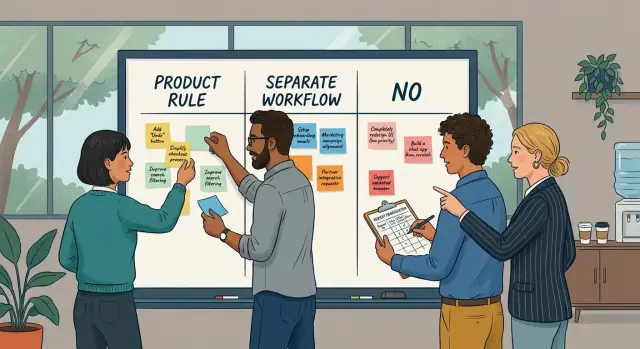
Table of Contents
Why custom requests pile up fast
Custom requests rarely arrive looking dangerous. They show up as small, reasonable asks.
One customer wants a different approval step. Another wants a special export. A third asks for one extra permission rule. Each request looks minor on its own, so the team ships it. Then sales hears, "Can you do that for us too?" and the bar quietly moves from "we do not do this" to "we already did it once."
That is how custom work spreads. Every exception makes the next one easier to approve.
AI makes this feel cheaper than it is. A coding assistant can draft a change in an afternoon, so the work looks almost free. The draft is the cheap part. The real cost starts after launch, when the team has to test odd cases, explain the behavior to support, update docs, and keep the change alive through future releases.
A simple B2B example makes the pattern obvious. One customer asks for a CSV export with extra columns. Engineering ships it quickly. Soon another customer wants the same export, but with different column names, date rules, and access limits. Support now has to remember who gets which format. QA gets more cases to test. A later reporting change breaks one export but not the others. The code may take a day. The ownership can last for years.
The hidden cost usually lands in the same places:
- support answers get longer and harder to teach
- test cases multiply with every exception
- product behavior gets harder to explain
- future changes slow down because old custom logic needs protection
Most roadmap damage does not come from one big bet. It comes from a pile of small exceptions that slowly become part of the product.
Build a rule, route a workflow, or say no
When customer-specific requests come in, do not treat every ask as proof that the product is missing a feature. The same request can point to three very different decisions.
Sometimes the right move is to turn the request into a product rule. That works when many customers are likely to need the same behavior and the rule is easy to explain in one sentence. "If a payment fails three times, pause the account and alert the owner" is clear. It is easy to test, easy to support, and easy to keep.
Other times the better answer is a separate workflow. This fits cases where the result matters more than the exact path. Maybe one group needs extra review, approvals, or an AI check, while most users do not. In that case, an internal process, a simple automation, or an ops step can solve the problem without changing the core product for everyone.
And sometimes the answer is simply no. Some requests sound small but create lasting cost in billing, permissions, reporting, and support. If a change only helps one account, adds risk, or gives your team a permanent manual job, it is usually a bad trade.
A few signals make feature request triage much easier. Repeat demand matters most. If several customers ask for the same thing in the same quarter, you may have found a real product rule. Risk matters next. If a bad outcome could expose data, break numbers, or block revenue, use a controlled workflow or reject the request. Then look at support load. If support already needs a playbook, manual fixes, and weekly exceptions, the request is costing you even before you build anything.
A simple test helps: can you explain the behavior in plain language, and will it still make sense six months from now? If yes, make a rule. If not, keep it in a workflow or leave it out.
Use a simple triage process
Most teams answer requests too early. Someone important asks for a special case, sales feels pressure, and the team starts talking about a build before anyone checks whether the problem is real. It helps to slow the first response down by ten minutes.
Start by forcing the request into one sentence. If nobody can write it clearly, nobody can build it cleanly. "Acme needs exports" is vague. "Acme needs a scheduled CSV export to S3 every Monday because finance copies data by hand" gives the team something concrete to judge.
Then check demand and pain, not just volume. Who asked for it? One large customer, three smaller accounts, or a prospect that has not signed yet? How often does the same request appear? What breaks today if you do nothing? You are looking for lost deals, repeated manual work, support tickets, or real operational pain. Preference alone is not enough.
A short scorecard keeps the conversation honest. Note who asked, how often the request comes up, what pain exists today, and how many teams the change will touch. Then estimate cost in two parts. Setup cost includes design, build time, testing, rollout, and docs. Ongoing cost includes support, monitoring, training, and every odd case the team will own later. That second number matters more than most teams think.
Edge cases deserve their own line. A small request can spread far beyond the first screen where it appears. A custom approval rule for one account might also affect permissions, audit logs, billing, and support scripts.
After that, pick one path and write down why. The reason should fit in one sentence. For example: "Approved as a separate workflow because four customers asked for it and it removes six hours of manual work each week."
That note saves time later. Without it, the same customer-specific requests come back every quarter and the same argument starts again.
If the answer is not final, set a review date. Thirty or sixty days is enough in most cases. That turns "not now" into a real decision instead of a soft maybe.
Questions to ask before you change the product
Small exceptions look harmless one by one. In a batch, they make the product uneven and hard to explain.
Before anyone opens a ticket, ask a few plain questions. Is this a shared problem or just one account's habit? If the request solves pain that shows up across customers, it may deserve product work. If it only matches one team's internal process, be careful.
Will a new customer understand the behavior without a long sales call? Good product changes make sense on their own. If every rep explains the same feature differently, you probably do not have a clean product rule.
Can the team handle the issue outside the product? A manual review step, an internal playbook, or a light workflow often solves the problem faster than code. This is especially true in companies using a lot of AI, where it is easy to add another prompt, route, or automation and call the issue solved, even when the team has really just created more hidden logic.
What permanent weight does this add? New fields, conditions, permission branches, and exceptions rarely stay small. They change onboarding, support docs, testing, and future releases.
Then ask one more question: what happens when five more customers want their own version? That usually exposes the real cost. One exception often becomes a category.
A quick example makes the difference clear. If a customer asks for a special approval step before data moves forward, you might build a generic approval option if the pattern fits many teams. But if it depends on one company's job titles, naming rules, and internal edge cases, ops can usually handle it better through a defined process.
That option may feel less elegant than a feature. It is often the smarter choice.
A realistic B2B example
A growing B2B product often gets requests that sound harmless. A customer says, "We need a special approval chain." Most purchases follow the normal flow, but deals above a certain amount must go to finance, and one business unit wants legal review before anything moves.
The product-rule option looks tempting. The team adds a few conditions, one admin toggle, and another notification. Sales keeps the account happy, and the customer renews.
The mess starts later. Another customer wants a different threshold. A third wants approval order to change by region. Support now has to explain why one request skipped finance, why another got stuck in legal, and why editing a draft restarted the whole chain. What looked like one rule turns into settings, exceptions, audit logs, test cases, and support debt.
A separate workflow is often the better middle path. Keep the core approval flow inside the product, then handle rare cases through custom workflow design outside the main path. An order that matches the special case can trigger a task for ops or send a structured message to a review queue before final approval.
That is less polished than a fully built feature, but it is easier to control. One person owns the extra step. The team can measure volume, delays, and error rates. If the same pattern appears across several customers later, you have real evidence for a broader feature.
Sometimes the answer is still no. If only one contract needs the extra chain and the request does not match where the product is going, a permanent product change is the wrong move. A documented service step or outside process is often enough.
Teams that handle this well pick the cheapest option that solves the real problem today, then wait for proof before turning an exception into product logic.
Common mistakes that bend the roadmap
The roadmap usually does not break in one dramatic moment. It drifts.
One special case gets shipped for a noisy customer. Another gets tucked into a prompt or small script. Then sales promises a third before product and ops have even talked. A few months later, the team is maintaining work it never meant to own.
One common mistake is building for the loudest customer instead of the common case. Large accounts matter, but repeated demand matters more. If one buyer needs a strange approval step and most customers do not, that is usually a workflow problem, not a product problem.
Another mistake is treating AI-generated code like free work. It is faster to produce, but it still needs review, tests, monitoring, and support. Teams say yes because the first version appears in an hour. The real cost shows up later when that code breaks after a model change, a schema update, or a new edge case.
Ownership also disappears too often after launch. Engineering wrote the custom flow. Support knows how to trigger it. Sales remembers why it exists. But nobody owns the result. When the customer asks for a change, the request turns into a scavenger hunt.
Hidden logic causes even more trouble. Teams keep special rules inside prompts, tiny scripts, or support notes because the work feels temporary. Temporary work lasts longer than people expect. If customer-specific requests live in five different places, nobody can see the real product roadmap decisions the company is making.
Promising delivery too early is another bad habit. Sales says yes to close the deal. Product assumes ops can handle it. Ops assumes engineering will automate it. Then the team learns the request needs manual checks every week.
One useful test is simple: if a request needs ongoing care, name the owner before you ship it. If nobody wants that job, pause or say no.
An outside operator can help when the team keeps looping through the same argument. Oleg Sotnikov at oleg.is works with startups and smaller companies as a fractional CTO, and this kind of decision is exactly where an outside view helps. The job is not to approve more features. It is to decide, clearly, whether the request belongs in the product, in an operational workflow, or nowhere.
Keep sales, product, and ops aligned
Teams drift apart when each group uses a different test for the same request. Sales sees a deal that could close this quarter. Product sees another branch in the app. Ops sees one more thing to support at 2 a.m. If nobody owns the final call, the loudest voice usually wins.
Pick one owner for exceptions and custom work. In a small company, that may be the product lead, the founder, or a fractional CTO. Everyone else gives input, but one person makes the call and writes down why.
Sales also needs plain language it can use with customers. Keep the options simple. Either the request fits the product you are building, it does not fit now and needs more proof, or it will not become product behavior and must be solved another way. That sounds basic, but it prevents a lot of damage.
Keep a visible log of every exception. A shared doc or board is enough if people actually use it. Each entry should say who asked for it, who approved it, what it costs to maintain, and what condition would justify removing it later. If nobody can explain why an exception still exists, it probably should not stay.
Use the same scorecard every time. Ask how many customers are likely to use the change within the next year, whether it will help sales more than once, what support or ops load it adds each month, whether a workflow can solve the same need, and what planned work slips if you say yes.
Then review that log every month. Remove dead custom logic. Retire old paths. Check whether repeated exceptions now deserve a proper rule. This habit matters even more in teams moving fast with AI, because experiments pile up quickly when nobody closes them down.
What to do next
Start with the requests already sitting in your backlog. Pick the ten that come up most often, or the ten that create the most internal debate, and sort each one into a clear bucket: build it into the product, handle it through a separate workflow, or decline it.
That exercise clears a surprising amount of fog. Teams often argue for weeks because they mix three different kinds of work and treat them as one problem.
Do the review with product, sales, and ops in the same room. Give every request one owner and one decision. Remove stale exceptions that no customer uses now, even if they once felt urgent. Write down the reason for every "no" so the team does not reopen the same debate next month.
Then write a short policy for custom work before the next big deal lands. One page is enough. It should say who can approve custom work, how long an exception can stay live, when a workflow is better than a product change, and what evidence the team needs before adding a new rule.
This matters even more in companies leaning hard on AI. It is very easy to say, "We can automate that" and move too fast. Automation can remove manual work, but it also makes it easier to pile on special cases that nobody cleans up later. A fast experiment is fine. A permanent exception needs a higher bar.
If customer-specific requests keep bending your roadmap, a short reset from someone outside the daily pressure can help. Oleg Sotnikov does this work with startups and smaller companies that need cleaner product decisions without hiring a full time CTO.
The next step is simple: sort the ten requests, delete two stale exceptions, and publish the policy before the next sales call forces the issue again.
Frequently Asked Questions
When should we turn a customer request into a product feature?
Build it when several customers ask for the same thing and you can explain the behavior in one plain sentence. If the rule stays easy to test, support, and keep over time, it likely belongs in the product.
When is a separate workflow better than a feature?
Choose a workflow when the outcome matters more than the exact product behavior. Extra reviews, approvals, or manual checks often fit better in ops or automation than in the main app.
When should we just say no to a custom request?
Say no when one account gets all the value and your team gets ongoing work in return. Billing, permissions, reporting, and support costs pile up fast from requests that look small at first.
Does AI-generated code make custom work cheap enough to approve?
No. AI makes the first draft faster, but the draft is only the start. Your team still has to test edge cases, explain the change, update docs, and keep it working after future releases.
What is a simple way to triage custom requests?
Start by forcing the request into one clear sentence. Then check who asked, how often it comes up, what pain exists today, which teams it touches, and what ongoing work it creates after launch.
What evidence should we look for before we build anything?
Look for repeated demand in a short time, not just one loud customer. Real pain also matters, such as lost deals, repeated manual work, support tickets, or blocked revenue.
Who should own decisions about exceptions and custom work?
One owner should make the final call and write down the reason. In a small company, that person is often the founder, product lead, or a fractional CTO.
How long should we keep a request in the maybe pile?
Set a review date when you are not ready to give a final answer. Thirty or sixty days works well because it turns a soft maybe into a real decision with a deadline.
How do we stop exceptions from piling up quietly?
A shared log or board works if the team keeps it current. Write down who asked, who approved it, what it costs to keep, and what would justify removing it later.
What should we do first if custom work already bends the roadmap?
Begin with the requests already sitting in your backlog. Sort the top ten into three buckets: build, workflow, or decline. Then remove stale exceptions and publish a short policy before the next sales push.


