Custom enterprise branches: the quiet cost for teams
Custom enterprise branches raise support work, slow fixes, and pull product teams into one-off promises that keep costing after the deal closes.
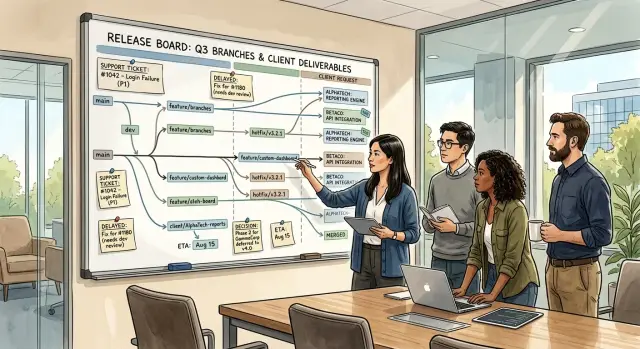
Table of Contents
What a custom branch really means
A custom branch is a separate version of your product that only one client gets. Teams often describe it as a small exception, but it rarely stays small. The moment you accept a special workflow, a different permission model, or a private integration, you create a second code path that someone has to maintain.
That changes more than the code. Product decisions split in two. QA tests the standard product and the client-specific version. Support has to remember which behavior belongs to which customer. Engineers stop asking, "Should we build this for everyone?" and start asking, "Will this break the enterprise branch?"
The shift can happen fast. A large customer asks for a different approval flow, custom SSO logic, or a report that works in a special way. The team wants the deal, so it puts the change in a branch instead of reshaping the main product. That feels tidy at first. Later, every fix, release, and refactor has one more place where things can fail.
That is why these branches keep raising costs long after the contract is signed. The branch does not disappear when the sales call ends. It stays around for renewals, audits, onboarding, bug reports, and the next "just one more change" request. Months later, the customer may use only a small part of it, but the team still carries the full maintenance cost.
The hidden work shows up in normal moments. A security patch lands in the main product, and now someone has to merge it into the branch and test both versions. A new feature ships, and the team checks whether the custom logic blocks it. A support ticket comes in, and the first step is not fixing the issue. The first step is figuring out which version the customer runs.
That is why a private branch is rarely a one-time favor. It turns one product into two, even if only one customer asked for it. Every release after that carries extra review, extra testing, extra support work, and one more reason for the roadmap to bend around an old deal.
Why teams say yes
Most teams do not plan to create a separate branch for an enterprise customer. They agree under pressure. A large buyer shows up with budget, a deadline, and a list of requests the current product does not cover.
Sales wants the contract signed this quarter. The founder wants the revenue and the credibility that comes with a well-known customer. Product can see the mismatch, but saying no feels expensive when one deal could cover months of payroll.
Roadmap gaps make the fork look smaller than it is. The customer asks for a special approval step, a custom permission rule, or a report that matches their internal workflow. None of that sounds huge on its own. The team says, "We will build it in a separate branch, close the deal, and clean it up later."
That promise is easy to make in the last week of a sales cycle. It is much harder to keep after the contract closes. The same engineers who rushed the branch now have to ship the main product, fix bugs, answer support, and deal with the next enterprise prospect with a different set of demands.
Fear drives the decision as much as optimism. If the buyer is a recognizable brand, people picture the missed revenue, the missed press mention, and the missed chance to use that customer name in future sales calls. A fork starts to look cheaper, even when everyone in the room knows it creates extra work.
The time horizon tricks teams too. The close feels immediate. The upkeep feels far away. A custom branch might help win a deal in 30 days, but the team can carry that code for three years. Every change needs more testing. Every release raises the same question: does this still work for that customer?
Early-stage teams are especially exposed. They do not yet have a complete product for every enterprise request, and they do not want to lose momentum while a larger competitor says yes. So they make a deal-by-deal choice instead of a product choice.
That is why these branches keep appearing. They rarely come from a clear product strategy. They usually come from a tense moment when short-term revenue feels real and long-term maintenance still feels abstract.
Where the extra work shows up
When one customer gets a separate branch, the team ends up doing the same job twice in the parts of the company that already move slowly. The extra work does not usually start in product design. It shows up later, in testing, releases, support, and urgent fixes.
Testing is often the first pain point. A feature that worked in the main product now needs checks in the enterprise branch too, even if the change looked small. One login update, one billing fix, or one new permission rule can create two test paths instead of one.
The repeat work spreads quickly. QA checks the same behavior in both code lines. Release engineers prepare separate builds and notes. Support learns which customer has which version. Product managers track exceptions that do not apply to everyone. Engineers keep patching old logic that nobody wants to extend.
Releases get heavier for the same reason. A normal update should be one decision: ship or wait. With a fork, each release becomes a small negotiation. The team asks whether the change belongs in both versions, whether it breaks the custom behavior, and whether one customer needs a special rollout.
Support load rises in a quieter way. A bug report that sounds simple now starts with extra questions. Which branch is the customer on? Do they use the custom workflow? Did the issue start after the last main release or only in the fork? That back and forth burns time before anyone even opens the code.
Documentation splits too. One setup guide becomes two. One admin manual needs extra notes, screenshots, and warnings. New hires take longer to ramp up because they have to learn both the current product and the older special-case logic sitting beside it.
Urgent fixes cost more than teams expect. If a security issue or production bug appears, engineers cannot patch once and move on. They have to check both code paths and make sure the fix did not wake up an old edge case in the custom version.
That last part matters. Keeping engineers tied to old logic does not just raise maintenance cost. It steals attention from better work, like improving the main product, reducing incidents, or shipping requests that help more than one customer.
A simple example after one enterprise deal
One enterprise customer asks for a special approval flow. Their finance team wants every large order to pass through two extra checks before anyone can mark it as paid.
The request sounds small. Sales wants the deal closed this quarter, the customer says the flow is a hard requirement, and engineering says it can ship fast if it stays in a private branch.
So the team says yes.
It adds a few new states, changes who can approve what, and keeps those changes out of the main product. The customer signs. Everyone moves on.
Six months later, a bug shows up in billing. Under one condition, an order can skip a status update and send the wrong notification. The bug exists in both versions, but the fix is no longer the same.
In the main product, the patch takes an afternoon. In the private branch, the custom approval flow changed the order logic, so the same patch breaks one of the customer's internal checks. Now support needs two issue notes, QA needs two test passes, and engineering has to read code nobody has touched in months.
That is when the real cost shows up. The sale is closed, but the branch still asks for attention every time a shared part of the product changes.
The product manager now has two promises in front of them. One promise went to the enterprise customer: keep their custom flow working and fix issues fast. The other went to the rest of the customer base: ship the new reporting update by the end of the month.
They cannot do both with the same team that week.
If they patch the branch first, the wider release slips. If they ship the wider release first, the enterprise customer waits and account management gets dragged into the problem. Nobody set out to create that conflict. The branch created it.
The code is only half the problem. The real drag comes from split priorities, repeated testing, and decisions that stay alive long after the contract lands.
How forks slow fixes and releases
A fork turns one bug into several jobs. The team finds the issue once, but then someone has to patch the main product, patch the enterprise branch, and check whether older branch rules break the fix. If three customers each have their own version, one defect can turn into four releases instead of one.
That extra work looks manageable on paper. In practice, it steals time from every release after that. Engineers stop thinking about the cleanest fix and start asking a different question: "Which version are we fixing, and what might this break in the others?"
Merge conflicts make this worse. A change that fits the main codebase may not fit a branch with custom login rules, special reports, or a different data model. Developers then spend hours pulling code apart, moving pieces by hand, and checking behavior line by line. It is slow work, and it is easy to miss a detail.
QA gets hit next. Testers cannot approve one fix and move on. They have to run the same checks across each branch, often with slightly different setup steps and expected results. A release that should take one afternoon can stretch into several days because the same test cycle repeats.
This is also where surprise regressions appear. A patch that fixes the original bug in the standard product can reopen an older issue in a custom branch. Sometimes the opposite happens: the branch passes, but the main product breaks because a branch-specific workaround leaked back during a merge. Release dates slip not because the bug was hard, but because the product now has too many versions of the truth.
Support feels the delay right away. When a customer reports a problem, support cannot give a clear answer until engineering confirms which branch the customer uses, whether the fix already exists somewhere else, and when that branch will get its own patch. What should be a simple update becomes a long thread of "we're checking."
That is the quiet cost of these branches. They do not just add code. They add waiting, repeated testing, slower answers, and release plans that move every time one special version falls behind.
A safer way to handle enterprise requests
Most enterprise asks are not bad ideas. Trouble starts when a team treats every large deal as a reason to change the product.
Start with product direction. Ask whether the request helps the kind of customer you want more of, not just the customer in front of you today. If it solves a common problem, build it into the main product. If it exists only because one buyer has an unusual internal rule, keep it out of the core code.
Before anyone writes new logic, look for a simpler shape. Many requests that sound like new features are really settings, permissions, approval steps, or templates. A company that wants a second sign-off before data export may not need separate code at all. A configurable review step or a role-based workflow can solve it once and keep releases on one path.
Teams also need a written rule for what belongs in the shared product and what stays custom. Security improvements, audit logs, and admin controls often make sense for everyone. A strange report format for one procurement process usually does not.
A short checklist helps:
- Who else will use this within the next year?
- Can settings, roles, or workflow rules solve it?
- Who owns support after the sales process ends?
- What will it cost to maintain through the next few releases?
If you still make an exception, treat it like one. Price it separately. Put a time limit on the commitment. Write down how long you will maintain it, who approves later changes, and what happens when the main product changes.
Then review the request again after the first renewal. If the customer still uses it heavily and similar requests keep showing up, move the idea into the core product and remove the special case. If usage is low, stop extending it. That second review matters because enterprise requests often sound permanent during a deal, then shrink into a niche case once the contract is signed.
Mistakes that trap product teams
Most teams do not get stuck because a request was hard. They get stuck because they made a small exception and left it open forever. That is how a private branch turns into a long tax on engineering, QA, support, and planning.
The first mistake is calling one-off code "temporary" without giving it an end date. If nobody sets a removal date, a review date, or a usage threshold, the branch becomes permanent by default. Six months later, the team still carries extra conditions, extra tests, and extra release notes for a feature that was supposed to last one contract cycle.
Another trap starts in sales. A rep wants to close a large account, so they promise behavior the product never planned to support. The contract gets signed, but the product team inherits the promise. Now roadmap decisions come from deal pressure instead of product logic, and every future request from that customer gets harder to refuse.
Ownership is where things often fall apart. A branch without a named owner does not stay cheap. Someone has to test it before every release, confirm bug reports, decide whether fixes need to land in both code paths, and explain the odd behavior to support. If no one owns that work, the whole team owns it in fragments, which is worse.
The last mistake is emotional, not technical. Teams keep old branches alive because one loud customer keeps asking, even when the branch no longer makes business sense. The costs build slowly, so they are easy to ignore. The support queue grows, release confidence drops, and product teams spend more time protecting old exceptions than improving the main product.
This is the kind of mess an outside technical leader often gets asked to untangle after the branch history is already deep. By that point, the code is usually not the hardest part. The hard part is setting rules, assigning ownership, and removing exceptions on purpose.
A quick check before you approve a fork
A fork looks cheap on the day a deal closes. The cost shows up months later, when every bug fix, patch, and release needs one more decision.
Start with the simplest question: should this code become part of the main product within a year? If the answer is no, treat it as a separate product with separate support and release work. Many teams call it a small exception and only admit the truth after the third urgent patch.
A short checklist can stop a bad yes:
- If you ship a hotfix on Friday, can the team patch this branch the same day without slowing everyone else down?
- Is the client paying for the full upkeep, including testing, merges, release work, and support time, not just the first build?
- Can support explain the difference to a customer without opening the repo or asking an engineer to read the code?
- Will this branch hold up a shared release because QA must test one more special path before anyone ships?
- If the branch still exists next year, would you keep it with no regret?
The support question matters more than teams expect. If a support agent cannot tell whether a problem comes from the standard product or one client's custom logic, tickets bounce between support, product, and engineering. A ten-minute answer turns into two days.
Picture a security fix in the main app. Engineering patches it in two hours. With a fork, someone has to check whether the branch changed the same login flow, retest that client's setup, and answer support when the screens no longer match the normal guide.
Money matters too. One enterprise contract often covers the build and ignores the upkeep. That gap lands on the product team, which then pays for one client's request every sprint.
This is how roadmap drift starts. The branch may look isolated, but it steals time from shared work. If one special case can block a release for every customer, the team did not approve a feature. It approved a recurring tax.
What to do next
If these branches already exist, stop making each request a fresh debate. Put a short written policy in place and use it every time. Teams drift when sales, product, and engineering all work from different rules.
Keep the policy plain. State what counts as a standard feature, what counts as a configuration, and what counts as a true exception. Add who can approve an exception, how long it can live, and who pays for the extra support work after launch.
A good first draft usually covers four things:
- which requests go into the main product
- which requests stay behind settings or add-ons
- which requests need a time limit and review date
- which requests you decline, even for a large deal
Then measure the cost of every branch the same way you measure hosting or payroll. If one deal creates two extra support calls a month, one delayed patch, and repeated merge work every release, write that down. Over time, branch count, support hours, and delayed fixes tell a much clearer story than opinions in a planning meeting.
Do not leave useful custom work stuck in a side branch forever. When an enterprise request solves a real problem for more than one customer, plan how to fold it back into the main product. Sometimes that means turning a one-off feature into a setting. Sometimes it means rewriting it so the whole codebase can use it cleanly.
Review that on a schedule, not only when someone finally gets annoyed enough to bring it up. Once a month is often enough for a small team.
If your team still decides case by case, outside judgment can help before the pattern hardens. Oleg Sotnikov at oleg.is does this kind of Fractional CTO work for startups and small to mid-sized companies, especially when product exceptions, delivery flow, infrastructure, and support load are starting to pull in different directions.
A simple policy, a small set of numbers, and a regular cleanup habit can pull a team out of branch debt faster than another round of internal debate.


