Why coding agents need an owner before work piles up
Learn why coding agents need an owner: clear repo rules, test gates, and merge limits stop noisy output and help teams keep shipping clean work.
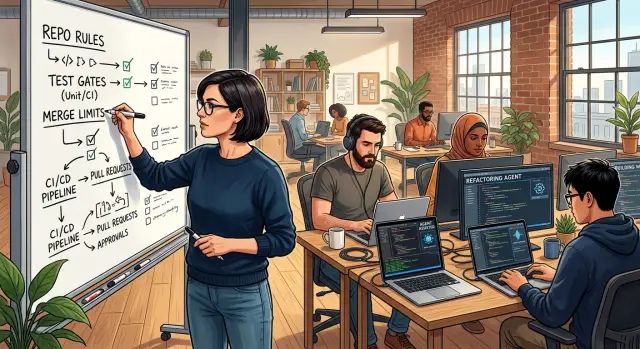
Table of Contents
What breaks when nobody owns the agents
A coding agent can make more changes in one hour than a small team can review in a day. A prompt that should touch one endpoint can end up editing a dozen files, renaming helpers, updating tests, and rewriting comments. The code still compiles, but nobody has a clean picture of what changed or why.
That is where teams start losing control. When nobody sets limits, agents follow their own local logic instead of the team's rules. They fix style in files outside the task, pull in unrelated cleanup, and open large diffs because the model wants to tidy every pattern it sees. What looked like a simple ticket turns into a branch with mixed intent.
Reviewers feel the damage first. Instead of checking behavior, they spend time on spacing, naming, import order, and other noise that should never have reached review. Real defects get harder to spot. A missed auth check or a risky migration can hide inside 150 lines of cosmetic edits.
The problem spreads fast. One agent copies a weak pattern into a second feature. Another agent reads that branch, treats it as normal, and repeats the same mistake. Soon the team has several branches with the same flaw, each one needing its own cleanup.
Output also grows faster than the team can verify it. Two engineers might comfortably review ten human sized pull requests in a day. They usually cannot review five large agent generated diffs with the same care. Work backs up in review, merge conflicts rise, and people start approving changes just to keep the queue moving.
Small startups feel this almost immediately. On Monday, the team asks agents to speed up bug fixes. By Thursday, they have six open branches, failing tests, duplicate refactors, and reviewers who no longer trust the diff. At that point, the issue is not the model. The issue is ownership. One person has to decide what agents may touch, how much they may change at once, and what must stop before merge.
What the owner decides before day one
Before the first agent opens a branch, one person needs the authority to set the rules. Not a committee. Not three people making exceptions in chat. One owner.
That person does not have to write every line of code. They do need enough technical judgment to say yes, no, and stop. In a small company, that might be the CTO or a founder who still has strong engineering range. If the team does not have that person in house, a fractional CTO can fill the gap and make those calls early.
The first decision is scope. Agents should not write anywhere they want. The owner defines which parts of the repo are safe for agent work and which parts stay human only until the process is stable. A common split is simple product code for agents, while payments, auth, infrastructure, and migrations stay with senior engineers.
The second decision is change size. Large pull requests look productive right up to the moment nobody can review them. The owner needs a hard ceiling before work starts. For most teams, that means small PRs with one narrow goal, limited file count, and a diff one reviewer can understand quickly.
The third decision is who can stop a bad run. Teams skip this more often than they admit. If an agent keeps opening weak PRs, rewriting the same files, or failing tests over and over, someone must be able to freeze agent output that day. No debate. No waiting for a meeting.
The starting rules can stay simple:
- One named owner sets the rules and updates them.
- Agents write only in approved folders or services.
- PRs stay small enough for quick review.
- One person can freeze agent output as soon as problems show up.
This is not about heavy control. It is about keeping the repo calm. Teams move faster when boundaries are clear.
Repo rules that keep output under control
The quickest way to lose control of agent output is to give the repo wide open access. Agents move fast. Without boundaries, that speed turns into mess.
A good owner starts with repo rules, not prompts. Prompts matter, but they are weaker than enforceable limits. If the branch rules are loose, even a well written task can drift.
A few repo rules usually do most of the work. Protect main and release branches so agents never push there directly. Fence work by path so a task in billing stays in billing instead of wandering into shared auth or deployment files. Keep the task prompt and acceptance notes in the repo so reviewers can see what the agent was told. Require a ticket number or a short written brief that says what to change, what not to change, and when to stop.
Those rules do more than prevent bad merges. They give the team a paper trail. If an agent makes a strange edit three days later, someone can trace it back to the prompt, the scope, and the branch.
A small example shows why this matters. If an agent gets asked to "improve checkout," the task is far too loose. If the repo rules require a ticket, allowed folders, and a saved prompt, the same request becomes clear: update tax rounding in the checkout service, do not edit pricing logic, add the tests named in the brief, and stop after one pull request.
Teams that skip these rules usually spend their time cleaning up side effects. Teams that set them early keep the output boring. Boring code is easier to trust.
Test gates and merge limits that hold the line
Agents can produce ten small patches before one reviewer finishes lunch. If the team does not set hard limits on what enters the repo, broken code spreads faster than anyone can read it.
Every branch needs the same test path, whether a human wrote the code or an agent did. Run linting, unit tests, type checks, and the smoke tests that matter for that service before anyone talks about merging. Teams get into trouble when they treat agent branches as drafts and skip the pipeline to save time.
A failed build should block the merge. Always. "We'll fix it in the next PR" sounds harmless until agent output stacks up. One red build becomes three rushed follow ups, and soon nobody knows which change caused the break.
Some areas still need a person every time. Auth, billing, permissions, schema changes, and deployment code can break trust, money flow, or production data in one bad merge. An agent can suggest the code, but a human should read the diff, check the edge cases, and decide whether it is safe.
Merge size matters just as much as test gates. If one reviewer cannot understand the change in about 10 to 15 minutes, the PR is too big. Large agent diffs hide silly mistakes: duplicated logic, wrong field names, quiet security gaps, or tests that pass for the wrong reason.
The rules themselves do not need to be fancy:
- Run CI on every branch.
- Block every merge with a failed check.
- Require human approval for auth, billing, schema, and infrastructure work.
- Split PRs until one reviewer can read them quickly.
A small startup does not need a giant process. It needs rules that still hold on a busy day.
A simple rollout for the first two weeks
Start with one repo. Pick something important enough to reveal real problems, but not so risky that one rough week hurts the business. Do not roll agents out across the whole company at once. One repo gives you enough signal to see how the agents write code, how often they break tests, and how much review time they create.
This is where ownership matters most. If nobody owns the setup, people start merging around problems instead of fixing them.
Week 1
Write five rules the team can follow today, even if they feel strict at first:
- Agents work in one repo only.
- Agents open small pull requests, not broad refactors.
- Every change must pass linting, tests, and the build.
- A human reviews every merge.
- Failed checks mean the agent stops and waits.
Keep the rules short. If a new engineer cannot read them in two minutes, they are too long.
Turn on the basic checks first. Linting catches sloppy edits. Tests catch broken behavior. Build checks catch missing imports, bad types, and packaging mistakes. These are cheap guardrails, and they filter out a lot of noise before review begins.
Week 2
Watch the first ten merges closely. Do not just ask, "Did it pass?" Ask what wasted time. Maybe the agent keeps touching unrelated files. Maybe it writes long comments nobody wants. Maybe it fixes one bug and changes naming across six folders. Those patterns tell you which rule to tighten next.
A small team can do this without much ceremony. If agents are cleaning up API handlers in one service, the team may notice after ten merges that two limits would save hours of review: no changes to shared types without approval, and no pull request over 250 lines.
Do not expand after one good week. Wait for two steady sprints with clean checks, low review pain, and no surprise regressions. Then move to the next repo using the same process. That is slower than a company wide rollout, but it is usually much cheaper than cleaning up a month of uncontrolled output.
A small team example
A six person startup adds two coding agents to help with bug fixes. The team is lean: three engineers, a product manager, a designer, and a founder who still joins release checks. For a few days, it feels great. Bugs move faster. Pull requests pile up. Then one agent turns a simple fix into changes across several services, and review slows to a crawl.
A technical lead steps in and sets one rule that sounds strict but works well: each agent task can touch one service and one ticket. If a bug lives in billing, the agent stays in billing. It does not rename shared helpers, update another service, or clean up unrelated code while it is there. That limit keeps the repo predictable and makes rollback much simpler when something slips through.
The team also draws a hard line on tests. If an agent opens a PR and the test suite fails, the work goes back before any engineer reviews it. Humans do not spend time sorting out lint errors, broken builds, or failing checks the agent should have handled first. That one rule saves a surprising amount of attention.
Small merges make the biggest difference. The owner caps agent PRs at a size a tired engineer can review in a few minutes. In a small diff, a reviewer can catch a bad query, a missing null check, or a risky migration. In a huge diff, people skim. That is where bad changes get through.
The agents still help. They just help inside a system the team can control.
Mistakes teams make with agent output
Teams rarely get buried by one bad agent run. They get buried by habits that make every change harder to review, test, and undo.
One common mistake is letting agents edit shared files without limits. That sounds fast until an agent touches auth, billing, build config, and a shared component library in one pass. A simple request turns into a cross repo cleanup job. Reviewers lose the thread, and small errors spread into places nobody meant to change.
Another mistake is measuring raw output instead of useful output. More pull requests, more lines changed, and more tasks closed can look impressive for a week. Then the team notices half the diffs are noisy, tests fail for unrelated reasons, and people spend their mornings sorting churn instead of shipping product.
Better signals are less flashy: how many agent PRs merge without rework, how long reviews take, how often changes get reverted, and how often builds or tests fail after agent edits. Those numbers tell you whether the process is working.
Rollback is another place where teams get caught. They let agents generate broad changes, merge them, and assume they can fix forward later. That works until an agent updates a shared migration, rewrites a config file, or changes a common API shape. When something breaks, the team needs a clean undo path. A revert commit, a feature flag, or an isolated branch can save hours of argument.
The last trap is changing the rules every day. If one engineer wants tiny diffs, another accepts giant PRs, and the founder pushes for speed above everything else, reviewers stop trusting the process. Agents need steady boundaries. Pick file limits, test gates, and merge size rules, then keep them stable long enough to learn what actually works.
Quick checks before you scale agent use
Teams usually scale agent use too early. Small process gaps turn into daily mess once output goes up.
Before you give agents more access, check whether the team can still see, review, and trace the work without strain. If the answer is no on even one point, fix that first.
A reviewer should be able to read a typical merge in about ten minutes. If one task creates 40 changed files, split the work or tighten the repo rules. Tests should fail fast on risky areas. Auth, billing, permissions, schema changes, and deployment code should stop bad output in minutes, not after a long pipeline run. Every task should point to a ticket, note, or short written request. If a change has no source, people stop asking why it exists. And if a reviewer bypasses tests or merges outside the usual path, the team should record who approved the exception and why.
These checks sound basic because they are basic. That is the point. They reveal whether the team controls the agents or whether the agents now control the pace.
A simple example makes this clear. Suppose an agent opens eight pull requests in one day. The code compiles, but two merges touch permissions, one changes a shared API, and three have no ticket. If the team cannot sort that in one short review session, it does not need more agent capacity. It needs tighter limits.
Outside technical leadership can help here, especially in founder led teams where nobody wants to police merge rules every day. Someone who sits above the ticket queue can define the rules, hold the line on exceptions, and keep one standard across the repo.
What to do next
Start with the repo that creates the most noise right now. Pick the one with the most reopened pull requests, the most broken builds, or the most time lost to review cleanup. Testing agent work in a quiet repo can hide the real problem for weeks.
Then give one person the authority to make final calls. That owner can be an engineering leader, a founder with deep technical range, or an outside advisor. What matters is simple: one person can say no to messy output, pause agent access, and tighten the rules when the team starts drowning in pull requests.
Write the first guardrails before you add more agents. Define which files agents can change without approval. Set the tests every pull request must pass. Limit pull request size and daily merge count. Block direct merges to protected branches. Require human review for schema, auth, billing, and infrastructure changes.
The tool can write code quickly. It cannot decide how much risk your team can absorb this week.
If nobody on the team has the time or range to own that job, outside help can make the difference. Oleg Sotnikov, through oleg.is, works with startups on this exact kind of problem: setting repo boundaries, test gates, and merge rules so AI assisted development stays useful instead of turning into cleanup.
Do not roll this out everywhere at once. Run the setup in one repo for a week or two. Watch the review load, failed tests, and revert rate. If pull requests get smaller, review comments get shorter, and broken merges drop, the rules are working.
If the opposite happens, stop adding agents and tighten the guardrails first. One owner, one noisy repo, and one short rule set will teach you more than a month of uncontrolled output.
Frequently Asked Questions
Why does a coding agent need one clear owner?
One person needs to set scope, PR size, and stop rules. Without that, each engineer makes exceptions, agents drift into unrelated files, and review turns into cleanup. A single owner keeps the repo calm and makes fast calls when output starts to slip.
Who should own agent rules in a small startup?
Pick someone who can judge risk and say no without waiting for a meeting. In a small startup, that is often the CTO, a technical founder, or a strong engineering lead. If nobody on the team has enough range or time, bring in a fractional CTO to set the rules and hold them steady.
What parts of the codebase should agents touch first?
Start with one repo and low risk product code. Let agents handle narrow fixes in clearly approved folders first, while humans keep control of auth, billing, infrastructure, and schema changes until the process feels stable.
How big should an agent pull request be?
Keep it small enough that one reviewer can understand it in about 10 to 15 minutes. If a PR mixes a bug fix with renames, cleanup, or edits across many files, split it. Small diffs make defects easier to spot and reverts much easier.
Which agent changes always need human review?
Always put a human on auth, billing, permissions, schema work, and deployment code. Those areas can break trust, money flow, or production data in one bad merge. An agent can draft the change, but a person should decide if it is safe.
What test gates should block an agent merge?
Run the same checks you already trust for human code: linting, unit tests, type checks, build checks, and a few smoke tests for that service. If any of them fail, stop the merge and send the branch back. Do not let agent work skip the normal path just to save time.
When should we pause or freeze agent output?
Stop right away when agents keep failing checks, reopening the same files, or sending large noisy diffs that reviewers cannot trust. Freeze output for the day, fix the rule that failed, and restart with tighter scope. Pushing through usually creates more cleanup than progress.
How do we roll out coding agents without creating chaos?
Use a short rollout. Start in one repo for a week or two, require small PRs, save the task prompt or brief, and watch the first ten merges closely. If review stays quick and regressions stay low, move to the next repo. If not, tighten the guardrails before you expand.
How can we tell if agent output is actually helping the team?
Ignore raw volume and watch review pain instead. Track how often agent PRs merge without rework, how long reviews take, how often you revert changes, and how often builds or tests fail after agent edits. Those numbers show whether the system works or just creates churn.
When does it make sense to bring in a fractional CTO for this?
Bring in outside technical leadership when the team moves fast but nobody owns repo boundaries, merge rules, or exceptions. That often happens in founder-led teams where everyone wants speed and nobody wants to police process. An experienced CTO can set limits early and stop the backlog before it grows.