Cap parallel AI experiments before delivery starts to slip
Cap parallel AI experiments to match review time and customer risk, so small teams keep prototypes useful without slowing real delivery.
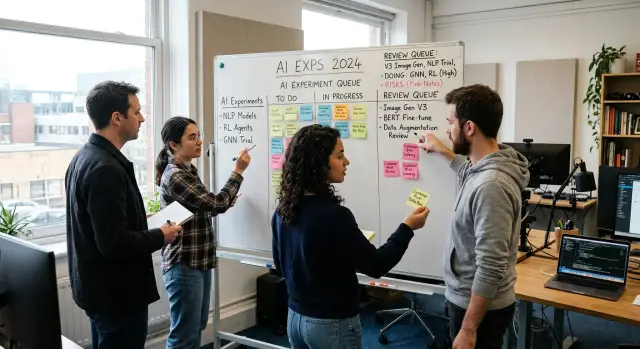
Table of Contents
Why this becomes a problem fast
A tiny team can spin up AI prototypes in a day, sometimes in an hour. That speed feels harmless at first. Then five rough tests land at once, and each one needs someone to read outputs, check edge cases, clean up prompts, and decide whether it deserves another round.
The queue forms before anyone notices. Building the first version is cheap. Reviewing it is not. Every prototype asks for the same scarce time: product judgment, bug checks, customer context, and edits. When two people can build but only one person can review, work starts to pile up by the end of the week.
Then focus breaks. An idea that should stay a quick test turns into a real task with comments, fixes, and one more try. Small teams feel this faster because the same people usually handle discovery, support, shipping, and cleanup. If every idea gets a ticket, the backlog fills with unfinished work.
Customer work loses first. A bug fix, onboarding issue, or billing problem sits while the team debates chatbot prompts and internal agents that may never ship. Nobody plans to slow delivery, but too many open tests create that result anyway. Customers notice slower replies, missed release dates, and features that change direction during the build.
Fast demos make this worse because they look more complete than they are. A model can produce a convincing screen, answer, or workflow in minutes. That does not mean the team understands failure cases, review effort, or customer risk. A good demo creates pressure to keep going even when the team has no room for more work.
That is why small teams need a limit early, not after delivery starts slipping. Once the queue grows, each new prototype pulls attention away from shipping. The team stays busy, but progress feels strangely slow. That is usually the first clear warning sign.
What counts as an experiment
An active experiment is not "anything with AI." It is any change that creates review work, branch work, or user risk. If someone has to check it, compare it, merge it, or explain it later, count it.
That definition matters because tiny teams usually lose time in review, not in prototyping. A fast test on Monday can turn into three more checks by Thursday if nobody agreed on what belongs in the count.
Private tinkering does not always count. If someone is testing ideas in a local notebook, on throwaway data, with no plan to merge or show it, leave it out. The moment that same test affects product decisions, enters a branch, reaches staging, or gets shown outside the maker's screen, it becomes an experiment.
Treat separate changes as separate experiments when they need separate judgment. That usually includes:
- a prompt or prompt chain meant for real use
- a model swap, even if the feature stays the same
- a code branch that changes outputs or workflow
- a tool or agent change that needs human review
- any test that can reach users, even behind a flag
This sounds strict, but it saves arguments later. A prompt rewrite can look small and still change tone, accuracy, latency, and cost. A model swap can keep the same interface and still behave like a different product.
The clean line is exposure. If the output can appear in a chat reply, support draft, summary, recommendation, or auto filled field, treat it as active work. If it stays private and dies in a sandbox, it was just exploration.
Each experiment also needs one owner and one purpose. One owner means one person tracks the branch, collects feedback, and closes it or ships it. One purpose means the team can answer a plain question such as "Does this cut review time by 20 minutes a day?" or "Does this reduce bad answers in support drafts?"
If a test has no owner, it floats. If it has no purpose, people keep changing prompts, models, and code at the same time, and nobody knows what caused the result. That is when delivery starts to drift.
Set the limit from review time
Most tiny teams do not run out of ideas. They run out of attention. Every AI experiment creates extra work after the prototype, and that work lands on the same few people.
Start by naming who reviews each part of the change. In a small team, one engineer usually checks code, logs, and failure cases. A founder, product lead, or manager reviews the product change. A support or domain expert checks whether outputs make sense for real users. Whoever owns releases checks rollout, fallback, and customer impact.
Then count how many review hours those people really have in a normal week. Use actual numbers, not hopeful ones. If an engineer seems to have eight free hours but bug fixes usually eat five, count three. If the founder only reviews product changes on Friday afternoon, count that block and stop there.
Next, give each experiment a rough review cost. Keep it loose. An internal prompt tweak might need 30 to 60 minutes. A feature visible to customers, especially one that writes emails, answers users, or changes product behavior, may need three to five hours across prompt checks, output sampling, edge cases, and release review.
The estimate does not need to be perfect. It just needs to stop the team from pretending review is free.
Once active work grows past your weekly review bandwidth, stop adding more. If the team has 12 review hours this week and open experiments already need 10, there is only room for very small tests. If a new idea needs four hours, something else waits.
A simple rule works well: do not start a new experiment unless its review still fits inside the current week. It feels strict, but it protects delivery. Fast prototypes look cheap at first. The review queue is where they start to cost you.
Add customer risk before you approve more work
Review time is only half the limit. Risk should lower the number further. Anything that can confuse customers or touch money deserves more caution, even when the prototype looks small.
A tiny team might handle several internal tests at once. That changes fast when an experiment can affect a real user. One prompt change in an internal research tool may waste ten minutes. One bad answer in billing support can create refunds, angry emails, and hours of cleanup.
Flag work early when it touches content users will see, payments or pricing, support replies or account changes, or personal and business data. Once a task enters any of those areas, lower the number of open experiments. Many small teams do better with one risky test at a time plus a few safer internal ones. That may feel slow. It is usually cheaper than fixing trust problems after launch.
Risky tests also need stronger checks before they move forward. Ask who reviews the output, how the team spots errors, what happens if the model makes a wrong call, and how fast the team can turn the feature off. If nobody owns those answers, the test is not ready.
The difference is easy to see. A tool that drafts internal meeting notes can stay loose for a while. A tool that suggests refund decisions or sends customer replies needs tighter prompts, human approval, and clear logs from day one.
Live issues should change the queue too. If bug reports rise, support slows down, or customers start seeing odd behavior, pause the less useful trials first. Protecting delivery and trust matters more than keeping every experiment alive.
A rule a tiny team can actually use
Start with a low cap. Most tiny teams do better with three active experiment slots than with a clever formula.
The simplest version looks like this:
- internal experiments use 1 slot each
- experiments that can affect customers use 2 slots each
- the team cap is 3 slots total
- if one person handles most approvals, cut the cap to 2 slots
- raise the cap by 1 only after three cycles of shipping on time
This works because it matches the real bottleneck. An internal prompt tweak for a support draft might take 15 minutes to review. A change that affects customer replies can create edge cases, support tickets, and cleanup work for days. They should not count the same.
For many teams, this means three small internal tests at once, or one customer visible test plus one internal test. Running two risky experiments in parallel usually makes sense only when review is spread across more than one strong reviewer and the team keeps shipping on schedule.
Lower the cap quickly when review is concentrated in one person. If the founder, tech lead, or product owner approves almost everything, that person becomes the queue. Once their inbox slips by even a day or two, prototypes sit unfinished and delivery starts to drift.
Raise the cap slowly. Wait until the team clears review, fixes, and release work on time for several cycles in a row. If one experiment causes a rollback, support churn, or constant hand holding, keep the cap where it is or reduce it.
Tiny teams rarely fail because they tested too little. They get in trouble when they approve more work than they can safely absorb.
A realistic example from a small team
A five person startup has one founder, two engineers, one designer, and one support lead. They want to move fast with AI, so they start four ideas in the same month. Three stay inside the company: draft support replies, sort bug reports, and generate draft test cases. One reaches users: an assistant that suggests answers inside the product.
On paper, this looks manageable. In practice, only two people can review the output well enough to trust it. One engineer checks logs, failure cases, and odd prompts. The support lead reads replies, spots tone problems, and catches answers that sound fine but are wrong.
Those two people have about 10 review hours a week after their normal work. The internal trials already eat most of that time. The support reply tool needs daily checks. The bug sorter makes fewer mistakes, but each mistake can hide a real issue. The test case generator saves time, yet someone still has to read what it produced and throw out the weak parts.
The assistant for users changes the math. Even with a small rollout, every bad answer has a customer cost. A messy internal summary wastes a few minutes. A wrong answer to a customer can create refund requests, churn, or a support thread that takes half an hour to untangle.
So when a fourth internal experiment comes up, the team does not squeeze it in. They pause it. The idea may be good, but the review time is gone. That is what limiting parallel AI work means in a tiny team. You do not limit ideas. You limit the number of things that need human checking at the same time.
That choice feels slow for a week or two. Then it pays off. Instead of juggling four shaky projects, the team finishes one change that sticks: the bug sorter moves into daily use, cuts manual triage time, and stops pulling reviewers away from delivery. The paused experiment can wait. Shipping one useful thing beats babysitting four unstable ones.
Mistakes that flood delivery
Small teams rarely get buried by a lack of ideas. They get buried by too many unfinished AI tests that never reach a clear yes or no.
The first mistake is starting new experiments before older ones get a decision. One prototype turns into three open branches, five prompt versions, and a pile of notes nobody has reviewed. The work looks fast because models generate code and copy quickly. The slowdown shows up later, when the team has to compare results, test edge cases, and decide what to keep.
Another common mistake is treating prototypes as free. They are cheap to create, not cheap to approve. A model can produce a chatbot flow or support draft in 20 minutes, but a person still needs to test bad inputs, vague requests, odd formatting, and obvious failure paths. That review work is where delivery usually breaks.
Teams also create trouble when they merge changes before anyone checks how the experiment fails. A demo can look fine with clean sample data and still break on empty fields, repeated requests, or messy customer language. If that reaches customers too early, support work jumps, trust drops, and the same engineers now stop feature work to clean up avoidable problems.
Switching models during a sprint creates another reset. A new model often changes output style, latency, cost, and error patterns. Even if the feature goal stays the same, the review does not. The team has to test again, and the earlier approval no longer means much.
The last trap is mixing customer requests with side experiments. When engineers slip experimental work into the same queue as promised delivery, priorities blur. A bug fix waits while someone tries a new prompt chain "just for an hour," and that hour expands.
Oleg Sotnikov's Fractional CTO work at oleg.is follows the same discipline: close or kill existing tests before opening more. The bottleneck is usually human review and user risk, not generation speed.
Quick checks before you start another test
A new test looks cheap at first. Then it eats review time, distracts the person who should ship this week, and creates one more branch nobody wants to touch on Friday.
Before you approve another experiment, stop and ask:
- Do we have enough review time this week for outputs, logs, and edge cases?
- Will this touch real users, real customer data, or any live workflow?
- Is one person clearly responsible from setup to cleanup?
- What exact decision ends the test: ship, revise, or stop?
- What planned work slips if we start this now?
The first question matters more than most teams admit. A prototype may take two hours to build, then six hours to review well. If nobody has those six hours, the experiment is already late before it starts.
Risk changes the answer fast. A small internal tool that summarizes notes is one thing. A change that can send wrong replies, expose private data, or affect billing needs tighter control. If real users or real data are involved, count that test as heavier than a sandbox idea, even if the code looks small.
Clear ownership keeps experiments from hanging around. One person should own the setup, test cases, rollback plan, and final call. Shared ownership sounds polite, but tiny teams often turn that into drift.
The stop rule is where teams get sloppy. "We'll see how it goes" is not a decision rule. "If accuracy stays under 85% after 100 samples, we stop" is a decision rule. So is "If support needs manual review for every output, we do not ship it."
Then state the tradeoff in plain language. If this new test delays a release, bug fix, or customer request that already matters, say it out loud. Tiny teams do not run out of ideas. They run out of review hours and calm delivery weeks.
When one of these answers is weak, defer the test. That is usually the cheaper choice.
What to do next
Put the limit where your team already makes commitments: sprint planning and the weekly review. If the cap lives in a note nobody checks, it will not change behavior. Add one line to planning: how many AI experiments can stay open this week without slowing code review, QA, and customer work.
Keep the number small enough that one person can review every result with care. For many tiny teams, that means only a handful of active tests at once. If a new idea appears midweek, pause, close, or reject something already in flight before starting another test.
A simple operating rule works well:
- set a hard cap for open experiments at the start of each sprint
- review every open test once a week and give it a clear status
- close stale work after a short time limit if nobody can explain why it should stay open
- count only tests that reached a real yes or no, not unfinished demos
That last point matters more than most teams expect. If you track only how many tests started, the numbers look busy but say nothing. Track how many experiments ended with a decision, how long review took, and how many touched customer flows. That shows whether your team is learning or just piling up prototypes.
Close stale experiments fast. A test that sits open for two or three weeks usually creates quiet pressure to keep feeding it. Then it steals time from shipping. Archive the notes, keep the lesson, and move on. Teams do better when they kill weak ideas early and protect delivery time.
If your team needs help setting those limits, Oleg Sotnikov at oleg.is advises startups and small businesses on practical AI adoption, review processes, and lean technical operations. The useful metric next month is simple: fewer open tests, faster decisions, and more work that reaches production on purpose.
Frequently Asked Questions
How many AI experiments should a tiny team run at once?
Start with 3 slots total. Let an internal test use 1 slot and a user visible test use 2. If one person handles most reviews, cut the cap to 2 until delivery feels steady again.
What counts as an active experiment?
Count anything that creates review work, branch work, or user risk. If someone needs to check outputs, compare versions, merge code, or explain results later, treat it as an active experiment.
Should private tinkering count toward the cap?
No, not always. If someone plays in a local notebook with throwaway data and no plan to merge or show it, leave it out. Once that test affects product decisions, enters a branch, reaches staging, or gets shown to others, count it.
Why do AI prototypes slow delivery so quickly?
Because building the first version is cheap and reviewing it is not. Tiny teams usually lose time in checks, fixes, edge cases, and release decisions, not in the first demo.
How should we set the cap from review time?
Look at real review hours, not hopeful ones. Add up how much time your engineer, product owner, support lead, or founder can actually spend this week, then stop opening work when the current queue fills that time.
When should a user visible test use more than one slot?
Give risky work more weight. If a test can affect replies, pricing, billing, account changes, or private data, count it as heavier than an internal tool and lower the number of open experiments.
Who should own each experiment?
Pick one owner for each test. That person tracks the branch, gathers feedback, sets the stop rule, and makes sure the team ships it, revises it, or closes it.
When should we pause or kill an experiment?
Stop it when the team cannot review it this week, when live issues need attention, or when the test misses its target after a fair sample. A stale experiment drains time because people keep feeding it without a clear payoff.
Can we swap models mid sprint without resetting review?
Treat a model swap like a new experiment. Even if the feature stays the same, the model can change tone, error patterns, speed, and cost, so you need fresh review.
What should we check before starting one more test?
Ask five plain questions before you start: do we have review time, does it touch users or real data, who owns it, what ends the test, and what planned work slips if we start now. If any answer feels weak, defer it.


