Business fragility: why good uptime still feels risky
Business fragility hides behind green uptime charts. Learn how weak ownership, slow recovery, and vendor risk put daily operations at risk.
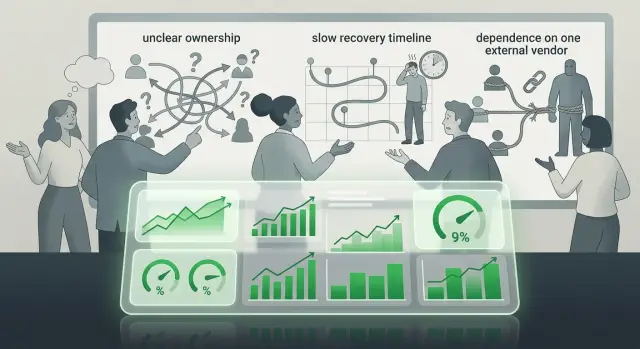
Table of Contents
Why uptime does not tell the whole story
A service can stay online and still get in the way of real work. Customers may log in, pages may load, and the status page may stay green, yet orders still get stuck, invoices wait for approval, and support loses access to the tool it needs. That gap is where business fragility starts to show.
Uptime measures one narrow thing: whether a system responds. It does not tell you whether the business can keep moving from request to payment, from complaint to fix, or from sale to delivery. A company can report 99.9% uptime and still lose hours every week to broken handoffs, unclear decisions, and slow recovery.
This gets worse when ownership is fuzzy. A problem appears, several people notice it, and nobody owns the next move. One person checks logs, another contacts the vendor, someone else pings finance, and no one makes a clear call. The app is still online, but work slows to a crawl because the path forward has no owner.
Recovery planning matters just as much. A short outage with a clear fallback often hurts less than a small issue that drags on all day. If someone knows how to pause a queue, switch to a backup process, or handle requests by hand for an hour, customers feel less pain. If nobody knows what happens next, even a minor glitch becomes operational risk.
Vendor risk causes the same problem in a quieter way. Your product may run fine while an outside tool blocks billing, support replies, identity checks, or shipment updates. The server is up, but part of the business is frozen. That is still downtime, even if the uptime chart says otherwise.
A quick test makes this obvious:
- If one vendor slows down for two hours, what stops first?
- Who notices it first?
- Who decides the fallback?
- Can the team keep serving customers by hand for a short time?
Stable companies do not rely on a green dashboard alone. They know who owns each step, how recovery works, and which outside tools can quietly stop the business.
What makes a business feel fragile
A company can look stable on paper and still feel one bad week away from trouble. That usually happens when work depends on a few people, a few tools, or a few unwritten habits. The systems seem steady, but the business is easy to disrupt.
Weak ownership is often the first problem. One team notices an issue, another team has the access, and nobody owns the result. Support waits for engineering, engineering waits for operations, and customers sit in the gap. Small gaps between teams turn ordinary issues into slow, messy delays.
Slow recovery adds a second layer of risk. A brief fault should stay brief. Instead, many companies lose hours finding the right person, getting approval, restoring data, or rerunning a job by hand. The alert clears in ten minutes, but the business impact lasts all afternoon.
Vendor risk is quieter, but it hits hard when it shows up. A team may depend on one payment provider, one cloud feature, one contractor, or one SaaS tool that nobody knows how to replace. Everything feels fine until pricing changes, support goes quiet, or an integration fails during a busy week. The service is still online, yet the company cannot move.
Manual steps hide the same weakness. If one person knows how to publish a release, fix a billing export, or restart a failed sync, that person's availability becomes part of your infrastructure. Sick days, holidays, and staff changes start to break routine work.
The early signs are usually plain. People keep asking who owns a problem. Recovery depends on the same one or two people. One vendor issue blocks internal work for hours. Important tasks live in someone's memory instead of a checklist.
This is common in growing companies. The product works, dashboards look calm, and customers can still log in. Under the surface, recovery is weak, ownership is blurry, and the business has less margin for error than it seems.
What weak ownership looks like day to day
When an incident starts, the first delay often has nothing to do with the bug itself. People ask who owns the service, who can approve a rollback, and who should tell customers what is happening. Those first ten minutes matter. They shape the whole response.
You can see weak ownership in the way incidents bounce around. Support sends the issue to product. Product asks engineering if the problem is real. Engineering checks one area, then asks infrastructure to look at logs. Infrastructure finds nothing obvious and sends it back. The issue keeps moving while nobody takes charge.
That is why uptime reports can be misleading. A dashboard can stay green while the team wastes time on confusion, repeated questions, and slow decisions.
Another common sign is hidden dependence on one person. The team says a process is documented, but the real process lives in Alex's head, or in a few old chat threads Alex wrote six months ago. If Alex is asleep, in a meeting, or on vacation, everyone slows down.
This usually shows up in everyday work before it shows up in a crisis. A release waits because only one person knows the last manual step. Billing support stalls because only one person understands the vendor settings. An urgent fix sits untouched because nobody else knows which change is safe.
Handoffs often make it worse. Teams rely on chat messages like "Can you take this?" or "I think this is your side" instead of a clear routine. That might work on a calm day. It fails under pressure because chat depends on memory, timing, and whoever happens to be online.
Healthy teams do something simpler. One person owns the response, each team knows its role, and the next step does not depend on guesswork. Clear service ownership often looks boring, and that is exactly what you want when something goes wrong.
A simple example from a growing company
A 30-person company can look healthy on paper and still feel one bad week away from chaos. Orders go through, the site stays online, and money reaches the account. Yet normal work depends on a few people, a few passwords, and a few messy habits.
Take a small subscription business. Its billing system rarely goes down. From the outside, that seems fine. But when a customer asks for a refund, support cannot complete it alone. Agents collect the request, paste details into a chat, and wait for one manager who knows the finance tool well enough to approve it.
That manager is often in meetings. Sometimes they are traveling. Refunds sit for a day or two, angry emails pile up, and support keeps checking the same queue. Revenue still comes in, but the team burns hours on work that should take five minutes.
The same company uses a vendor portal to manage orders after payment. Support can see the order, but it cannot fix a wrong address, split a shipment, or cancel a duplicate purchase without that portal. If the account has a permissions issue, or the portal turns slow, support has no backup path. Customers hear, "We are waiting on our partner," which rarely makes them calmer.
Then there is a login issue that returns every month. A batch sync resets some account states, a few users get locked out, and support scrambles again. Everyone knows the pattern. Nobody owns the real fix. Engineering patches the symptoms, support sends the same replies, and the bug comes back on schedule.
That is business fragility in plain form. The systems are up, but the company cannot recover quickly, cannot act without specific people, and cannot control parts of the customer experience. The real danger is not a dramatic outage. It is a business that stays open while small failures eat time, trust, and margin every week.
How to map ownership and recovery
A simple ownership map usually shows why fragility stays hidden even when uptime charts look good. A service can stay up while orders pile up, agents lose customer history, or nobody knows who should make the first call.
Use one page or one spreadsheet. List every system and process that would stop sales, support, or delivery if it failed for an hour. Include software and the handoffs between people. Payment processing, login, the website form that creates leads, cloud hosting, release approvals, and the inbox support uses all belong on the list.
Next to each line, name one owner. Use a person's name, not a team name. That owner does not have to fix everything personally. They make the call, pull in help, and keep everyone focused on the same problem. If two people share ownership, response usually slows down.
Then write the first three actions people take when that item fails. Keep them simple: confirm the fault and its scope, switch to the fastest safe workaround, and contact the right internal specialist or outside vendor.
After that, track three times for every incident. Restore time tells you when the service comes back. Workaround time tells you when staff can keep operating, even if they use a manual path. Full fix time tells you when the root cause is gone and normal work resumes. These numbers expose weak recovery planning fast. A system with five minutes of downtime can still create four hours of cleanup.
Finally, mark every outside vendor beside the systems it affects. Payment tools, hosting, identity providers, DNS, email delivery, and support software often sit quietly in the background until one of them slows down. If a vendor fails and your team has no contact path, no fallback, and no owner, you have vendor risk even if the dashboard still looks green.
When you finish the map, the gaps are usually obvious. Blank owner fields, missing workarounds, and hidden vendor dependencies are where fragility lives.
Where vendor risk hides
Vendor risk usually sits inside the parts of the business that feel routine. A team may watch server uptime, database health, and response times, yet the real break starts somewhere else. Payment, login, email, SMS, booking tools, and support systems often sit inside every customer flow. If one of them slows down or fails, customers cannot buy, sign in, confirm an order, or reset a password.
That is how business fragility shows up even when your own systems look fine. The app is online, but money stops moving or users get locked out.
The hidden problem is depth. Teams keep pushing more logic into a vendor over time. They add custom rules, templates, user segments, rate limits, fraud settings, and account recovery steps. After that, switching is no longer a simple replacement. It becomes a migration full of messy exports, missing fields, and awkward edge cases.
A contract will not save you in the moment. Service credits might cover a small part of the bill later, but they do not restore checkout during an outage. Premium support has limits too. If your staff cannot route around the failure, the contract is just paperwork while revenue slips.
A few questions usually reveal the risk:
- Which outside tools sit on the path from visit to payment?
- Which one holds data you cannot export cleanly?
- Which one has rules your team changed by hand in a dashboard?
- Which one could fail today and leave no manual fallback?
Messaging tools are a common trap. A company may say it has a backup provider, but the backup account often has old templates, wrong sender settings, or no tested routing rule. The same thing happens with authentication and payments. A second vendor only helps when the team has already tested failover with real traffic, current credentials, and current business rules.
One growing company might use one provider for card payments, user login, and one-time codes. That feels neat until the provider has an incident. Sales stop, users cannot log in, support queues fill up, and staff cannot even verify accounts by phone because the process depends on the same tool.
Pick three core customer flows and write down every vendor inside them. Most teams find more risk there than in their own infrastructure.
Mistakes that make fragility worse
Many companies make the same mistakes.
The first is naming a team as the owner of a service. "Platform owns it" sounds reasonable until something breaks at 6:40 p.m. Then nobody knows who decides, who approves a rollback, or who speaks to customers. Service ownership needs one clear person, even if several people help run the system.
The second is tracking uptime and ignoring recovery. A short outage can hurt less than a slow, messy recovery. If checkout returns after four hours because nobody knows the restore steps, customers do not care that monthly uptime still looks good.
Another mistake is letting one expert carry the whole process. That person becomes the hidden backup plan for every incident, vendor problem, and edge case. It feels efficient right up to the day they take vacation, get sick, or leave.
Companies also make things worse when they keep adding tools instead of removing weak manual steps. More software often means more handoffs, more alerts, and more places where work can stall. The better fix is often simpler: remove one shaky step, write the recovery path down, and test it with the people who will actually do it.
Vendor risk hides in boring places too. A billing add-on, a login provider, a single cloud region, or one contractor with admin access can all create real exposure. If nobody has mapped those dependencies, the business stays exposed even when systems seem stable.
A good weekly check is blunt: for each critical service, name one owner, write the first three recovery steps, and ask what happens if one vendor or one expert disappears tomorrow. If the answer is silence, you found the fragile spot.
A short check you can do this week
You do not need a long audit to spot fragility. Spend 30 minutes with the people who run support, finance, and operations and test a few simple questions.
Use a red, yellow, and green score for each answer. Red means one person knows the answer, the steps live in chat, or the team cannot agree on what happens next.
- Pick five processes that matter most, such as sales handoff, customer support, invoicing, deployments, or incident response. For each one, write down one owner by name. If two or three people "kind of own it," no one owns it.
- Take one recovery task and ask two different people to run it from the written steps. If either person gets stuck, your recovery planning is weaker than it looks.
- Pretend your main vendor goes down for one full workday. Check whether the team can still take orders, answer customers, ship work, or collect money with a temporary backup.
- Compare incident status across finance, support, and ops. If each team sees a different version, bad calls follow fast.
- Open the recovery notes from your last serious issue. If the real fix depends on scrolling old chat threads or calling the same expert, the process is still trapped in someone's head.
This check works because it tests service ownership, recovery planning, and vendor risk at the same time. It also shows whether the team can act without waiting for one hero.
Small companies usually feel this first. One missing owner or one undocumented fix can turn a minor issue into a full day of confusion.
If you find even one red item, assign one owner and one deadline this week. That single change often lowers operational risk more than another month of good uptime numbers.
Next steps that make the business less fragile
Most teams start in the wrong place. They audit every system, buy another tool, and end up with more moving parts. A better first move is smaller: pick the process that blocks cash flow or customer communication when it breaks.
That might be invoicing, order approval, the support inbox, or the handoff between sales and delivery. If that process stalls for half a day, the company feels unstable even if every dashboard still shows green.
Before you add software, remove one manual handoff. Look for the point where one person copies details from one place to another, waits for approval in chat, or keeps the latest status in their head. Cutting even one of those steps often does more than paying for another subscription.
A simple sequence works well:
- Pick one business process that affects revenue or customer updates.
- Mark every person, tool, and approval in that process.
- Find the step that only one person understands.
- Replace or document that step first.
Then write a recovery runbook in plain language. A second person should be able to read it and restore the process without guessing. Include where the data lives, who approves what, what to do if a vendor is down, and how to tell customers or staff what is happening.
If the runbook only works when the usual owner is online, it is not finished.
Vendor exposure needs the same treatment. Many teams know which tool they pay for, but not what breaks if that tool locks an account, changes terms, or has an outage. For each critical vendor, note the owner, fallback option, export path, and the maximum time you can live without it.
Outside review can help when the same problems keep repeating. Oleg Sotnikov, through oleg.is, works with startups and small businesses on service ownership, recovery planning, infrastructure, and AI-first operations. A fresh review often names the weak spots an internal team already feels but has not written down clearly.
The goal is not perfect safety. It is a business that keeps moving when one person is away, one tool fails, or one supplier becomes a problem.
Frequently Asked Questions
Why doesn’t 99.9% uptime mean the business is safe?
Because uptime only tells you that a system answered. It does not tell you whether orders moved, refunds cleared, invoices went out, or support finished work. If staff still wait on one person, one vendor, or one missing approval, the business still loses time and money.
What is the first sign that a company is fragile?
Listen for one question that keeps coming up: “Who owns this?” You will usually hear it during incidents, delayed refunds, failed releases, or vendor issues. When people argue over ownership or wait for the same person every time, fragility already exists.
How can I spot weak ownership quickly?
Pick one service that matters and ask one direct question: who makes the call when it fails? If the answer is a team name, a chat channel, or two people “sharing it,” you have weak ownership. Name one person who decides, pulls in help, and keeps the response moving.
What should I measure besides uptime?
Track three times. Measure when the service comes back, when staff can work again through a workaround, and when you remove the root cause. Those numbers show the real cost of an issue far better than uptime alone.
How do I know if one person is a hidden bottleneck?
Take one recovery task and ask two different people to do it from the written steps. If one of them stops to ask questions, search old chat, or call the same expert, that person still acts as part of your infrastructure. Fix that before the next incident.
Where does vendor risk usually hide?
It usually hides inside routine customer flows. Payments, login, email delivery, SMS, booking tools, and support systems often sit on the path from request to money. Your app may stay online while one outside tool stops sales or locks users out.
Do backup vendors really reduce risk?
Only if you already tested them with real traffic, current settings, and current credentials. Many teams pay for a second provider but never check templates, routing, permissions, or approval rules. A backup that fails on day one is just another unchecked assumption.
What is the fastest way to map ownership and recovery?
Open one page or one spreadsheet and list every system or process that would stop sales, support, or delivery for an hour. Put one owner name next to each item, then write the first three actions for failure. You will usually find the gaps fast: blank owners, missing workarounds, and tools nobody mapped.
What should a recovery runbook include?
Write the runbook for the person who did not build the process. Include where the data lives, who approves what, the fastest manual fallback, which vendor might block the work, and how staff should update customers. Then hand it to someone else and watch them use it.
When should a small company ask for outside help?
Bring in outside help when the same incident returns, when one vendor issue freezes several teams, or when only one person knows the recovery steps. A fresh review can name the weak spots and turn them into clear owners, runbooks, and fallback paths. If you need that kind of review, Oleg Sotnikov can help small teams sort out ownership, recovery, and infrastructure before the next bad week hits.


