Buildable product plan for founders before coding starts
Learn how to turn a rough startup idea into a buildable product plan with scope limits, milestones, simple stop rules, and a clear first release.
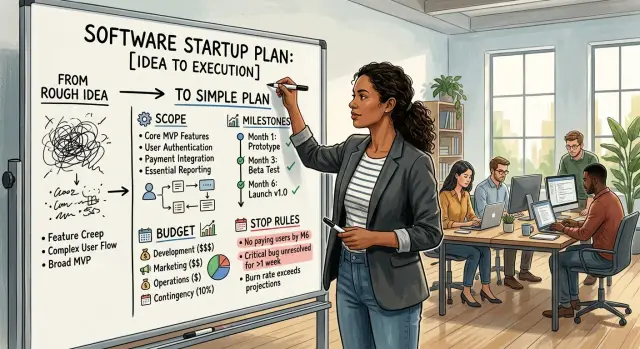
Table of Contents
Why rough ideas fall apart when coding starts
A rough idea feels clear in a founder's head. It rarely sounds clear to the people who have to build it. One sentence often hides four different things: the business goal, the user problem, the first release, and a few guesses about what customers will want.
Once coding starts, those hidden parts split apart.
A founder might say, "We need an app that helps field teams work faster." One engineer hears offline sync. A designer hears mobile forms. A salesperson hears customer portal access. Everyone acts in good faith, but they're building different products. The team is not the problem. The brief is.
When nobody writes the missing details down, people fill the gaps with their own judgment. That creates silent scope growth. A simple login turns into roles and permissions. A dashboard turns into filters, exports, alerts, and custom reports. Each addition sounds small. Together, they can add weeks.
Teams also skip the basic test: does this solve a real problem in a way customers will pay for or use often? Instead, they debate screens, tech choices, and integrations. That's how a company spends two months building software for a workflow users would have handled with email and a spreadsheet.
Deadlines slip for a plain reason. Nobody defines what "done" means. One person thinks version one is ready when the main flow works. Another wants edge cases covered, admin tools added, and analytics in place. Work keeps expanding because the finish line keeps moving.
A solid plan clears this up before the first ticket exists. It separates goals from guesses, sets limits, and gives the team one shared picture of the first release. That does not kill ambition. It protects it.
Founders usually do not need more ideas at this stage. They need sharper boundaries. A smaller plan that solves one clear problem beats a bigger plan that never reaches users.
Write the problem in plain language
Founders often describe a product before they describe the pain. That creates fuzzy plans because the team starts debating screens, integrations, and edge cases without knowing what must change for the user.
Write one short statement about who the product is for. Use a real person in a real job, not a market segment. "Independent insurance brokers who lose leads when they forget to follow up" is clear. "Small businesses needing digital transformation" says almost nothing.
Then write the task that hurts today. Keep it concrete. Maybe they copy data between email and spreadsheets, miss deadlines, or answer the same customer question 20 times a day. If you cannot describe the current pain in plain words, you are not ready to plan the build.
The next line should name the result the user wants. Focus on the change after using the product, not the features inside it. "They send quotes in 10 minutes instead of two hours" is useful. "They have an AI dashboard" is not an outcome.
A simple test works well here. Can someone read the problem statement and explain it back without jargon? Does the outcome describe a visible change in time, errors, cost, or effort? Would a user care about that result even if the product looked basic?
Once those lines are clear, use them to cut scope. If a feature does not make the painful task easier or move the user toward the stated result, take it out of version one. Chat, analytics, custom themes, and admin controls often sound useful. Many of them can wait.
This feels strict, but it saves weeks. Teams often spend early budget on ideas that sound good in a pitch and do nothing for the first user's actual problem. Plain language keeps the plan honest.
Set the limits before you discuss features
Most early product plans fail for a simple reason: the team talks about screens and features before anyone agrees on the edges of the project. That usually leads to wish lists, moving targets, and a version one that tries to serve everyone.
Start with limits. Put a budget range on paper, even if it is rough. Set a latest launch date too. A range like "$20k to $35k" and a date like "live by October 15" forces better choices than "keep costs reasonable" and "ship soon."
Version one also needs one clear audience. Pick the first group you want to help and ignore the rest for now. If you build for customers, staff, partners, and admins all at once, each decision gets slower and the product gets muddled.
Write down the systems you must keep. That includes the tools your team already uses, the data you need to pull in, and any software you cannot replace yet. If the product must work with an existing CRM, payment provider, or internal database, say that before design starts. Integration work can eat weeks.
Some limits are not technical, but they still shape the work. Legal rules, privacy needs, security standards, and brand rules should sit on the same page as the feature notes. A healthcare startup cannot treat user data like a casual side project. A company with a strict brand style cannot let five different people invent the product voice as they go.
It also helps to write a short "not now" list. Keep it blunt.
- No mobile app in version one
- No custom reporting
- No support for more than one user role
- No migration beyond the last 12 months of records
- No manual approval flow unless the law requires it
That list saves money because it stops polite feature creep. When someone says, "Can we add one small thing?" the team can check the page and decide whether it belongs in version one or later.
Founders often worry that limits will make the product feel smaller. Usually the opposite happens. Clear limits give the team enough focus to ship something usable, test it with real people, and learn from facts instead of guesses.
Break version one into milestones
Version one should deliver one useful result. If it cannot do one real job from start to finish, it is still a concept, not a product.
Start by naming that result in plain words. A founder might want "an AI sales assistant," but the smallest useful result is often narrower, such as "a sales rep uploads notes and gets a draft follow up email." That one sentence keeps the team from building five side features before the first test.
Next, list the few user actions that must happen for that result to work. Keep the list short. If users must sign in, add data, review an output, and send or save it, that is enough to shape version one. Ignore the extras for now.
Most early products fit into two to four milestones. More than that, and version one usually hides too much work. Fewer than that, and progress gets hard to judge.
A simple split might look like this:
- Milestone 1: the user creates an account and enters the minimum data
- Milestone 2: the system produces the first usable output
- Milestone 3: the user reviews, fixes, and finishes the task
- Milestone 4: the team measures real use and support issues
Each milestone needs one owner and one finish line. "Backend done" is not a finish line. "A test user completes the task without staff help" is. Owners matter for the same reason. When everyone owns a milestone, nobody really does.
Before the team moves to the next step, decide what proof counts. This is where many plans get fuzzy. Proof can be small, but it must be visible: one customer completes the flow, response time stays under a set limit, error rate stays low for a week, or support requests stay below a number you can handle.
That is what makes a plan feel real. You stop arguing about what sounds impressive and start checking what works. If a milestone fails its proof test, fix it or cut scope before more code piles up.
Write stop rules before work begins
Most teams agree on the goal. Fewer agree on when to pause. That gap wastes money fast. A buildable plan needs clear stop rules so the team knows when to review the plan instead of pushing ahead on habit.
Write those rules before the first task goes into the backlog. If you wait, sunk cost takes over. Founders start saying, "We already spent two weeks on this," and the team keeps building past the point where the idea still makes sense.
Stop and review if the work crosses any of these lines:
- One feature now needs a new platform, a separate team, or a major rewrite
- Costs move past the budget range approved at the start
- Users still cannot finish the main task in the latest version
- New requests only help rare edge cases while the common path still feels rough
- The team misses two checkpoints in a row
These rules help founders make calmer decisions. They turn vague worry into a simple check: did we cross a line or not?
A small example makes this real. Say a team starts with a simple client portal. Halfway through, one requested feature needs a mobile app, a new login system, and separate support work. That is not a small add on. It changes the shape of the project. A stop rule lets the founder pause, cut the feature, or move it to a later phase before the whole budget bends around one request.
Keep the action after each stop rule simple. Pause work, review the reason, then choose one of three paths: cut the feature, shrink the scope, or approve a new plan with new dates and cost limits. If nobody makes that choice clearly, the team will make it by default. That usually means more scope, more delay, and less focus.
A simple example from a small service business
A founder runs a local cleaning business and wants "software for the whole operation." That sounds clear until the team asks what to build first. A plan turns that broad idea into one small result people can test.
The first result is simple online booking. A customer picks a service, chooses a time slot, enters an address, and gets a confirmation. On the business side, staff can view new bookings and assign them by hand.
That scope is enough to learn something real. It shows whether customers will book without a phone call and whether the business can handle demand with fewer messages.
Payroll, crew chat, and route planning stay out of version one. They may matter later, but they do not need custom software on day one. If the business has one crew in one city, a spreadsheet, text messages, and a calendar can cover those jobs for now.
Milestone one is narrow on purpose. The company launches booking in one city with one team and runs it for a short test period. If the founder gets steady bookings, fewer manual calls, and no major scheduling mess, the next step becomes easier to justify.
A simple milestone plan could be:
- Launch one booking flow for one cleaning service
- Accept bookings in one city only
- Let staff confirm and assign jobs manually
- Track completed bookings, no shows, and customer questions
Stop rules matter just as much as milestones. If early customers ask for promo codes, special crew preferences, or complex account features, the answer is "not yet." Log those requests, but do not build them until booking volume proves the basic flow works.
The founder might set a number before work starts: no custom requests until the business reaches 50 completed online bookings or saves at least five staff hours a week. That rule protects the team from building side features too early.
With limits like these, the project stays small enough to finish. The founder gets proof, the team gets clarity, and the next decision depends on real bookings instead of guesses.
Mistakes founders make before the first sprint
Founders often rush into mockups, menus, and polished flows before they can explain the problem in one plain sentence. That feels productive, but it sends the team straight to surface details. If you start with screens, people argue about buttons and layouts instead of asking who has the problem, how often it happens, and why anyone will care enough to switch.
Another common mistake is calling every nice extra "mandatory." A dashboard, admin panel, custom roles, exports, notifications, and mobile apps can all sound reasonable in a planning call. Put them together, and the first release turns into six months of work. Most early products need one strong path that solves one painful job.
Founders also mix launch goals with long term vision. They say they want to test demand fast, then add goals meant for year three: integrations, partner portals, support across regions, deep analytics, and automation for edge cases. Ambition is fine. Mixing time horizons is what breaks planning.
A good plan separates what the first release must prove from what the business may need later. Those are different decisions. The first asks, "Can we solve the problem well enough that real users come back?" The second asks how big the product could become.
Scope also gets distorted by the loudest person in the room. Sometimes that is a founder. Sometimes it is a sales lead, an investor, or one early customer with strong opinions. Volume is not evidence. If one person keeps adding requests, the team needs a simple filter: does this help the first release answer its main question?
The missing piece in many early plans is a clear no list. Teams write what they will build, but they skip what they will not build. That creates daily confusion and endless debate.
A small service business shows the problem well. The owner wants online booking. During planning, the wish list grows into staff payroll, inventory, memberships, customer chat, and a native app. The smarter first sprint builds scheduling, confirmations, and a basic admin view. The rest goes on the no list until customers prove they need more.
If your plan cannot say no, your sprint probably has no real boundary.
Quick check before anyone starts coding
A weak plan often sounds fine in a meeting and falls apart the moment engineers ask simple questions. If people give different answers about the user, the budget, or what "done" means, coding will turn guesswork into wasted weeks.
Read the draft out loud and pause on any line that sparks debate. Debate is cheap at this stage. It gets expensive after design work, tickets, and commits.
- Explain the first release in one sentence. If the sentence needs a long "and," the scope is probably too wide.
- Name the main user in plain words. "Small shop owner who needs to track repeat bookings" works better than "businesses" or "everyone."
- Check every milestone for a real test. A milestone should end with something people can try, review, or measure.
- Write a short "not in version one" note.
- Put numbers on the plan: budget, target date, and stop rules.
A small example makes this easier to see. A cleaning company says it wants "an app for customers and staff." That is still too vague. A better first release is: "Customers can request a quote, and staff can approve jobs from a phone."
Now the team can work with it. The main user is clear. The first milestone can end when one real customer submits a request and one staff member handles it without help. Online payments, loyalty points, and route planning stay out for now.
If any answer still feels fuzzy, do not patch it with optimism. Write the missing rule, cut the extra feature, or move the date. A short plan with sharp limits beats an exciting plan that nobody can ship on time.
What to do next with your draft plan
Put your draft on one page. If it needs a long slide deck to make sense, it is still too loose. A founder should be able to hand one page to a developer, a designer, or a salesperson and get the same summary back.
Keep that page tight. It should name the problem, the user, version one, the limits, the milestones, and the stop rules. If one of those parts is missing, the plan is not ready for design work or pricing.
A simple layout is enough:
- One sentence on the problem
- Who will use it first
- What version one must do
- What stays out for now
- Two to four milestones with clear checks
- The rule for stopping, pausing, or cutting scope
After that, review the page with the people who will build it and the people who will sell it. Engineers usually spot hidden complexity fast. Sales and support teams usually spot weak demand, unclear language, or steps buyers will resist. If those groups disagree, that is useful. It means you found a gap before spending money on mockups and estimates.
Do not ask for detailed estimates yet. First, fix the obvious holes. Maybe the user is too broad. Maybe milestone two depends on data you do not have. Maybe your stop rule is vague and gives no real protection when the project starts slipping. Clean up those issues before anyone starts detailed design.
This review does not need to take long. In many small teams, one focused hour is enough to expose the shaky parts. That hour can save weeks of rework later.
If you want an outside check, Oleg Sotnikov offers fractional CTO advice for this stage. On oleg.is, he works with founders on scope, milestones, early architecture choices, and practical ways to keep software projects lean before the team commits to the wrong build.
When the page reads clearly, survives questions, and still looks small enough to ship, you are ready to move into design and estimates.
Frequently Asked Questions
What should I write first before I list features?
Start with one plain sentence that names the user, the pain, and the result they want. If you cannot explain the problem without product jargon, pause and tighten the idea before you talk about screens or tech.
How can I tell if version one is too big?
Your scope is too big when version one tries to help several user groups, solve more than one job, or needs a long sentence full of "and" to explain it. A good first release does one useful task from start to finish.
What belongs on the not now list?
Put anything that does not help the main user finish the main task on that list. Mobile apps, custom reports, extra roles, deep analytics, and edge-case automation often belong there until real usage proves you need them.
How many milestones should version one have?
Most early products work best with two to four milestones. That gives you enough checkpoints to judge progress without hiding too much work inside one vague phase.
What counts as done for a milestone?
A milestone ends when someone can try a real piece of the flow and you can check a clear result. Think in proof like one user finishing the task, low error rates, or support questions staying manageable.
When should we pause the project and review the plan?
Stop and review when cost moves past the agreed range, the team misses two checkpoints in a row, or the main user still cannot finish the core task. Also pause when one request changes the whole project, like adding a new platform or a new login system.
Should I include admin tools, analytics, and a mobile app in v1?
Usually no. If those parts do not help your first user solve the first problem, leave them out and ship the simpler flow first.
How do I set a budget and deadline if I still have many unknowns?
Set a rough budget range and a latest launch date before feature talks get serious. Even a simple range like "$20k to $35k" forces better tradeoffs than vague goals like "keep it affordable" or "ship soon."
What if my team keeps hearing different things from the same idea?
Write the plan on one page and read it out loud with the people who will build and sell it. If engineers, design, and sales give different summaries, the brief still has gaps and needs sharper limits.
When does it make sense to ask a fractional CTO for help?
Bring in outside CTO help when the idea still feels broad, the team cannot agree on scope, or estimates swing because nobody trusts the first plan. A fractional CTO can cut the brief down, set milestones, and catch expensive complexity before coding starts.


