Async release approval across time zones without late pings
Async release approval helps distributed teams ship on time with shared checklists, named rollback owners, and fewer late-night messages.
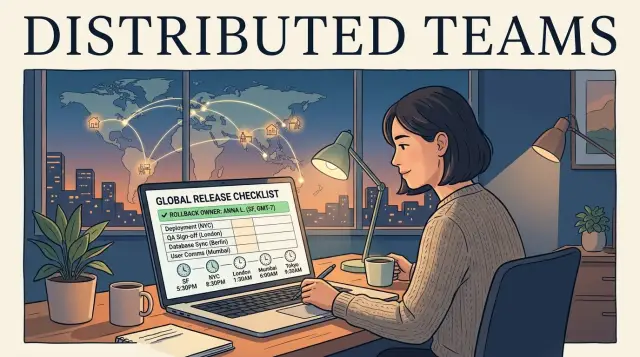
Table of Contents
Why launches turn into late-night pings
Most launch trouble starts before the code goes live. A team uses chat as the approval system, so one person writes "ready from QA," another adds "looks fine," and then everyone waits for the last reply. That gap feels small at noon and painful at 11:40 p.m. in someone else's city.
Chat-based approvals create dead time. People scroll through a long thread, miss one message, and ask again. Nobody feels sure that all checks are done, so they ping the person who seems awake. It is faster than reading fifty messages, and that habit keeps the whole process messy.
This gets worse when nobody owns the final go or no-go call. Teams often confuse input with approval. QA can say the build passed. Product can say the feature is ready. Ops can say the deploy window is open. Still, someone has to decide whether the release ships now or waits. If that owner is unclear, the team collects opinions instead of making a decision.
A short delay can turn into a late-night chain reaction. The engineer in Europe waits on a product manager in the US. The product manager waits on a support lead in Asia. Each person sends a quick ping before logging off, hoping the next person will pick it up. Nobody wants to block the launch, so everyone stays half-online.
Rollback ownership adds another layer of stress. Teams can live with a slow approval if they know exactly who will reverse the release if errors spike. Many teams do not name that person. They assume the on-call engineer, the tech lead, or whoever pushed deploy will handle it. That guesswork makes even small issues feel bigger than they are.
Without clear async release approval, launches depend on who is awake, who replies first, and who feels brave enough to make the call. That is why late pings keep showing up. The problem is rarely time zones alone. It is missing ownership in a process that already moves across them.
What an async approval flow looks like
A good flow lets each region finish its part during normal work hours. People review, approve, and leave notes before the release window starts, instead of waiting around for a late-night message. That is the backbone of async release approval.
Start with one release window that gives every region at least some overlap. It does not need to be perfect. It just needs to be predictable. For example, a team in Europe, the US, and Asia might agree that releases always start at 14:00 UTC, because each group can still check in during its own day.
Put everything in one place. Use a single release ticket, document, or board for status, approvals, open issues, and final notes. If one person posts approval in chat, another leaves comments in email, and a third updates a spreadsheet, someone will miss something.
Deadlines matter as much as the window itself. Each team should approve or flag a problem by a set time, such as 2 hours before launch. If a team misses that deadline, the release lead should know what happens next: proceed, pause, or stop. You do not want people debating that at the last minute.
The people who can make those calls should be named before release day. One person can say "go." One person can say "pause." One person can say "stop" if the risk is too high. In small teams, that may be the same person. In bigger teams, write the names down so nobody guesses.
Shared language also cuts down noise. Pick a few terms and use them every time:
- "Ready" means this team finished checks and approves release.
- "Blocked" means release cannot proceed yet.
- "Paused" means the launch is on hold while someone investigates.
- "Stopped" means the release will not continue in this window.
A small example shows why this works. If QA in Poland signs off by 11:00 UTC, product in New York approves by 12:00 UTC, and the on-call engineer in Singapore sees one status page with all notes, nobody needs a 1 a.m. ping asking, "Are we good to go?"
Set one source of truth before release day
Pick one place for the whole release and stick to it. A shared doc, ticket, or release page works fine. What matters is that nobody has to hunt through chat, email, and old notes to figure out what is shipping.
That single page should show the build number, version, and release date at the top. Put them where people see them first. If someone in Singapore, Berlin, or New York opens the page half awake, they should know within five seconds whether they are looking at the right release.
Order matters more than most teams think. Write the checks in the same sequence people do them, not in the order they came up during planning. If the app team verifies the build before ops updates config, write it that way. A messy checklist creates delays because each person has to stop and guess what comes next.
Keep the page concrete:
- List every approval step in run order
- Put one owner name beside each step
- Add a short note field for blockers or decisions
- Mark whether a step is done, waiting, or skipped with reason
- Show who owns rollback if the release fails
Owner names stop a common problem in async release approval: everyone assumes someone else already looked at the risky part. Use real names, not team names. Product approved the copy is less useful than Maya approved the copy at 14:10 UTC.
The note field should stay short, but it matters. When someone pauses the release, they should leave one clear line: what blocked them, what they decided, and what the next person needs to do. That cuts down on late pings because the answer is already there.
A simple example looks like this: version 3.8.2, build 1847, release date Thursday 21:00 UTC. QA signs off first, then ops checks migrations, then the regional lead confirms customer support is ready, and one engineer owns rollback if error rates jump. One page, one order, one set of names. That alone removes a surprising amount of release stress.
Assign rollback ownership clearly
When a release goes sideways, teams lose time because nobody knows who can say "roll it back." That gap gets worse in async release approval, especially when one region is asleep and another is watching alerts. Pick one rollback owner for every release and write that name in the release record before work starts.
That person does not need to solve every problem alone. Their job is narrower than that. They watch the agreed signals, make the rollback call, and stop the team from arguing in chat while errors keep rising.
A clear rollback plan answers four plain questions:
- Who makes the rollback decision?
- What exact signals trigger that decision?
- What is the first action if those signals appear?
- Who takes over if the owner is offline?
Be specific with the trigger. "If things look bad" is useless at 2 a.m. "Rollback if checkout errors stay above 3% for 10 minutes" gives the owner something they can act on without asking three other people for permission.
Write the first move as one short sentence. For example: "Turn off the new feature flag, confirm the error rate drops, then post status in the release channel." If your team uses full deploy rollback instead, say that just as plainly. People make better decisions when the first step is already written.
Name a backup owner before the release window starts. Do not wait until the main owner goes silent. If the handoff crosses time zones, include the exact time when backup ownership begins. That removes the awkward moment where two people think the other one is still watching.
Teams also need one person to post the final rollback update. Sometimes that is the rollback owner. Sometimes it is the release manager. Either way, decide it ahead of time and state where that update goes. A short final message should confirm three things: rollback completed, user impact now stable, and who will check follow-up items after the window closes.
When one name owns the call, one backup covers the gap, and one person closes the loop, late pings drop fast.
Build a checklist people can finish half asleep
A release checklist works best when every line has a clear answer. People should read it at 11:30 p.m., tired, on a phone, and still know whether the answer is yes or no. If a line needs a meeting to explain it, cut it.
Vague checks slow everyone down. "API looks good" invites debate. "Payments API returns a successful test charge" gives one person a simple job and a simple result.
Use the exact names your team sees in tools and dashboards. Write "Billing service", "signup form", or "iOS app version 4.8.1" instead of "backend" or "mobile stuff". That matters even more in async release approval, where the next person may wake up six hours later and have no context.
Smoke tests should match what users actually do. Skip checks that only prove the server is alive. A better test is a short path like: sign in, create an order, send a confirmation email, open the dashboard. If customers cannot do those basic actions, the release is not ready.
A good checklist entry looks more like this:
- Signup form loads and creates a new account: yes or no
- Billing service processes one test payment: yes or no
- Search returns results for an existing product: yes or no
- Error rate stays normal for 15 minutes after deploy: yes or no
- Approval recorded with time and team location: yes or no
Proof helps, but only when the risk is real. Ask for a screenshot, log line, or test result on steps that can block users or cost money. Do not demand proof for every small item, or people will spend more time documenting the release than checking it.
Add the sign-off time and the team's location on every approval. "Approved, 21:10 UTC, Berlin team" tells the next region two useful things at once: who checked the release, and how fresh that check is.
One simple rule keeps these lists usable: each line should tell one person to verify one thing in one place. That is how distributed team launches stop turning into late pings.
Run a follow-the-sun handoff step by step
When a release moves across regions, the handoff matters more than speed. Async release approval works when each team leaves clear proof of what is done, what is still open, and who owns the next move.
Start in the earliest time zone, during normal working hours. That team should finish the prep work first: update the release record, attach test results, note the exact build, name the rollback owner, and flag any risk that still needs a human check. If they leave loose ends, they are not handing off a release. They are handing off confusion.
A simple flow usually works best:
- The first team completes the checklist and turns every required item green.
- The release owner posts one handoff note in the shared release record with the build number, status, and planned next action.
- The next team replies in that same place and confirms receipt with a start time.
- If any owner leaves an open blocker, the team pauses the release instead of pushing forward and hoping for the best.
- The final team closes the release window at the agreed time and records one result: shipped, paused, or rolled back.
Do not hand off yellow work. If database checks are still running, if support has not been warned, or if nobody can trigger rollback, stop there. Waiting for a quiet chat reply at 1:30 a.m. is not a process.
The fixed closing time matters more than teams expect. If the window ends at 18:00 in the active region, it ends at 18:00. No one should linger online "just in case." The next region can pick it up later, but only after the release record shows a clean state and clear ownership.
This keeps distributed team launches boring in the best way. People wake up to status, not surprises.
Example: a Thursday release with three regions
A Thursday release works well when each region has one clear job and leaves enough context for the next team. The point of async release approval is simple: nobody should wake up just to repeat something they already knew six hours earlier.
On Thursday afternoon, the Europe team finishes prep and updates the release checklist before sign-off. They confirm the build version, migration status, feature flags, support notes, and known risks. If something may confuse the next team, they leave a short plain note beside it instead of hiding it in chat.
- 16:00 CET: Europe marks pre-release checks done and records any open question.
- 10:30 ET: The US team picks up the same checklist, reviews dashboards, and compares live metrics to the agreed baseline.
- 13:00 ET: The US team approves the launch window and starts the release.
- 09:00 SGT: APAC starts its day and watches the first full business-hours traffic after release.
The US team does not ask Europe to stay online "just in case." If Europe leaves weak notes, the launch waits. That sounds strict, but it saves more sleep than any busy release channel.
Once the release is live, APAC handles the early post-release watch. They check a small set of signals that everyone agreed on before launch: login failures, payment success, queue depth, and support tickets. They are not guessing. They are checking numbers against a line that already exists.
If those numbers cross that line, the rollback owner acts. One person owns that call. They have access to the deploy tools, know the rollback steps, and can turn off a feature flag or move traffic back to the previous version without asking five people for permission.
That single owner matters more than teams expect. A group chat does not roll back a bad release. One prepared person does.
Nobody needs a midnight ping because the checklist carries the context forward. It tells each region what changed, what to watch, what counts as trouble, and who decides. That is how a release process across time zones stays calm instead of turning into a chain of late-night messages.
Mistakes that keep dragging people back online
Chat is the worst place to approve a release. One person says "looks good" in Slack, another replies in email, and a third adds a blocker in a different thread 20 minutes later. By the time the window opens, nobody knows which message counts.
Async release approval works only when every approval lands in one place with names, timestamps, and a clear status. If people have to search chat to reconstruct a decision, the process already failed.
Rollback confusion creates even more damage. Teams often name a release owner, then quietly assume someone else will reverse the change if metrics drop. At 1:15 a.m., the engineer on call thinks product will decide. Product thinks ops already rolled back. That gap wastes more time than the bug itself.
Vague steps create fake confidence
A checklist line like "check if things look fine" is almost useless when someone reads it half asleep. People need concrete actions and clear limits. Check error rate. Confirm login still works. Verify payment success stays above the normal range. If a step cannot end with a clear yes or no, rewrite it.
Last-minute additions create their own mess. A manager jumps in after the window starts, asks for one extra screenshot or one more smoke test, and everyone scrambles to reopen work they already finished. Freeze the checklist before release day. If someone wants a new check, add it to the next release unless the risk is urgent and specific.
Missing approvals also need a hard deadline. If support, product, or compliance does not answer by the agreed time, the team should already know the rule: delay the release, escalate to one named person, or move ahead without that signoff. Without a cutoff, people keep watching their phones long after their workday ended.
Most repeat problems come from the same habits:
- approvals live in scattered threads
- rollback ownership is unclear
- checklist steps are vague
- managers add checks after the release starts
- nobody sets a final approval deadline
These mistakes look small on paper. In real launches, they pull tired people back online and turn a normal release into a long night.
Quick checks before each launch
Most release stress starts with small gaps that nobody notices until someone goes offline. A short pre-launch check catches those gaps early and keeps your team from turning an ordinary deploy into a chain of late pings.
If your async release approval flow depends on people remembering details from chat, it will break. The safer approach is boring on purpose: one status page, one owner per step, one deadline, and one person who can undo the release fast.
Use this quick pass before every launch:
- Confirm that everyone can see the same release status in one place. If one person checks a spreadsheet, another checks chat, and a third checks the CI pipeline, confusion starts before the deploy does.
- Put one named owner on each approval step. Shared ownership sounds polite, but it often means nobody acts quickly when the handoff arrives.
- Set a clear cutoff time before people log off. "Approve by end of day" is too loose when your team spans three regions. Use an exact time and timezone.
- Make sure the rollback owner can act without chasing permission. If production starts failing, that person should not need to wake up a manager to reverse the release.
- Test the handoff on a low-risk change first. A small internal update is enough to show where your process is vague, slow, or too dependent on one person.
A simple example: your Europe team finishes the build, your US team approves customer-facing notes, and your Asia-Pacific teammate watches the first hour after release. That only works if each person knows where to check status, when their decision is due, and who can roll back without a meeting.
Teams usually treat these checks as admin work. They are not. They are the part that lets people sleep through the night while the launch still moves forward.
Next steps for calmer releases
Start with one release that has low business risk. A routine Thursday update is better than a big launch. Run the full async release approval flow once, even if the team still keeps chat open as a backup.
People trust a calmer process after they see it work under normal pressure. One clean release does more than five meetings.
Before that release, cut any step that survives only because "we've always done it." Old habits create most late pings. If nobody can explain why a step exists, remove it or fold it into the checklist.
Write the rules in plain language. Each person should know:
- who can approve the rollout
- who owns the rollback
- what signals mean "pause"
- where the final status lives
Keep those rules short enough that someone can read them late at night and still make the right call. If a sentence sounds like policy text, rewrite it.
After the release, review one handoff that felt messy. Do not review everything at once. Pick the missed approval, unclear note, or vague ownership that pulled someone back online, then fix the checklist that same day while the details are fresh.
This is where most teams improve fast. A small repair to the checklist usually beats a full process redesign.
You also do not need a new tool to make this work. For most teams, a shared document, one release thread, and named owners are enough. If your release process across time zones keeps breaking because nobody owns the decision points, get help setting the rules.
A fractional CTO such as Oleg Sotnikov can help define rollout steps, rollback ownership, and handoff rules without turning release day into paperwork. Keep it simple, test it on one smaller launch next week, and judge the process by one standard: did anyone get pinged who did not need to be awake?


