AI pilot review lane for accelerators that keeps pilots small
An AI pilot review lane helps accelerators keep tests small, score outcomes, assign one owner, and decide fast whether a pilot should grow or stop.
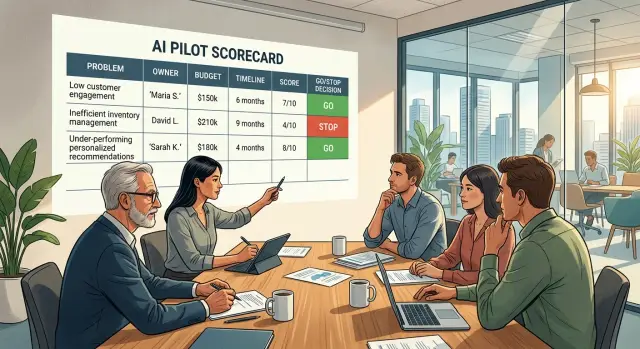
Table of Contents
Why budget alone fails
Budget feels concrete, so many accelerators start there. A startup asks for a modest AI budget, the number looks manageable, and the pilot gets approved. That sounds disciplined, but it skips the harder question: what problem is the team trying to fix?
When founders pitch a pilot before they name the exact workflow, user pain, or cost they want to change, the work turns into open-ended research. One team wants a chatbot. Another wants internal automation. A third wants better onboarding. All three ideas might sound promising, but none gives you a clean test on its own.
Time creates the next problem. If nobody sets a stop date, pilots drift. A six-week test turns into three months of model tuning, prompt changes, and demo prep. The cash spend may still look small, but the real cost grows through founder attention, staff time, and lost momentum.
Reporting often breaks after that. Each startup explains progress in its own way. One sends screenshots. One shares slides. One reports token costs and latency. Another tells a good story about user excitement. You can't compare results when every team uses a different format.
Polished demos make this worse. A smooth prototype can hide weak business results.
A founder might show an AI assistant that answers questions in seconds. It looks impressive. But if only five users tried it, nobody came back the next week, and support tickets didn't drop, the pilot didn't earn another round of funding.
Budget alone misses four things that matter more: the problem being tested, the deadline for the test, the reporting format, and the business result that decides whether the pilot continues or stops.
A review lane fixes this by forcing small bets to behave like real tests. Budget still matters, but it stops being the only guardrail. That shift usually saves more money than trimming a few software line items.
What a review lane should do
A review lane gives every portfolio company the same starting point. If one startup sends a two-page memo and another sends a chat message, the accelerator can't judge them fairly. A simple intake form fixes that. It should ask for the problem, the single use case, the team running the test, the expected result, and the cost ceiling.
Small pilots are easier to judge and easier to stop. Limit each one to a single use case and a single team. A seed startup might test AI to draft support replies for one support rep, not for the whole company. If a founder wants to test AI for sales, support, and product research at the same time, that isn't a pilot. It's spending without a clear signal at the end.
The lane should also force ownership. Every pilot needs one named owner, not a committee. That person collects the baseline, checks progress, and closes the test. Set the review date before work starts. Four weeks is often enough to tell whether a narrow test saves time, cuts errors, or gets ignored.
Consistency matters more than elaborate paperwork. The review lane should let the accelerator compare ten pilots side by side, even if the startups sell very different products. Use the same scorecard each time. Score business fit, effort, risk, adoption, and measurable outcome on the same scale. Then you can see which pilots deserve more time and which ones should end.
Outside technical leadership can help here. A good Fractional CTO can set the intake form, the scorecard, and the stop rules once, then let founders move fast inside clear limits. Every pilot should start the same way, have one owner, and end with a decision.
Set the rules before pilots start
Small limits make pilots easier to judge. If an accelerator lets every team define a pilot on the fly, scope grows, costs drift, and nobody knows when to stop. A review lane needs a few fixed rules that apply to every company in the batch.
Start with hard caps. Put a ceiling on time, cash, and team size before anyone writes a prompt or buys a tool. A simple rule works well: one pilot, one owner, no more than two people involved, and a short test window. That keeps pilots from turning into side projects that eat a founder's week.
Each pilot also needs two plain sentences. One says what success looks like. The other says when to stop. "Cut first reply time by 30%." "Stop if staff still has to rewrite most outputs after two weeks." Those rules are plain on purpose. They stop teams from calling a messy result a win.
A one-page brief is usually enough if it answers a few direct questions: What problem are we testing right now? Which number will prove the test worked? What makes us shut it down? Where will the data come from? Who can approve more time or money?
The data question matters more than many teams expect. If a startup wants to test an AI sales assistant but its CRM data is thin, old, or full of duplicates, the pilot may fail for a basic reason: bad input. Ask that early and you can save weeks.
Approval rules matter too. If a team reaches day 14 and asks for "just one more sprint," someone named in advance must say yes or no. That person might be the accelerator lead, a partner, or an outside technical advisor. The title matters less than the clarity.
Run a fast risk check before launch. If a pilot touches customer messages, contracts, pricing, health data, or public content, flag it early. Legal issues, brand damage, and lost customer trust cost more than a small pilot budget.
Picture one portfolio company testing an AI support drafting tool. The lane gives it 21 days, a modest spend cap, one support manager as owner, and one metric: reduce agent handling time by 15% without lowering customer satisfaction. If the team can't get clean ticket data by day 5, the pilot stops. That one rule saves money and opens space for a better test.
Run each pilot in a simple flow
Pilots get messy when teams try to test too much at once. A simple flow keeps the review lane fair across the portfolio and makes weak ideas cheap to stop.
Start with one sentence that names the problem in plain language. For example: "Support agents spend too much time answering repeat refund questions." If a founder needs a full paragraph to explain the problem, the pilot is still too fuzzy.
Then cut the scope down to one narrow use case. Don't test "AI for customer support" or "AI for sales." Test one small job, with one team, in one channel. A better pilot drafts refund replies for English email tickets only, or writes follow-up emails after first demo calls for one sales rep.
Before any work starts, assign two people. The owner runs the pilot day to day. The reviewer checks scope, timing, and the final score. In an accelerator, the owner might be the startup CTO, product lead, or founder. The reviewer can be an operating partner or technical advisor. Keep those roles separate. People tend to grade their own work too kindly.
Set a short window and stick to it. Most accelerator AI pilots fit inside two to six weeks. That's long enough to collect real results and short enough to prevent drift. If a team says it needs three months just to learn, the scope is too wide.
Use the same flow every time:
- Write the problem in one sentence.
- Choose one use case.
- Name the owner and reviewer.
- Set the end date and one or two measures.
- Score the result and make a go, revise, or stop decision.
A realistic example helps. One portfolio company wants "AI for sales." The review lane pushes the team to test only demo follow-up drafts for one rep over four weeks. The founder owns it. The accelerator reviewer checks the result. At the end, they score time saved, reply rate, and error count. If the rep saves 20 minutes a day and the messages stay accurate, the pilot moves forward. If not, it stops, and the team records why.
That final step matters. A pilot without a clear stop decision doesn't stay small for long.
Score results with the same rubric
A review lane only works if every team reports results in the same format. If one startup sends a polished slide deck and another sends a rough spreadsheet, reviewers start judging presentation instead of outcomes.
Use one simple scale for every pilot, such as 1 to 5. Keep the rubric the same across the portfolio:
- Business value: Did the pilot save time, bring revenue, cut costs, or protect margin?
- Effort: How much work did the team spend to launch it and keep it running?
- Risk: Could it create legal, security, brand, or workflow problems?
- Confidence: How strong is the proof behind the result?
Business value should carry more weight than the rest. A pilot that saves a founder 10 minutes a week is fine, but it shouldn't outrank a pilot that cuts support time by 25% or lifts demo-to-paid conversion. Measurable impact on time, cost, or revenue should move a pilot up the list faster than team excitement.
Confidence matters just as much as ambition. If the startup can't show before-and-after numbers, if the sample size is tiny, or if tracking is missing, lower the score. A modest result with clean data is still more useful than a big claim with no proof.
Ask the same questions every time. What changed for users? What changed for staff? What changed for margins? Those answers usually tell you whether the pilot should grow, stay small, or stop.
Keep notes short so reviewers can compare five pilots in ten minutes. One compact block is enough: goal, metric, result, risk, and next step. Short notes force teams to be clear, and clarity makes portfolio experiment scoring much easier.
Give one person the job
Every pilot needs a named owner inside the startup. Not a team, not "the founders," and not the tool vendor. One person carries the pilot from setup to review. When nobody owns it, updates get fuzzy, deadlines slip, and the test stays alive long after it stopped helping.
Pick the owner based on where the pilot shows up in daily work. If the test changes sales calls, the sales lead should own it. If it changes support replies, the support manager should own it. The owner needs enough authority to get data from the team, ask for time, and admit when the pilot is failing.
That owner should bring evidence to every check-in. Opinions are cheap, especially when a team wants the experiment to survive. A short update is enough if it covers the same points each time: what changed, what it cost, what users actually did, what broke, and whether the pilot moved the number it was supposed to move. Screenshots, usage logs, sample outputs, and a simple before-and-after count beat a polished deck every time.
Keep the reviewer separate from the owner. The owner runs the pilot. The reviewer scores it. That split matters because people rarely grade their own work fairly. The reviewer might be an accelerator partner, a startup advisor, or a founder who isn't running the test day to day.
You also need clear stop authority before the pilot starts. If the evidence is weak, the cost jumps, or the team stops using the tool, someone must be able to end the test that week. In a small startup, that person is often the CEO, COO, or a Fractional CTO. Speed matters. If stopping a bad pilot takes three meetings and six opinions, the budget keeps leaking.
A simple example makes this concrete. Say a startup tests an AI support assistant. The support lead owns it and brings weekly numbers on reply time, error rate, and staff usage. An accelerator reviewer checks the scorecard. The founder can stop the pilot at once if the bot gives customers wrong answers twice in one week.
A realistic portfolio example
Picture an accelerator with three portfolio teams testing AI in the same month. They all have the same budget cap, but the review lane doesn't treat them as equal. It checks owner, scope, proof, and risk before anyone talks about scale.
The first company uses AI to draft refund email replies. A support lead reviews every message before it goes out, so the test stays small and safe. This pilot scores well on ownership and proof because the team can track reply time, approval rate, and complaint volume after two weeks.
The second company tries AI summaries for sales calls. The idea sounds useful, but the inputs are messy. Reps log notes in different formats, some calls never reach the CRM, and the sales lead has no shared standard for what a summary should include.
That gives the pilot a mixed score. The upside is decent, but readiness is low, and the owner is weak because nobody has time to clean the data or review the output every day.
The third company wants AI code review for a four-person product team. On paper, it looks modern and cheap. In practice, the team ships only a few pull requests a week, one senior engineer already reviews most changes in minutes, and nobody has defined what the AI should catch beyond style comments.
This pilot scores low. Ownership is unclear, the volume is small, and the likely gain is minor. There is also a real risk of noisy comments that slow reviews instead of helping.
After one review cycle, the accelerator makes three different decisions. It scales the refund email pilot because first-draft time dropped by about 40% and approval quality held steady. It reworks the sales summary pilot because the team needs one call template, one owner, and a better baseline before testing again. It stops the AI code review pilot because the review volume is too low to justify another tool and extra oversight.
That's the whole point of a review lane. It stops the portfolio from treating every AI idea like a winner, and it gives each pilot a fair, plain test before more money goes in.
Mistakes that waste pilot budgets
The fastest way to burn through an accelerator budget is to fund too many AI pilots at once. Five small tests can look safe on paper, but the review load, staff time, and follow-up work pile up fast. By the time the first check-in happens, people already feel committed, even if two pilots should have stopped in week one.
Another common mistake is letting the vendor define success. Vendors often choose measures that flatter the demo: faster draft output, more messages handled, nicer summaries. The accelerator needs its own scorecard. If a startup wants to test AI for support, success might mean fewer repeat tickets, lower handling time, or fewer manual handoffs, not "the team liked the tool."
Scope creep is where a cheap test turns into a quiet budget leak. One good demo call often leads to extra features, another team joining, and a longer trial. A pilot that started as "test AI on 50 support tickets" becomes "roll it into onboarding, sales, and docs too." That is no longer a pilot. It's an unplanned product project.
The budget line also lies when it ignores staff time. Founders, ops leads, and engineers may spend 20 or 30 hours setting up prompts, cleaning data, checking outputs, and fixing process gaps. If that time sits outside the pilot budget, the experiment looks cheaper than it is. Lean teams learn this quickly: labor is part of the cost, even when no invoice shows it.
The last trap is emotional. Weak pilots often stay alive because nobody wants to make the awkward call. A founder likes the vendor. A mentor asked for the test. The team got one promising result and wants "just two more weeks."
Pause any pilot that starts without review, uses vendor-written metrics, adds scope after an early demo, leaves staff hours out of the cost, or asks for an extension without new evidence. One pause at the right moment can save more than the original budget ever did.
Quick checks before the next round
A second round should be harder to enter than the first. More budget or more time only makes sense when a team can show that the pilot touched a real workflow problem, not a loose idea that sounded good in a meeting.
The proof should be plain. A founder or operator should be able to say what changed, where it changed, and how they measured it. If they can't do that in a few lines, the pilot is still too fuzzy to expand.
Before approving anything, ask a short set of questions. What exact workflow did the team test? "Research" or "operations" is too broad, while "drafting first replies for inbound leads" is specific enough. What do the before-and-after numbers show? Time per task, error rate, handoff delay, cost per case, or completion rate all work. Who owns the pilot day to day? One person needs enough time on the calendar to run it, collect results, and answer questions. How fast can reviewers stop it? If a weak pilot needs three meetings and six opinions before anyone can end it, it will drag on. And what can the rest of the portfolio learn from it? A pilot doesn't need to succeed to matter, but it should leave a reusable lesson.
A simple example makes this easier to judge. Say one startup tested AI for customer support triage. If the team can show that routing time dropped from 9 minutes to 2, the support lead owned the work, and two other companies can copy the same intake rules, the pilot earned a second round. If the team only says, "the model seemed promising," it didn't.
This is where the lane does its best work. It keeps the bar clear and stops weak pilots from surviving on enthusiasm alone. If a team can't answer these checks on one page, pause the next round and send the pilot back for tighter work.
Next steps for the accelerator
Most accelerators should start smaller than they think. Run three to five pilots first, not twenty. A small batch is easier to review, easier to compare, and much harder for weak ideas to hide inside.
Too many pilots create the same problem every time: founders stay busy, but nobody can say which test earned more time or money. A tighter batch gives mentors and operators room to judge results instead of chasing updates.
Use one shared scorecard across the whole cohort. Keep it simple and keep it the same for everyone. Each startup should report the problem, the pilot owner, the cost, the time spent, the early result, the risk, and the decision for the next month. Set the review date before any pilot starts. Monthly works well for most programs. It's long enough for a real test and short enough to stop drift.
One person should run this process across the cohort. That person doesn't need to build the product or write prompts. They need to make sure every pilot has one owner, one scorecard, and one decision date. If nobody owns the lane, the lane disappears.
A sensible first round is simple: pick a small set of pilots, assign one owner to each, use the same scorecard across the batch, review results on the same date each month, and then stop, narrow, or extend each pilot after review.
Some accelerators also need a neutral operator who can review several startups without founder bias. If that's the case, Oleg Sotnikov at oleg.is is one option. He works as a Fractional CTO and startup advisor, helping startups and small teams set practical pilot rules, technical ownership, and AI adoption processes.
If the program needs help defining the lane before the next cohort starts, a short consultation can be enough. The goal isn't more process. It's a simple system that keeps pilots small, comparable, and easy to stop.
Frequently Asked Questions
Why is budget alone not enough for an AI pilot?
No. Budget only limits spend. It does not tell you what problem the team will test, when the test ends, how the team will report results, or what result earns more time. Start with a narrow workflow, one metric, one owner, and a stop date.
What does an AI pilot review lane actually do?
It gives every startup the same rules before work starts. You use one intake form, one scorecard, one owner, and one review date, so you can compare pilots by results instead of by demo quality or founder enthusiasm.
How small should a pilot be?
Keep it small. Pick one use case, one owner, and no more than two people involved. If a team wants to test support, sales, and research at the same time, split that into separate pilots or stop and narrow the scope first.
How long should a pilot run?
Most teams can learn enough in two to six weeks. Four weeks often works well for a narrow test. If a team asks for three months just to learn, the scope is too wide or the data is not ready.
What should go in the pilot intake form?
Ask for the problem, the exact use case, the owner, the expected result, the cost cap, the data source, and the review date. Add one sentence for success and one sentence for stopping. That gives reviewers enough to judge without slowing the team down.
Who should own the pilot inside the startup?
Choose the person closest to the workflow. A support lead should own a support pilot, and a sales lead should own a sales pilot. That person needs time to collect baseline numbers, check progress, and say when the test is not working.
How should we score pilot results?
Use the same rubric every time. Score business value, effort, risk, and confidence on the same scale. Put more weight on measurable gains like time saved, lower costs, better conversion, or fewer errors than on a polished demo or positive comments.
When should we stop a pilot?
Stop when the team misses the success metric, lacks usable data, sees poor adoption, or keeps adding scope instead of proving the first use case. Also stop fast if the pilot creates legal, brand, security, or customer trust problems.
What mistakes waste pilot budget the fastest?
Teams waste money when they run too many pilots at once, let vendors define success, hide staff time outside the budget, or extend tests without new evidence. Another common problem is vague ownership. If nobody owns the pilot, it drifts.
When does a pilot deserve a second round?
Approve another round only when the team can show a real workflow, clear before and after numbers, one active owner, and a lesson the rest of the portfolio can reuse. If you need outside help to set the rules, a Fractional CTO can set the lane and keep reviews consistent.


