AI-first CTO interview: use one messy workflow test
An AI-first CTO interview works better when you give one messy workflow and ask for review steps, cost limits, and failure handling.
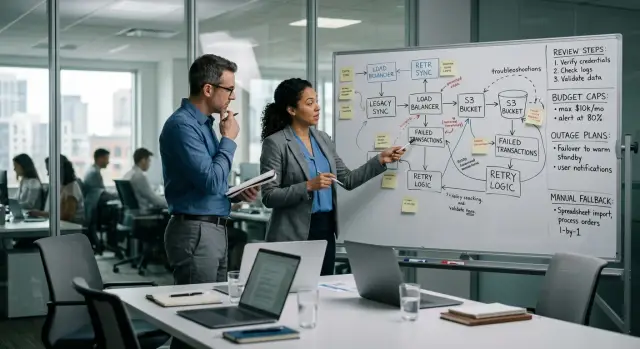
Table of Contents
Why broad AI talk gives weak signals
A candidate can sound sharp for 20 minutes and still tell you almost nothing about how they run work. AI talk makes that worse. People can repeat familiar points about agents, RAG, fine-tuning, Claude, GPT, or open-source models and still have no habit of setting limits, checking output, or cleaning up failures.
Broad opinion questions invite polished answers. Ask, "What do you think about AI in engineering?" and you often get a confident speech about speed, innovation, and the future of teams. That speech does not show whether the person can protect production, control spend, or stop a bad automation before it spreads bad data.
A CTO earns trust through operating judgment. You see that judgment when the problem is messy. Give the candidate one workflow with missing details, conflicting goals, and a real downside if the AI gets it wrong. Now they have to make choices.
They need to say where the AI starts, where a human checks it, what gets logged, what gets retried, and when the system should stop and ask for help. Those review steps tell you much more than tool names do.
A weak candidate often stays at the buzzword level:
- "I would use agents for this"
- "We should add RAG"
- "A multi-model setup would help"
A stronger candidate gets concrete fast. They ask what the input looks like, how often it fails, what an error costs, and who owns the final approval. They might say a simple prompt plus a human review is enough for phase one, then add automation only after they measure error rates and token spend.
That is the real signal. Good CTO candidates turn vague AI excitement into a small, controlled process. If they cannot do that in an interview, they probably will not do it when deadlines, costs, and production risk show up.
Pick one messy workflow
Use a process your company already struggles with. The best test is not a clean demo case. It is a real chain of work with awkward handoffs, late approvals, and missing details that people patch over every day.
Good choices usually cross a few boundaries. One person starts the work, another reviews it, a third approves it, and two or three tools hold bits of the truth. That mess is useful. It shows whether a CTO candidate can improve the system you have, not an imaginary one.
A strong interview workflow usually has these traits:
- People make decisions at more than one step
- Data arrives incomplete or in the wrong format
- Work moves across several tools
- Delays happen because nobody owns one part clearly
- Someone has to approve cost, risk, or customer impact
Do not clean the process up before the interview. Leave in the duplicate fields, the copied notes, the spreadsheet export, the Slack message that starts the whole thing, or the approval that only happens when one manager is online. Those rough edges reveal how the candidate thinks.
For an AI-first CTO interview, this matters more than broad opinions about models. A candidate can sound smart while talking about agents, automation, or model choice in the abstract. It is much harder to stay vague when they have to explain how they would handle bad inputs, human review, and tool failures in one real workflow.
Avoid toy tasks like "write a prompt for support" or blank-sheet questions like "how would you rebuild our ops with AI?" Those questions reward confidence more than judgment. A messy workflow forces tradeoffs. The candidate has to ask where the data comes from, which step really needs a human, and where cost can quietly get out of hand.
Keep the scope tight enough to explain in 10 minutes. If the process is too big, the interview turns into storytelling. If it is too neat, you learn almost nothing.
What to give the candidate
Give them a small packet, not a vague prompt. One page is often enough. If the brief takes ten minutes to read, it is probably too polished and too easy.
Start with one plain sentence that names the job to be done. "Support agents receive customer emails, copy details into the CRM, draft a reply, and escalate refund cases" is enough. A simple goal keeps the interview grounded and stops the candidate from drifting into broad talk about AI.
Then describe the workflow as it happens today. Keep it messy and human. Include the real handoffs, copy-paste work, tools people use, and where delays show up.
If three people touch the same task, say so. If staff still use a spreadsheet because the main system is slow, include that too. This is where a good AI-first CTO interview starts to feel real.
Do not clean up every detail. Leave a few holes on purpose. Maybe the brief does not say who checks AI output before a refund goes out. Maybe it skips where source documents live, or how often the CRM fields change.
Strong candidates notice those gaps fast and ask about them. Weak candidates fill them with guesses and act confident.
Add hard limits so the conversation stays tied to the business:
- Set a budget limit, such as $3,000 a month for new tools and model use
- Set a time limit, such as 4 weeks with one engineer
- Set a business risk, such as wrong refunds, leaked customer data, or missed urgent cases
- State one rule they cannot ignore, such as keeping a human approval step for refunds
A short pack gets even better when you add two or three raw examples. Paste in a real support email, a messy CRM note, and one case that went wrong last month. That gives the candidate something concrete to review instead of forcing them to speak in general terms.
You do not need a perfect case study. In fact, a rough one works better. The point of a CTO candidate assessment is not to see whether they can admire AI. It is to see whether they can turn a flawed workflow into a safer, cheaper, faster process without pretending the messy parts do not exist.
How to run the interview
Give the candidate one messy workflow and keep the room calm. You are not testing who can talk fastest about AI. You are checking whether they can turn a vague process into a system that people can trust, afford, and ship.
In an AI-first CTO interview, the first ten minutes matter more than most hiring teams expect. Let the candidate ask clarifying questions before they propose anything. Strong candidates ask about inputs, edge cases, approval rules, current tools, who owns the process, and what failure looks like. Weak ones jump straight to model names.
Then move through the interview in a fixed order:
-
Ask for review steps before any model choice. A serious candidate should describe where humans review outputs, what gets auto-approved, and which actions need a second check.
-
Only after that, ask what they would build first. The best answers stay small. They pick one narrow version, define a success metric, and avoid turning the workflow into a giant platform project.
-
Ask how they would test the first version safely. Look for staging data, red-team style prompts, bad-input cases, and a clear way to compare AI output against the current manual process.
-
Ask how they would cap spend and track usage. Good answers include request limits, budget alerts, logs per task, token or API cost tracking, and rules for when a cheaper model is enough.
-
End with a rollout plan for the first month. They should explain week one setup, a pilot with a small group, what they will measure each week, and when they would expand or stop.
One thing usually separates experienced operators from enthusiastic talkers: they think about failure early. If the candidate leaves fallback paths, audit logs, and rollback rules until the end, that is a warning sign.
A practical candidate often sounds a bit less flashy. That is fine. If they can explain who reviews output, how they test safely, where the budget cap sits, and what happens on day 12 when the system makes a bad call, you are getting real signal.
What a solid answer includes
A solid answer starts with the current workflow, not the AI stack. The candidate should ask who does the work now, what inputs arrive, where delays happen, where errors slip in, and what a finished result looks like. If they jump straight to model names or agent ideas, they are skipping the part that decides whether automation will help at all.
They should also break the workflow into three clear buckets: automate, assist, and keep manual. That split shows judgment. Repetitive steps with clean rules often fit automation. Drafts, summaries, and first-pass classification often fit an assist model. Approvals, payments, legal changes, and unusual cases should stay with a person unless the company has very tight controls and real evidence that the system handles them well.
In an AI-first CTO interview, this is one of the best signals to watch for. Good candidates treat human review as part of the design, not as an afterthought. They know that a person should stay in the loop where mistakes cost money, create compliance trouble, or hurt customer trust.
Operational detail matters too. A thoughtful candidate names what gets logged at each stage, what should trigger an alert, and who owns the step. For example, they may want logs for the incoming request, extracted data, model output, retries, approval status, and final action. They may suggest alerts for queue buildup, sudden cost spikes, repeated parsing errors, or confidence scores that drop below a set level. Just as important, they assign an owner, such as support, operations, or an engineer, instead of saying "the team" will handle it.
A good answer also gets smaller when the first version starts to sprawl. That is usually a good sign, not a weak one. Sensible candidates cut scope to one source of input, one model path, one approval rule, and one or two measures that matter, such as time saved or error rate.
The best answers sound practical. They do not promise full automation in week one. They show where AI helps, where people still decide, and how the company can test the idea without turning one messy workflow into three new problems.
A simple example to use in the interview
Use a workflow that looks ordinary but breaks in small, expensive ways. A good one is a sales team that copies leads from email into a CRM, then uses AI to draft follow-up emails and meeting notes.
This works because it is easy to understand and hard to fake. Most CTO candidates can talk about AI in general terms. Fewer can look at a messy process and say where bad data enters, where money gets wasted, and where a wrong message can damage trust.
Give them a scenario like this: the sales inbox gets direct emails, forwarded referrals, and replies from old prospects. A staff member or simple parser pushes contact details into the CRM. Then an AI step drafts the first reply, writes a short summary for the account record, and prepares meeting notes after a call.
Add a few realistic problems:
- the same lead arrives twice with slightly different names
- one email has no company name
- another includes an old signature block with the wrong phone number
- a forwarded message mixes two people in one thread
- the CRM already has a record from six months ago
A solid candidate should pause on duplicates right away. They should ask how the system matches records, what fields count as trusted, and what happens when email data conflicts with the CRM. If they do not ask that, they are probably thinking about the AI layer first and the workflow second.
They should also set approval rules before any message goes out. For example, AI can draft a reply, but the team should block automatic sending when the lead is new, the confidence score is low, the CRM record has conflicting facts, or the draft includes details that did not appear in the source email.
The best part of this test is the failure case. Ask what happens when the draft gets facts wrong. Maybe it mentions the wrong company, invents a meeting time, or assumes interest that the lead never showed. A strong answer is simple: do not send it, show the source text next to the draft, flag the record for review, and log the error so the team can see whether the issue came from parsing, retrieval, or the prompt.
That tells you much more than a broad AI-first CTO interview question about "strategy."
Cost controls to ask about
A candidate who reaches for the biggest model first is already giving you a weak answer. Good AI work usually starts with a cheaper option, then moves up only where accuracy really changes the result.
Ask them to break the workflow into steps and price each one. A sensible plan might use a small model to sort incoming items, a stronger model only for hard cases, and plain code for rules that never need a model at all. That is how teams keep costs under control without slowing the work down.
In an AI-first CTO interview, a few direct questions tell you more than broad opinions:
- Which step can run on the cheapest model without hurting the outcome?
- What is the spend cap for a two-week test, and what is the cap once this goes live?
- How will you track usage by workflow, by team, and by a business result such as tickets closed or invoices processed?
- Which low-risk jobs would you batch every hour or overnight instead of sending one by one?
- How often would you review the numbers, and when would you cut a step that costs money but adds little?
Listen for concrete numbers. “We will monitor cost” is soft. “We will cap the pilot at $1,500, then pause if cost per resolved ticket goes above $0.80” is much better. The exact number matters less than the habit of setting one.
Batching is another easy test. Many candidates forget it. If the workflow includes summaries, tagging, or draft replies, they should ask whether those tasks need instant results. If not, they can group requests and send them together. That often cuts API cost and reduces traffic spikes.
Weekly review matters because waste hides in small steps. One prompt gets added, then another check, then a second model “just to be safe.” A strong CTO candidate will say they want a short weekly review of spend, quality, and business output, then remove anything that does not earn its place.
That answer shows discipline. It also shows they know AI costs do not drift down on their own. Teams have to trim them.
Failure handling they should cover
A strong CTO candidate does not talk about AI as if it only works on sunny days. They should start with breakage. If the workflow depends on emails, forms, tickets, invoices, or call notes, ask what happens when the data arrives late, arrives twice, or arrives with missing fields.
Good answers get concrete fast. A weak candidate says, "we'll validate inputs." A better one says, "if the invoice total is missing, the system sends it to a review queue, logs the reason, and stops any downstream action." That level of detail matters because most messy workflows fail at the edges, not in the happy path.
Wrong answers that sound right need their own checks. If a model extracts terms from a contract or drafts a reply to a customer, ask how the team would catch a clean, confident mistake. The candidate should talk about simple controls such as source citation, rule checks against known fields, spot reviews, and human approval for actions that touch money, compliance, or customer commitments.
You want to hear a fallback plan too:
- what triggers a stop or downgrade
- who owns the incident when the model or vendor fails
- which manual path keeps work moving that same day
- when the team rolls back queued actions
- who tells customers, and what they say
The owner matters. "Engineering will look at it" is too vague. A solid answer names a person or role, such as the on-call engineer, ops lead, or support manager. If the main model goes down, the candidate might switch to a simpler rules-based path, a second model, or a manual queue. Any of those can work if they keep the business moving.
A small example makes this easy to judge. Say the workflow sorts inbound support requests and drafts replies. If the vendor fails for two hours, the system should stop auto-sending messages, route new tickets into a human queue, alert the team, and keep a record of what did not run. If bad drafts already went out, the candidate should explain how they would pause the job, trace affected customers, and send a plain correction.
That answer shows operational judgment, not just AI enthusiasm.
Mistakes interviewers make
A polished answer can fool a hiring team fast. Many candidates sound sharp when they talk about AI in broad terms, but that tells you very little about how they would run a team, control spend, or deal with failure on a real project.
One common mistake is rewarding confidence instead of operating detail. If a candidate says they would "use agents," "automate reviews," or "add a model layer," ask what happens when the model gives a bad answer, who checks output, what gets logged, and how much the process costs each week. Strong candidates get specific. Weak ones stay abstract.
Another mistake is turning the interview into a debate about AI trends. That usually favors people with strong opinions, not people who can build a process that works on Monday morning. A better CTO candidate assessment uses one messy workflow and asks for decisions, tradeoffs, and fallback plans.
Interviewers also skip privacy, security, and audit questions far too often. That is a problem. A candidate who ignores customer data boundaries, access rules, prompt logging, or change history is telling you how they will operate later. If your workflow includes invoices, support tickets, medical notes, contracts, or internal code, those details matter right away.
Staff adoption gets ignored too. A plan is incomplete if nobody owns it after launch. Ask who trains the team, who approves prompt changes, who reviews failures, and who can stop a bad automation before it spreads bad output through the business.
A few red flags show up often:
- They speak in general claims and avoid numbers.
- They skip human review points.
- They treat security as a later step.
- They assume the team will "figure it out" after launch.
The comparison itself can also be flawed. If one candidate gets a vague scenario and another gets a detailed one, your result is noise. Give every person the same workflow, the same budget limits, and the same follow-up questions. In an AI-first CTO interview, consistency matters as much as the answer.
Quick checks and next steps
A good AI-first CTO interview should leave you with something concrete. You are not trying to find the person with the strongest opinions about AI. You are trying to find the person who can take a messy workflow, explain it clearly, reduce risk, and move it into production without wasting money.
Start with a simple scorecard. If two candidates sound equally smart, this makes the difference easier to see.
- Ask yourself if they could explain the workflow in plain language. If they hide behind jargon, they may struggle with real teams.
- Check whether they asked about cost, failure paths, and who owns each step early in the conversation. Strong candidates do this almost right away.
- Look for a small pilot, not a giant plan. The pilot should have one clear success measure, such as cutting manual review time by 30% or reducing support backlog by a set number of hours each week.
- Ask every candidate to send a short written plan after the interview. One page is enough if they know what they are doing.
That written plan matters more than most interview chatter. It shows whether they can think in sequence: what to test first, what data they need, where the model can fail, how much it may cost per month, and when a human should step in.
If you compare candidates, use the same exercise and the same follow-up request for all of them. This keeps the process fair. It also stops confident speakers from winning just because they talk well.
A second review can help if the role is important or the answers feel close. Oleg Sotnikov can review the exercise as a Fractional CTO and help you compare candidates on delivery, cost, and risk. That is useful when one person sounds ambitious and another sounds careful, and you need to know who will actually ship a working system.
One messy workflow, one interview, one short written plan. That usually tells you enough to make the next call.


