AI demo prep for founders: explain choices buyers trust
AI demo prep for founders helps you explain model choice, fallback paths, and human review in plain words buyers can follow during a live demo.
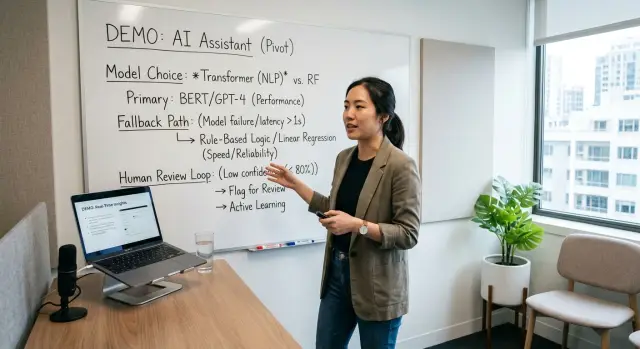
Table of Contents
Why buyers get lost in AI demos
Most buyers do not care whether you use GPT, Claude, an open-source model, or a mix. They care about the job in front of them. Can your product answer support tickets, review contracts, draft reports, or clean up messy data without creating more work for the team?
Founders lose people when they lead with model names, benchmarks, and terms like RAG, agents, fine-tuning, or context windows. That language might impress another technical founder. It usually does not help a buyer picture what happens after they click "run."
Jargon also hides the real workflow. Buyers want to know where the input comes from, what the AI does with it, what happens if the answer looks wrong, and who checks the final result. If those steps stay fuzzy, the product feels risky even if the demo looks polished.
Vague claims make that worse. "Our AI is highly accurate" sounds good for a second, then the harder questions show up. Accurate on what kind of task? What fails first? Who catches mistakes before they reach a customer or a manager?
A simple example shows the gap. If a founder says, "We use two models with retrieval and agent routing," many buyers nod politely and wait for it to end. If the founder says, "The system reads the customer email, drafts a reply, checks your policy docs, and sends uncertain cases to a human," the same buyer can judge the product in seconds.
Clear flow beats benchmark talk in almost every room. Buyers trust products they can follow. During demo prep, founders usually do better when they explain the work in plain steps and save the model detail for the moment someone asks.
Trust grows when the buyer can repeat the flow back to you. If they cannot explain it after three minutes, the demo is still too abstract.
Start with the job, not the model
Pick one task the buyer already knows from daily work. Good choices are easy to picture: turning a sales call into CRM notes, sorting support tickets by urgency, or checking invoices for missing fields. If the buyer can picture the job in five seconds, they can follow the rest.
Then show the input in plain words. Say what the system receives as if you were explaining it to a new hire: "a call transcript," "an email from a customer," or "a PDF invoice." Skip words like model, agent, context window, or fine-tuning at the start. In the first minute, those terms make people work too hard.
Next, show the output the team will actually use. Keep it concrete. "The sales rep gets three clean CRM fields and a follow-up draft." "The support lead gets a priority label and a short summary." Buyers trust demos more when they see work land in a familiar place, not in a clever interface with no obvious use.
The flow itself can stay simple. The user uploads one real piece of work. The system reads it and pulls out the parts the team cares about. Then the team gets the result in the format they already use. That order matters because people buy a result, not a model choice.
A short example makes this stick. A founder can say, "Our customer success team spends ten minutes reading each account handoff. We give the tool the handoff notes, and it returns a short risk summary, next steps, and missing items for the manager to review." That is easy to grasp because the buyer knows the job, the input, and the output.
A good test is simple: can someone repeat your first minute without using AI words at all? If they can, the demo starts on solid ground.
Explain model choice in plain words
Buyers do not need a tour of model names, benchmark scores, or vendor drama. They need a clear reason for the choice. Tell them what the model does for the user, how fast it works, what it costs to run, and where it needs help.
A simple explanation works better than a technical one. For example: "We use this model for first-pass answers because it is fast, cheap enough to run on every request, and good at routine language tasks. When the question gets harder, we switch to a stronger model or send it to a person."
That tells a buyer three useful things at once. The model fits the task, it fits the budget, and you are not pretending it is perfect.
If you need a short version during the demo, frame the choice around daily work. Say the model answers in a few seconds so staff do not wait. Say you can afford to run it on common requests. Say it handles routine cases well but can miss nuance in unusual cases, long documents, or requests with policy risk.
Keep the comparison tied to what the team already does. If the buyer runs sales, talk about drafting follow-up emails, summarizing call notes, or pulling next steps from meetings. If the buyer runs support, talk about sorting tickets, writing draft replies, and flagging cases that need a human.
A concrete example helps. If you are demoing an assistant for customer support, you might say, "For normal shipping questions, this model is fast and good enough. For refund disputes or angry messages, we route the case to a stronger model and then a team member checks the reply before it goes out." That sounds more honest than claiming one model handles everything.
Skip score charts unless the buyer asks for proof. Most people decide based on whether the workflow makes sense for their team, not whether one benchmark was two points higher than another.
Show the fallback path step by step
Buyers trust AI more when they can see what happens after the first answer goes wrong. Do not say "we have safeguards" and move on. Name the trigger, the backup path, and what the user sees.
Start with the trigger in plain language. A fallback starts when the first answer looks weak, incomplete, or off-topic. You can say, "If the first model misses required details, gives a vague answer, or conflicts with the source data, we do not treat that answer as final."
Then give the second path in one short line: "We send the same task to a stronger model with more context."
That sentence does a lot of work. Buyers hear that you do not hide failure, and you do not ask the user to guess what went wrong.
Next, explain the user view. If the first path fails, the user should not see a broken answer and wonder whether it is safe to trust. They should see a clear status such as "Checking this request" or "Reviewing for accuracy," then get the revised answer or a note that a person will confirm it.
A small example helps. Imagine a buyer asks, "Summarize this contract and flag renewal risk." The first model replies, "This is a standard vendor agreement," but it misses the auto-renewal clause on page 8. That weak answer triggers the fallback because it skipped a required risk item.
Now explain how your team tracks the handoff. Keep it concrete. Log the request ID, the reason for fallback, which model handled the second pass, whether a person reviewed the result, and how long the handoff took.
This matters because buyers want proof that your team can spot patterns, not just fix one bad answer during a demo. If ten similar requests trigger the same fallback, your team can improve the prompt, adjust the rules, or change which model handles that job first.
If a human reviews the result, say where that happens in the flow. One clear line is enough: "If the second answer still looks uncertain, a team member checks it before we show it as final."
A good fallback story makes the product feel safer. It also shows that your team understands real work, where first answers are useful but final answers need checks.
Show where a person reviews the work
Buyers relax when they can see the exact moment a person steps in. Keep that moment concrete. Say, "The system drafts the answer, then a support lead checks it before it goes out," or "The tool fills the claim, then an ops manager approves it." A clear handoff feels safer than vague talk about oversight.
Name the reviewer as a real role, not "the team." Buyers want to know who owns the decision. If it is a sales rep, nurse, analyst, or finance manager, say so. Then add the timing. "Most reviews take under two minutes" is better than "a human validates the result." It helps people picture daily use.
Explain what that person can do with the output. In most products, the choices are simple: approve it as is, edit the draft and send it, or reject it and start over. Simplicity builds trust faster than a complicated control diagram.
Risk changes the review rule
Review should get stricter when the stakes go up. A product description for an online store may need only a quick glance. A pricing quote, medical note, or legal summary needs a slower check and often a second person. Say this out loud in the demo. Buyers want to hear that you do not treat every task the same.
A small example works well. If your product drafts refund replies, the agent might approve most standard cases in one minute. If the refund is large, the customer is angry, or the account history looks unusual, the case goes to a senior manager. Buyers understand that rule right away.
Edge cases matter more than polished happy paths. Say that people handle unclear requests, missing data, conflicting records, or anything that looks unusual. That tells buyers the system knows when to stop and ask for help. It also shows that human review is part of the workflow, not a patch added at the last minute.
Build a three-minute explanation founders can rehearse
The best script is short enough to memorize and plain enough to survive a skeptical buyer question. If you have three minutes, spend about 30 seconds on the explanation and the rest on the product.
Start with the buyer's pain, not your stack. Buyers care about the moment work slows down, costs rise, or errors pile up. Give them one sentence that names that problem in normal language.
A script you can adapt
"Sales teams lose time because lead notes arrive in different formats and reps still clean them by hand."
"We use one model for this step because it handles messy text well and returns the output in the structure the workflow needs."
"If that model is unsure or the format looks wrong, the system tries a backup path or sends the case to a rules check instead of guessing."
"A person reviews the small set of low-confidence cases before anything changes in the system."
"The buyer gets faster processing, fewer bad updates, and a process they can trust."
That script works because each sentence answers one buyer fear. The first proves you understand the job. The second explains model choice in plain words. The third makes fallback practical. The fourth shows exactly where human review happens. The fifth ends with an outcome a budget owner can repeat later.
After the script, move straight into the screen that proves it. Show the input, the output, the point where the backup path kicks in, and the review queue. Buyers trust a demo more when they can connect each sentence to one visible step.
Rehearse until it sounds like speech, not copy. Cut model names if they do not help. Add one real number if you have it, such as "about 15 minutes saved per case" or "only 3 percent go to review." Specific numbers make the explanation feel lived in.
What a realistic buyer conversation sounds like
A buyer usually cares less about the model name than about what happens when their team uses the product on a normal Tuesday. Imagine a sales rep who uploads a customer email asking for a discount and a faster delivery date. The founder can walk through that moment in plain language.
"Your rep drops the email into the system. In a few seconds, it drafts a reply based on your rules, past approved responses, and the tone you want the team to use. The rep does not start from a blank page."
The buyer asks, "What if the draft gets it wrong?"
"The system checks how sure it is before anything moves forward. If the email is routine, the rep gets a draft right away. If the request looks unusual, unclear, or risky, the system sends it to a second path for a closer check."
That second path matters because buyers want to hear what happens when the first answer is not good enough. The founder does not need to talk about routing logic or model orchestration. A simple version is better: "We use a faster first pass for common cases. When confidence drops, we slow down and verify before anyone sends a reply."
The buyer then asks, "What counts as risky?"
"Things like refund requests, legal language, angry customers, custom contract terms, or discounts outside the normal range. In those cases, a manager reviews the draft before it goes out. The manager sees the original email, the proposed reply, and a short note on why the system flagged it."
Now the buyer can see the whole flow. A customer email comes in. The first model drafts a reply in seconds. Low-confidence cases move to a safer path. Sensitive replies stop for human review. No one has to guess where the guardrails are.
That kind of explanation builds trust because it sounds like an actual business process, not a lab demo. When founders explain it this way, buyers usually stop asking, "Which model is it?" and start asking, "How fast can my team use this without making mistakes?"
Mistakes that weaken trust
Buyers lose confidence fast when a demo sounds smarter than it is. They are not grading your choice of model. They want to know what the product does, where it can fail, and who steps in before a bad answer reaches a customer.
A common mistake is leading with model names instead of the task. "We use Claude for drafting and GPT for classification" does not tell a buyer why the feature matters. "The tool reads a support ticket and drafts a reply from the account history" is much clearer. After that, you can explain model choice in one plain sentence.
Another mistake is saving failure cases for the Q&A. That usually looks evasive. If the tool can miss context, time out, or produce a weak draft, say that early and explain the fallback path. Buyers trust a team more when they hear, "If confidence is low, the system asks for more data or sends the case to review," than when they hear a polished story with no weak spots.
Founders also hurt trust when they say humans check everything, even when they do not. That claim is easy to challenge. Be exact. Say when a person reviews the work and when the system acts on its own. For example, a human might review first-time customer requests, billing changes, or any output that scores below a threshold.
Promising perfect answers is another fast way to lose the room. Buyers already know AI makes mistakes. If you say "always" or "never," they start looking for the hole in your claim. A better promise is narrower and more believable: faster first drafts, fewer repetitive steps, and review on risky cases.
Too many features can also make a short demo feel slippery. One clean workflow usually beats five rushed ones. Show a single path from user request to answer, include the fallback, show the human check, and stop there. A simple demo often feels more real than an ambitious one.
Quick checks before demo day
A strong demo survives a plain retelling. If a buyer cannot tell your flow back to you after two minutes, the story is still too messy.
Ask a teammate to watch the demo once. Then stop and ask, "What happens first, what decides the next step, and where does a person step in?" If they miss the order, or jump straight to model names, your explanation needs simpler words.
You do not need another slide. You need a cleaner explanation. Describe the product as a job, not a model. Explain the backup path in one short breath. Point to the exact moment a person checks the output. Say what the system does after a bad answer. Then remove one slide that sounds smart but explains nothing.
The fallback part should take less than 20 seconds. For example: "We start with the fast model. If the answer looks weak or the confidence score drops, we send the same task to a stronger model. If it still looks wrong, a team member reviews it before anything reaches the customer." That is enough for most buyers.
Do not leave human review vague. Name one step. Maybe a sales rep approves a drafted email. Maybe an analyst checks flagged summaries. Buyers relax when they hear who reviews the work, what they review, and when they do it.
You also need one clear sentence for failure. Say it plainly: "If the AI gives a bad answer, we do not auto-send it. We log it, route it for review, and use that case to improve the prompt or rules." That sounds much safer than pretending the system rarely fails.
Then cut one jargon-heavy slide. Terms like "multi-agent orchestration" or "RAG pipeline" can wait for technical follow-up. In the room, buyers care about risk, speed, and control. If your demo still makes sense after removing the buzzwords, it is ready.
After the first rehearsal
The first rehearsal usually reveals the same problem: people follow the demo in the moment, then explain it back in a much fuzzier way. That gap shows where trust breaks. If a non-technical person cannot retell how your product picks a model, when it switches to a fallback, and where a person checks the result, your script is still too technical.
Ask one person outside your team to repeat the demo in their own words. Do not help. Just listen and note the exact step where they hesitate or simplify too much. If they say, "It sends it to AI and then someone reviews it," but cannot explain why that path exists, tighten that part.
A few edits usually fix most of the confusion. Replace model names with the job each one does. Explain the fallback trigger in one short sentence. Say who reviews the output and what they check. Cut details that sound clever but do not help a buyer decide.
Then write two versions of the script. Buyers care about risk, accuracy, handoff, and control. Investors usually care more about cost, speed, margins, and whether the workflow can grow without adding a big team.
For example, a buyer version might say, "We use a faster model for the first draft. If the result looks uncertain, we send it to a stronger model. A team member reviews anything customer-facing before it goes out." An investor version can keep the same flow but add why it keeps costs in check.
If you want an outside review, Oleg Sotnikov at oleg.is can help founders tighten the story, model choice, and review flow before the next session. His Fractional CTO and startup advisory work is especially useful when the product works but the explanation still sounds like it was written for engineers.
Bring the cleaner script into your next accelerator session and test it again. When people can repeat it back in about a minute, you are close. If they fall back on vague phrases like "AI magic," rewrite those lines until the story holds up without you in the room.
Frequently Asked Questions
Why do buyers get lost in AI demos?
Buyers get lost when founders explain the tech before the work. Most people want to see one familiar job, the input, the output, and who checks the result. If they cannot picture that flow fast, the demo feels risky.
What should I show in the first minute of the demo?
Open with one task the buyer already knows, like a support ticket, a sales email, or an invoice. Then show what goes in, what comes out, and where the result lands in the team's normal workflow.
How do I explain model choice without sounding technical?
Frame the choice around speed, cost, and fit for the task. You can say, "This model handles routine requests fast and at a cost we can afford on every request. If the case looks harder, we switch paths or ask a person to review it."
Should I mention GPT, Claude, or other model names early?
Wait until someone asks, or mention them only after the buyer understands the workflow. Model names help in technical follow up, but they rarely help in the first few minutes of a sales demo.
How do I explain the fallback path clearly?
Give the trigger, the backup path, and the user view. For example: if the first answer looks weak or misses required details, the system checks the task again with a stronger model or sends it to review, and the user sees a clear status instead of a shaky answer.
Where should human review appear in the workflow?
Put the review step at the exact point where risk matters. Say who reviews the work, what they check, and when they do it. A sentence like "The support lead reviews refund disputes before we send the reply" feels much safer than vague talk about oversight.
What kinds of cases should go to human review?
Send unusual, sensitive, or expensive cases to a person. That often includes refund disputes, legal terms, pricing exceptions, missing data, angry customer messages, or anything that conflicts with your rules.
How long should my explanation be during a demo?
Keep the explanation to about 30 seconds, then spend the rest on the product. Buyers remember short, plain language better than a long tour of your stack.
How can I tell if my demo explanation is clear enough?
Ask someone outside the project to retell the flow in their own words. If they can explain the task, the fallback, and the review step without using AI jargon, your story works. If they cannot, cut detail and make the steps simpler.
What mistakes weaken trust the fastest?
Founders usually lose trust when they promise perfect accuracy, hide failure cases, or stay vague about review. Another common mistake is cramming in too many features. One clean workflow with a clear backup path wins more often than five rushed ones.


