AI coding incident response: rules that prevent a second outage
AI coding incident response needs clear limits. Learn read-only checks, patch scope, approval steps, and fast checks that reduce outage risk.
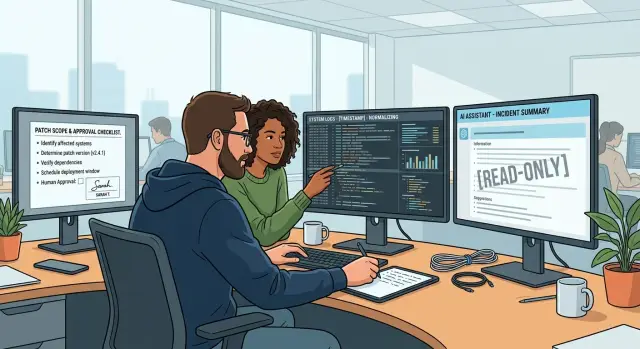
Table of Contents
Why AI can make an outage worse
During an outage, speed feels like the only thing that matters. That is exactly when an AI assistant can push a team the wrong way.
A model can read logs, suggest a patch, and explain it in a calm, confident tone. Tired people often accept the first answer because it looks plausible and arrives fast. In incident response, that habit is risky. The first fix is often a guess that sounds certain.
The model also works with whatever you give it, and outage data is usually messy. Logs are partial. Metrics lag. Alerts conflict. One service fails because another one failed first, but the model may lock onto the loudest symptom and miss the real cause. If the team acts on that guess, they can change the wrong service and slow recovery.
The risk jumps as soon as writes are involved. A single restart, config change, queue purge, schema edit, or cleanup script can erase the evidence you still need. Once someone overwrites a file, rotates a log, or changes production data, the team loses part of the story. Then they are no longer debugging the original outage. They are debugging the outage plus their own interference.
This gets worse when nobody sets limits. One engineer asks the model for a quick patch. Another copies the same idea into a second service. A third person deploys a related change "just to be safe." What started as one unproven fix spreads across the stack in minutes.
Small teams feel this pressure even more. If one person owns incident command, coding, and deployment, AI can amplify rushed decisions instead of acting as a safety check. The tool is fast. That speed is useful for summarizing logs or comparing recent changes. It is a bad reason to let it write straight into production.
Most second outages start the same way: partial evidence, a believable patch, and no clear boundary around what the team may change. Protect diagnostics, limit patch scope, and require human approval before any write. That keeps urgency from creating a fresh problem on top of the first one.
Start with read-only diagnostics
When alarms go off, make the AI a reader, not a writer. Keep write access off at the start. No file edits, no config changes, no generated patches, and no deploy actions until a person sets the boundaries.
That pause matters because the first story during an outage is often wrong. A model can spot patterns fast, but if you let it act before the facts are clear, it may change three things when only one is broken. That is how a bad hour turns into a long night.
Start by pulling evidence from systems that already tell you what happened. Give the model raw material and ask it to organize it, not solve it.
What to gather
- Recent logs from the affected service
- Metrics around errors, latency, traffic, and resource use
- Traces for failed requests or slow paths
- Notes on recent deploys, config changes, feature flags, and incidents
Keep the request narrow. Ask for a timeline, a list of symptoms, the likely blast radius, and gaps in the data. Ask questions like "What changed first?" or "Which service started failing before the others?" Avoid prompts like "fix this" or "write a patch" at this stage.
A useful summary separates facts from guesses. Facts are things your team can verify: error spikes at 09:14, one service restarted twice, checkout failures rose after a config push. Guesses belong in a separate section and should be labeled clearly.
Save every prompt and every answer in the incident channel, ticket, or notes document. Later, that record helps the team review decisions, spot bad assumptions, and improve prompts for the next incident. It also makes approval easier because everyone can see exactly what the model saw and how it framed the problem.
Read-only diagnostics can feel slower for about ten minutes. They usually save far more time by stopping rushed edits before they create a second outage.
Set patch scope before anyone writes code
During an outage, vague prompts make AI dangerous. If someone asks it to "fix the errors," it may touch retries, logging, routing, packages, and helper code in one shot. That is how a small production fault turns into a second outage.
The patch needs a hard fence. Name the exact service, the files, and the config area that the model may change. If the problem sits in the auth API, say that. If the only allowed edit is one timeout value in one config file, say that too.
Write the boundary down
A short written scope keeps everyone honest. It can be as simple as this:
- Service in scope: auth API only
- Files in scope:
session_validator.goand one related config file - Allowed edits: one timeout, one retry count, or one feature flag
- Out of scope: database schema changes, package upgrades, refactors, and cleanup edits
That last line matters most. Ban schema changes, dependency bumps, and refactors during incident work. AI often suggests them because they look helpful in a diff. They are rarely helpful when users are already failing.
Keep each patch tied to one hypothesis. If you think request failures come from an aggressive retry loop, change only the retry setting or the branch that triggers it. Do not mix in log cleanup, renamed variables, new abstractions, or unrelated test fixes. A reviewer should be able to say, in one sentence, what the patch is trying to prove.
Define rollback before anyone writes code. Decide whether the team will revert one commit, switch off a feature flag, restore a known config value, or redeploy the last good image. Write down who can do it and how long it takes. If rollback takes twenty minutes and five manual steps, the patch is too broad for incident mode.
Teams that run lean usually get this right by staying boring under pressure. A narrow patch can feel slow for five minutes. A wide patch can waste the rest of the night.
Decide who approves each move
Confusion about approval causes its own damage. If three people can say yes, people assume someone else checked the patch. If nobody owns the final call, a rushed fix can slip into production with hidden side effects.
Pick one incident lead and give that person the final say on code changes. This person does not need to write the patch. They need enough context to keep the fix narrow, stop scope creep, and say no when the team starts guessing.
Even under pressure, a simple split of roles works well. One person gathers facts and confirms the likely cause. Another reviews the patch and checks that it only addresses the proven issue. A third handles the deploy, watches the rollout, and prepares the rollback. One person gives final approval for any merge that affects production.
On a small team, one person may hold two roles. Try not to let the same person diagnose, write, review, approve, and deploy the same change. That is how obvious mistakes stay invisible for ten extra minutes, which can feel very expensive in an outage.
Human signoff should happen twice. First, before the merge. Second, before the rollout. The first check asks: did we prove the cause, keep the patch small, and avoid unrelated cleanup? The second check asks: do we have a rollback, are we deploying to the right place, and do we know what metric tells us the fix worked?
Raise the approval bar when the patch touches payments, authentication, permissions, or customer data. Those areas can create a second outage fast. A small mistake can lock users out, charge them twice, or write bad records that are harder to repair than the original bug.
A realistic example helps. Say an AI tool suggests edits in session handling after login failures spike. The reviewer may accept a narrow fix in one middleware file. If the suggested patch also changes billing retries or account state, the incident lead should stop it and pull in the owner for that area before anyone deploys.
Speed matters during an incident. Clear approval lines matter more.
A simple flow for the first 30 minutes
When alarms go off, control matters more than speed. A calm routine keeps one outage from turning into two.
Start by naming the customer impact in plain words. Can users log in, pay, sync data, or finish the main task? Then mark the systems that touch that path: the app, API, queue, database, cache, or one recent deploy. This trims the search area before the team burns time on noise.
For the first checks, lock the model to read-only diagnostics. Ask it to summarize logs, compare configs, group errors, inspect recent diffs, and point out odd timing. Do not ask for fixes yet. Early guesses feel productive, but they often pull the team toward the wrong patch.
A simple clock helps:
- In the first 5 minutes, confirm impact, affected services, and the last known good state.
- By 10 minutes, collect fresh evidence from logs, metrics, traces, and recent changes.
- By 20 minutes, write one hypothesis and test only that hypothesis against the new evidence.
- Before 30 minutes, draft one small patch or one rollback that fits the evidence.
Keep the hypothesis narrow. "The new cache setting broke session reads" is useful. "Something is wrong with infrastructure" is not. If fresh evidence breaks the idea, throw it away and write the next one. One clear guess beats five half formed debates.
When the evidence points to a fix, keep the patch small. Revert one setting, guard one code path, or disable one job. Skip cleanup, refactors, and side improvements.
One person writes the patch. Another approves it. Keep the approval workflow simple. One reviewer decides yes or no, and one owner handles rollback if the patch misfires.
Then stage the change, run a quick sanity check on the failing path, and watch a short set of signals before wider rollout: error rate, latency, queue depth, and one business check such as successful checkout or login. If those numbers move the wrong way, stop the rollout and go back to the evidence.
A realistic example
At 9:12 a.m., customers start seeing checkout errors a few minutes after a config change in the payment pipeline. The change looked small: someone lowered a queue timeout to clear stuck jobs faster. Instead, new orders backed up, API calls waited too long, and failed checkouts jumped fast enough that support noticed before the dashboard alert finished paging everyone.
One engineer pulls logs and deploy history, but the team keeps the AI assistant in read-only mode. It can search logs, match timestamps, compare recent changes, and summarize patterns, but it cannot edit code or touch settings. After a few minutes, it spots the same signal in three places: the timeout spike starts right after the config change, checkout workers begin failing in bursts, and latency climbs at the same time.
The team sets patch scope before anyone writes a fix. They allow one change only: restore the queue timeout for checkout workers to the last known good value. They ban everything else for now, including retry changes, database tuning, and cleanup work that can wait until the fire is out.
That boundary keeps the incident from getting worse. The AI suggests one extra adjustment: increase retries so failed jobs re-run sooner. A reviewer rejects it. More retries would send more traffic into an already slow path and could push error rate and latency even higher.
After a human approves the single config rollback, the team rolls it out to a small share of traffic first. They watch the error rate, queue depth, and p95 latency for ten minutes. The numbers move in the right direction: checkout failures drop, queue depth stops growing, and response times settle.
Only then do they expand the rollout to everyone. That is what disciplined incident response looks like under pressure: read first, change one thing, and make a human own the risk.
Mistakes that trigger a second outage
The fastest way to turn one outage into two is to let the fix sprawl. Teams move too fast, trust the first patch, and stop checking what changed.
One common mistake is letting AI edit production config directly. Config changes look small, but they can restart services, break secrets, or shift traffic in ways nobody expected. Keep AI on read-only diagnostics first, then move any config change through the same approval path a human would use.
Another mistake is packing three ideas into one hot patch. A timeout tweak, a retry change, and a cache fix may all sound related when users are down. They are still three separate bets. If the patch works, you do not know which change helped. If it fails, rollback gets messy and the blast radius gets bigger.
Teams also accept patches with no rollback plan because the incident feels urgent. That wastes time later. Before anyone merges, name the exact file, flag, or commit you will revert, and name the person who will do it if error rates climb again.
Stale logs cause more trouble than most teams admit. If the latest deploy changed code, old traces can send the team after the wrong bug. Check the timestamp, release version, and environment before AI summarizes logs or suggests a fix. Five minutes spent on fresh evidence can save an hour of chasing ghosts.
Review often disappears when stress goes up. That is when you need it most. One engineer can miss a hidden side effect, especially if AI produced the diff in seconds. A second person should ask plain questions: What changed? What did we leave untouched? How do we undo it?
A simple example makes the risk obvious. Checkout errors spike after a deploy, and AI suggests raising the database pool size, changing retry logic, and disabling one validation check. That bundle is too risky. Start with the smallest change tied to current logs, keep the rest out of the patch, and make sure rollback takes one step instead of a late night scramble.
Quick checks before you merge or deploy
Speed matters, but a narrow fix matters more. A rushed patch often creates a second outage because the team mixes one real fix with two guesses.
Start with one question: does this change match one tested hypothesis? If the team thinks a queue worker is failing because a timeout is too short, the diff should stay close to that problem. If the patch also updates logging, refactors helpers, or changes retry behavior in another service, stop and cut scope.
A second human check is not optional during an incident. Two people should read the diff before merge: the author and one reviewer who did not write it. The reviewer is not there to admire clean code. They are there to catch risky extras, hidden config edits, dependency bumps, and changes that touch more systems than the team intended.
Use a short release gate before deploy:
- The patch changes only the code or config tied to the tested cause.
- The team can roll back in minutes with a known commit, image, or toggle.
- Someone has named the services that might feel side effects after release.
- The team already has the right graphs, logs, and alerts open.
That last point matters more than many teams admit. If you fix a checkout timeout, watch checkout success rate, API latency, database connections, and queue depth right after release. Do not stare at a broad uptime dashboard and assume you are safe. A patch can lower one error while raising another.
Write the rollback step down before you deploy, not after. Keep it plain: who presses the button, what gets rolled back, and how long it should take. If rollback depends on three people remembering shell commands from memory, you do not have a rollback plan.
If any answer sounds vague, hold the merge for a few more minutes. That pause is cheaper than explaining why the fix caused a wider outage.
Next steps for your team
Teams handle incidents better when the rules fit on one page. For AI assisted incident response, that page should answer four plain questions: what the AI may inspect, what it may change, who can approve a change, and what evidence the team must save. If the rules run longer than that, people will skip them when the pressure rises.
Keep the first draft simple. Default to read-only diagnostics until a named human approves a patch. Limit each patch to the smallest safe fix and note what is out of scope. Name one approver for each severity level, plus a backup. Save the prompt, diff, test result, approval note, and deployment decision.
Then practice it. A 20 minute drill is enough. Use a fake outage, ask one person to gather diagnostics, another to review the AI output, and a third to approve or reject the patch. You will spot the weak points fast. Most teams learn that the rules are fine, but the handoff is slow or nobody knows who owns the final call.
Store the record where your team already keeps incident notes. Do not scatter it across chat, terminals, and personal documents. During the postmortem, those prompts and diffs show whether the AI stayed inside the patch scope or nudged the team toward a second outage. They also make the next drill more useful because you can compare real decisions with the playbook.
This does not need a big process. One short rule set, one short drill, and one clean record of decisions will put most teams in a much safer place.
If your team is small or the approval path is fuzzy, outside help can speed this up. Oleg Sotnikov at oleg.is works with startups and small businesses as a fractional CTO and can help set practical AI incident rules, review workflows, and production safeguards without adding unnecessary process.
Frequently Asked Questions
Should I let AI write a hotfix during an outage?
No. Keep AI away from writes at the start. Let it sort logs, metrics, traces, and recent changes while a person decides what the team may edit.
What should AI do first when production breaks?
Ask it to build a timeline, group errors, compare recent deploys or config changes, and point out gaps in the data. That gives the team a cleaner picture without changing production.
Why does read-only mode matter so much?
Because early evidence is messy, and a fast guess can destroy the clues you still need. One restart, config edit, or cleanup script can turn one outage into a harder one.
How small should an incident patch be?
Keep it tied to one hypothesis and one small change. If you think a timeout caused the failure, change that timeout or roll it back and leave everything else alone.
What changes should stay out of scope during incident work?
Leave out schema changes, package upgrades, refactors, logging cleanup, and side improvements. Those edits add risk, slow rollback, and make it harder to tell what actually fixed the problem.
Who should approve an AI-assisted fix?
Pick one incident lead to approve production changes, even if someone else writes the patch. Split diagnosis, review, approval, and deploy across people when you can so one person does not miss their own mistake.
Can a small team still use this process?
Yes, but keep the flow simple. One person gathers evidence, one person reviews the patch, and one person owns deploy and rollback; if the team is tiny, at least make sure the author does not approve and deploy alone.
What should we save from the AI during the incident?
Save the prompts, the AI answers, the tested hypothesis, the diff, the approval note, and the rollback plan. That record helps the team review decisions later and spot where a bad assumption slipped in.
When should we deploy the fix?
Roll out only after a person confirms the cause, the patch stays narrow, and rollback takes minutes instead of guesswork. Start small, watch the failing path, and expand only if error rate, latency, or queue depth move the right way.
What usually triggers a second outage?
Teams usually cause it with partial evidence, a believable patch, and weak approval lines. They trust the first answer, mix several changes into one hotfix, and push it before anyone checks scope or rollback.


