Review lanes for AI-generated code in mixed seniority teams
Review lanes for AI-generated code help mixed teams sort small fixes, risky logic, and infra changes into clear checks that fit each level.
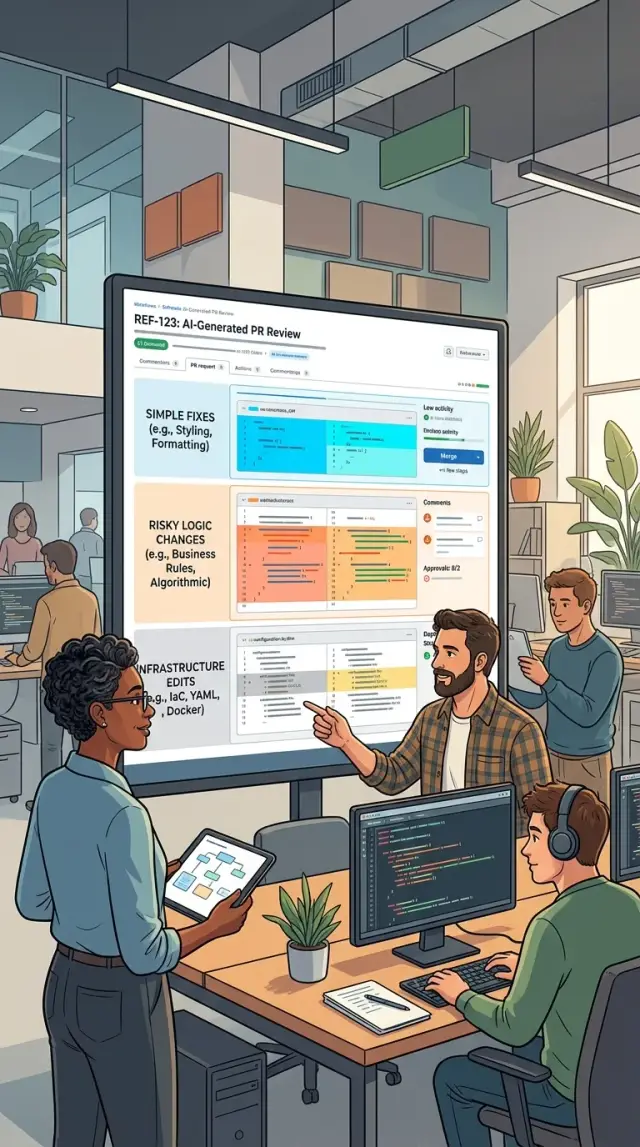
Table of Contents
Why mixed teams struggle with AI output
AI assistants flatten the first draft. A junior engineer can produce a clean looking patch in minutes, and a senior engineer can do the same for a much larger change. That speed helps, but it hides a real problem: the code often looks more certain than the person who asked for it.
Junior engineers usually use assistants to fill gaps. They ask for tests, small refactors, SQL queries, or glue code they do not write every day. Senior engineers use the same tools differently. They push them into broader work, such as schema changes, deployment edits, service boundaries, or internal automation.
That difference matters because neat code does not tell you how risky the change is. An assistant can produce a tidy pull request for a typo fix and a tidy pull request for a database migration. Both may pass basic checks. Only one can wake up the whole team at 2 a.m.
Teams run into trouble when they apply one review rule to every AI-assisted change. If every edit needs the same depth of review, tiny fixes wait behind risky changes. Reviewers spend too much time on harmless diffs, then rush through the pull requests that need slow reading and extra testing.
The mismatch gets worse in mixed seniority engineering teams. A junior engineer may need close review for a two line auth change because they do not yet see the edge cases. A staff engineer may safely ship a copy update with almost no discussion. Seniority still matters, but the change itself matters more.
A simple example shows the gap. Renaming a button label and editing a Terraform module can each take five minutes with a coding assistant. One mistake may confuse users for a day. The other may break deploys, raise cloud costs, or take a service offline.
Teams need rules that are easy to follow and tied to risk. Tiny edits and high risk changes should not sit in the same queue, and they should not need the same checks. Review lanes help because they cut noise, reduce delays, and give both junior and senior engineers a safer way to use assistants every day.
What a review lane does
A review lane gives each change a clear path before anyone merges it. It tells the team which edits are routine, which need closer review, and which need someone with deeper system context.
This matters even more with coding assistants. AI can help a junior engineer fix a flaky test in ten minutes, then produce a risky config change with the same confidence. The review path should match the change, not the polished look of the output.
A lane answers two questions early: who should review this, and what should they check? For a small front end fix, the reviewer may only need to confirm scope, tests, and whether the change solves the ticket. For an auth update, database migration, or infrastructure edit, the reviewer should inspect failure cases, rollback steps, permissions, and production impact.
The author should know the lane before opening a pull request. If the team decides late, review gets messy fast. One person asks for deeper testing, another asks for ops approval, and the pull request sits open while people argue about process instead of checking the change.
A good lane does four things. It groups changes by risk, assigns the right reviewer, sets the depth of review, and keeps small fixes moving without waving risky edits through.
This does not require heavy process. Clear lanes often remove process because they stop the same debate from happening over and over. People spend less time guessing who owns the review and more time checking the parts that can actually break.
This also helps mixed seniority teams work better together. Junior engineers get room to move on safe changes. Senior engineers spend their time where judgment matters most. On lean teams, especially ones with thin ops coverage, that split saves real pain. One careless infrastructure edit can hurt uptime, cost, or security far more than a rough refactor or a bad copy change.
When the lane is obvious before the pull request starts, reviews feel calmer. People know what good looks like, and they can use assistants with less risk.
Pick lanes by risk, not by seniority
Teams get better results when they sort AI-assisted changes by blast radius. A junior engineer can safely ship a copy fix with a light review, and a senior engineer can still create a risky change that needs a hard stop. Job title does not tell you how much damage a bad edit can cause.
That matters because AI tools flatten the first draft. Almost anyone can produce working looking code, config, or tests in minutes. The real difference shows up later, when the team asks a simple question: if this is wrong, what breaks?
Think in blast radius
A typo fix in a settings page usually has a tiny blast radius. A change to billing rules, authentication checks, or database writes can quietly hurt users, money, or data. Terraform, Kubernetes, CI pipelines, and production config sit at the top because one bad line can affect every deploy or every customer.
Most teams do well with four lanes:
- Light lane for copy edits, typo fixes, and very small UI tweaks with no logic change
- Standard lane for normal product code that stays inside clear guardrails
- Strict lane for business rules, auth, permissions, billing, and data updates
- Infrastructure lane for deployment, secrets, CI, Terraform, Kubernetes, and production config
This keeps reviews fair. Junior engineers should not get blocked just because they are junior, and senior engineers should not get a free pass on risky work. The lane should come from the change itself.
On teams with lean operations, this matters even more. Oleg Sotnikov's work with AI first teams and production infrastructure shows why a tiny app patch and a CI runner change do not deserve the same review path. Treating them as equal slows the team down in one case and invites outages in the other.
If you remember one rule, make it this: the closer a change gets to money, access, data, or production, the stricter the lane should be. That gives mixed seniority teams a review system people can trust, even when assistants do most of the drafting.
Set clear checks for each lane
A lane only works if people know what proof they must attach before anyone reviews the change. Without that, every pull request turns into the same argument: "Did you test this?" "Did you read the diff?" "Can we roll it back?" That wastes time and makes junior engineers guess what good looks like.
Start with one rule for all AI-assisted work: the author writes a short summary in plain English. Two or three sentences are enough. It should say what the assistant changed, what the author asked it to do, and anything that still feels uncertain. That note gives reviewers context fast, and it often exposes shaky changes before review starts.
For user facing changes, ask for evidence, not promises. A test result helps when behavior changed. Screenshots help when text, layout, or flows changed. If a junior engineer updates a signup form with an assistant, a reviewer should not have to imagine the result from a diff alone.
Risky code needs one more thing: a rollback note. Keep it short. Say what to revert, what data might break, and how the team would know the rollout went wrong. This matters even more for database, config, and deployment edits, where a small AI mistake can create a very long afternoon.
Infrastructure changes should wait for a senior reviewer every time. That is not about rank. It is about blast radius. A typo in app copy annoys users. A bad network rule, Terraform edit, or CI change can stop releases or take services down.
A simple review template usually covers enough:
- What the assistant produced
- What I checked by hand
- Proof the change works
- How to roll it back if needed
- Who must approve before merge
That "checked by hand" line matters more than teams think. Ask authors to name the files, queries, prompts, or commands they reviewed themselves. In review lanes for AI-generated code, that habit separates real ownership from copy paste confidence.
Build the flow step by step
Start with real work, not theory. Pull the last two or three weeks of merged changes and look for patterns. Most teams ship the same few things again and again: text updates, small UI fixes, API changes, database edits, access control changes, CI tweaks, and server settings.
That list gives you the raw material for your lane system. If an assistant helped write the change, the lane should still depend on risk, not on who typed the prompt.
First, write down the change types you ship most often. Keep the list plain and specific. "Copy update" is better than "content work." "Terraform edit" is better than "cloud task."
Next, sort each type into three or four lanes. A simple lane means low impact and easy rollback. A risky lane covers business logic, auth, payments, data changes, or anything users will feel right away. An infrastructure lane covers deploy scripts, cloud settings, networking, secrets, CI, and anything that can break the whole service.
Then give each lane a short checklist. Keep it to a few lines that people will actually read. A simple lane might ask for passing tests and a quick product check. A risky lane might need one senior review, test proof, and a rollback note. An infrastructure lane should ask for staging proof, monitoring checks, and a reviewer who knows the stack.
After that, match reviewers to the lane. Junior engineers can own simple fixes and review them with light support. For risky work, let juniors prepare the change, but ask a senior engineer for the final review. Infrastructure edits usually need the most experienced person available.
Run the flow for two weeks, then cut what slows people down. If a rule catches nothing, remove it. If one lane creates long queues, loosen it or add reviewers.
A small team can set this up in an afternoon. One startup might decide that AI written copy fixes go through a simple lane, billing logic goes through a risky lane, and Docker or cloud changes go through infrastructure review. That is enough to start. The first version does not need to be perfect. It needs to be clear enough that nobody guesses.
A simple team example
Picture a small product team with one junior engineer, one senior engineer, and one person who watches infrastructure. They all use an assistant, but they do not send every AI-generated change through the same review path.
On Monday morning, the junior engineer uses the assistant to rename labels on a settings page. The change touches button text, field labels, and one helper message in a React component. There are no logic changes and no data changes.
That goes through the light lane. The engineer adds two screenshots, writes a short note that the update only changes UI text, and checks the page in the browser. A teammate reviews the diff, confirms the labels match the design, and merges it.
In the afternoon, the same engineer asks the assistant to refactor a billing rule for prorated credits. The code looks neat, but this change affects money. It can break edge cases like plan upgrades near the end of a billing cycle or old accounts with custom pricing.
The team sends that change to a stricter lane. A senior engineer reviews the logic line by line. The junior engineer adds test results that compare old and new outputs for a few billing cases, then runs the change in staging with a sample account. They merge only after the numbers match.
Later, the assistant suggests an nginx config edit to change caching and route handling. The diff is short, but the risk is not. One bad line can block traffic or break uploads.
That change goes to the infrastructure lane, even though it is smaller than the billing refactor. The engineer includes rollout notes, a rollback step, and a short checklist for what to watch after deploy, such as error logs and request failures.
This is why review lanes work better than one rule for everything. The junior engineer still moves quickly, but the team adds extra checks to changes that can hurt users, revenue, or uptime.
Mistakes that slow reviews down
Review lanes break down when the author can pick the easiest path every time. A change that touches auth, billing, migrations, or deployment often gets labeled as a "small fix" because that lane moves faster. Teams should not let the author decide alone. The lane should come from the change itself, not from who wrote it or how confident they feel.
Another common miss starts in review. People comment on naming, formatting, and file structure because those things are easy to spot. Meanwhile, risky logic stays untouched. AI written code often looks clean, so reviewers relax too early. The trouble usually hides in conditions, retries, permission checks, error handling, and odd edge cases.
One green test run also fools people. Generated code can pass the happy path and still break when real users hit stale data, duplicate requests, or partial failures. A junior engineer may trust the output because the assistant sounds certain. A senior engineer may trust it because CI is green. Both mistakes cost time later, when the team has to reopen the same pull request or fix production issues.
Small changes that cause big delays
Infrastructure edits create another bottleneck when they hide inside app pull requests. A harmless looking feature branch may also change a Dockerfile, CI job, Terraform file, secret handling, or nginx config. Then the app reviewer assumes someone else checked the ops side, and the infra reviewer never sees it. One mixed PR can waste a full day of back and forth.
Teams also slow themselves down when lane rules turn into a policy document nobody reads. If the rules fill three pages, people guess. If they guess, they route work badly. Good rules fit on one screen and answer simple questions.
A shorter set of rules works better:
- If a change touches infrastructure, route it through the infrastructure lane.
- If it changes business logic, ask for scenario based review before style comments.
- If tests pass once, ask what happens on the second run, with bad input, or during rollback.
- If a PR mixes app code and ops changes, split it unless the team has a clear reason not to.
Mixed seniority teams do best when the review path feels boring and obvious. That usually means fewer exceptions, shorter rules, and less room for wishful thinking.
Quick checks before you merge
A merge should feel calm. If people still argue about what changed, why it changed, or who approved it, the team is moving too fast.
Good review lanes make that final pause much easier. The last check is not about reading every line again. It is about making sure the change went through the right path and has enough proof behind it.
Merge checklist
Before anyone merges, ask five plain questions:
- Does this lane match the real risk of the change?
- Did the author explain what the assistant produced and what they kept or changed by hand?
- Can the reviewer see evidence, such as tests, screenshots, a short video, or staging logs?
- If this change can hurt production, is there a rollback plan?
- Did the right person sign off?
Mixed seniority teams trip over one pattern all the time. A junior engineer starts with a small bug fix, asks an assistant for help, and the tool quietly rewrites a config file or adds a new dependency. That is no longer a simple lane. Stop, move it to the higher risk lane, and review it there.
Oleg Sotnikov often works with lean teams that use AI heavily, and this kind of discipline matters more when teams move fast. The merge button should confirm a decision the team already understands, not open a fresh debate.
Next steps for your team
Most teams do better when they start small. For review lanes for AI-generated code, three lanes are enough on day one: a fast lane for small, low risk fixes such as copy changes, tests, and minor refactors; a standard lane for product logic and anything that changes behavior; and a careful lane for infrastructure, security, permissions, billing, and data migration work.
Use names your team already says out loud. "Fast," "standard," and "careful" works better than a policy label nobody remembers.
Then pull 20 old pull requests from the last month and sort them into those lanes. You will spot patterns quickly. Some work got too much review, and some risky changes got too little. That exercise gives you better rules than a long debate in chat.
Once the lanes feel right, add them to the places people already use. Put a lane field in the pull request template, add a label in your repo, and tie each label to simple review rules in CI. A careful lane might require a senior reviewer, passing tests, and a short rollback note before merge.
Keep the first version plain. If a rule needs a paragraph to explain, it is probably too hard to follow when the team is busy.
After two weeks, check what happened. Count how many pull requests changed lanes after opening, how long each lane waited for review, and where reviewers still felt unsure about assistant generated changes. Those are the parts to fix next.
Some teams can set this up alone. Others need an outside view, especially when AI use, CI checks, and infrastructure rules all changed at once. If you need that kind of help, Oleg Sotnikov shares his Fractional CTO and startup advisory work at oleg.is, with a strong focus on AI first development workflows, infrastructure, and practical review processes. It is a sensible option when you want safer reviews without adding a lot of process.
Frequently Asked Questions
What is a review lane?
A review lane is a simple path for a pull request based on risk. It tells the team who should review the change, how deep they should look, and what proof the author needs before merge.
Why shouldn’t every AI-assisted change get the same review?
Because AI makes small and risky changes look equally polished. If you use one review style for everything, tiny fixes get stuck and dangerous edits slip through too fast.
Should senior engineers get lighter review by default?
No. Seniority helps, but the change matters more. A senior engineer still needs a hard review for billing, auth, data, or production work, while a junior engineer can move quickly on a safe copy fix.
What belongs in a light review lane?
Use the light lane for copy edits, typo fixes, and very small UI changes with no logic or data impact. If the change touches behavior, permissions, money, or production config, move it out of the light lane.
Which changes need the strictest review?
Put auth, permissions, billing, database writes, migrations, deployment files, secrets, CI, Terraform, Kubernetes, and production config in the strictest lanes. Those changes can hit users, revenue, data, or uptime fast.
What should I include in an AI-assisted pull request?
Ask for a short plain English note that says what the assistant produced, what the author checked by hand, and what still feels uncertain. Add proof that matches the change, such as tests, screenshots, staging results, or a rollback note for riskier work.
Who should approve infrastructure changes?
A senior reviewer should approve them every time. That rule is about blast radius, not rank, because one small infra edit can break deploys or take a service down.
Should we split app changes and infrastructure changes into separate PRs?
Usually yes. When app code and ops edits land in one PR, reviewers miss things or assume someone else checked them. Split them unless you have a clear reason to keep them together.
How many review lanes should a small team start with?
Start with three lanes if you want a fast setup: one for low risk fixes, one for normal product work, and one for high risk or infrastructure changes. That gives enough structure without slowing the team down.
How can we tell if our review lanes are working?
Check whether PRs move faster without more mistakes. Look at how often people change lanes after opening, how long each lane waits for review, and whether reviewers still feel unsure before merge.


