AI code ownership: review rules, cleanup, responsibility
AI code ownership needs clear review rules, cleanup duties, and named owners so teams move fast without losing responsibility.
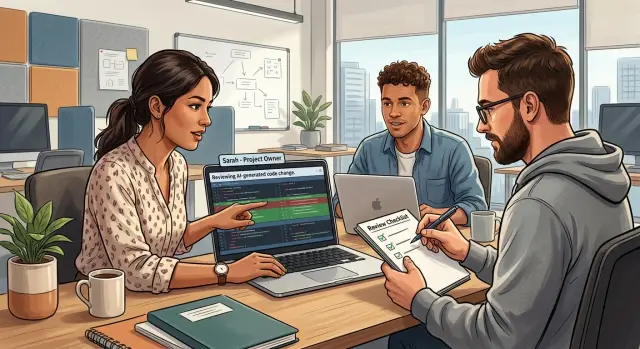
Table of Contents
Why AI blurs ownership
A developer can ask a model for a refactor, send a few follow up prompts, and end up with 800 changed lines before anyone asks whether the approach makes sense. The diff looks busy, so it feels like progress. Sometimes it is. Sometimes speed hides weak decisions.
Reviewers often read AI heavy diffs backwards. They check whether tests pass, scan for obvious bugs, and move on. What they miss is the part that used to happen before coding: the tradeoff, the rejected option, and the reason this design fits the product. When that thinking lives only in prompts or chat history, nobody else can inspect it.
That is when code ownership gets messy. The author may feel they did not really write the change. The reviewer may assume the author checked the logic. The team lead may think the review covered it. Then a bug shows up in production and the discussion turns awkward fast. Who picked this pattern? Who accepted the risk? Who fixes it now?
A small team can hit this in a single sprint. One engineer uses AI to add billing retry logic in an afternoon. Another reviews the diff between meetings. It ships. A week later, customers get duplicate charges because the retry logic missed an edge case. The engineer blames the generated code. The reviewer says the author owned the change. The manager says both should have caught it. Nobody is fully wrong, which is the problem.
Prompts make this worse when teams treat them like design notes. A prompt can describe intent, but it usually disappears into a tool log, a chat tab, or local editor history. Six months later, the code is still there, but the reason behind it is gone.
Fast output helps. Blurry responsibility does not. If a team wants ownership to mean anything, someone has to own the decision, not just the diff.
Name one owner before the first prompt
If nobody owns an AI assisted change, everyone assumes someone else checked it. That is how weak code gets merged, tests get waved through, and bugs land in production with no clear follow up.
Good ownership starts before anyone asks a tool to write code. Put one engineer's name on the ticket, branch, or pull request. That person owns the final decision to merge, even if AI wrote half the diff and three teammates suggested edits.
Shared ownership sounds fair, but it usually becomes thin ownership. One person writes the prompt, another pastes the code, a reviewer leaves comments, and a manager approves the deadline. Then the first bug appears after release and nobody feels fully responsible. A single named owner stops that drift.
That owner should answer review comments, answer test questions, and take the first bug that appears after release. The last part matters more than most teams admit. If the same engineer expects to fix the first issue, they read the generated code more carefully, check more edge cases, and avoid merging code they do not understand.
This does not mean one person must write every line by hand. It means one person accepts responsibility for the result. If AI suggests a database migration, a cache rule, or a retry loop, the owner needs to know what it does and why it is safe.
A simple checkout example makes this clear. Say a team updates payment validation with AI help. The model writes validation, error handling, and part of the test file. Priya opens the pull request under her name. Reviewers can challenge the logic, ask for extra tests, or question the rollback plan, and Priya answers those points. If a payment bug appears the next morning, the team knows who investigates first.
That kind of clarity is better than group blame and better than silence. One name on the change keeps speed, but it also keeps accountability attached to the work.
Match review depth to risk
Review time should follow risk, not diff size. A tiny change in password reset logic can do more damage than a big UI cleanup. This is where ownership often gets fuzzy: people trust the small diff, merge fast, and learn later that the change touched something sensitive.
Start with impact. Ask what happens if this code fails in production. If failure can lock users out, move money the wrong way, or leak or corrupt data, slow down and inspect the code line by line.
Auth, billing, and data handling need the strictest review. Read every condition, every default, and every place where the code trusts input. AI often writes plausible code that looks neat but misses one branch, one permission check, or one rounding rule.
UI work needs hands on review too. A small visual diff can still break a checkout step, hide an error message, or reset form state at the wrong moment. If the change affects screens people use, run the product and click through the flow. Reading the diff alone is not enough.
Large mixed diffs create another problem. AI can generate a lot of decent looking code very quickly, which makes oversized pull requests feel normal. They are not. If one diff mixes schema changes, business rules, refactors, and UI updates, reviewers will skim. Once people skim, ownership starts to disappear.
Tests should match the risk as well. New logic, edge cases, retries, permissions, and money calculations deserve tests before merge. Copy changes or spacing fixes usually do not. The goal is simple: keep speed high, but do not let anyone say the AI wrote it, so I assumed it was fine.
Plan cleanup before you merge
Fast code often lands with small messes that nobody wants to touch a week later. AI makes that worse because it can produce working code with rough names, copied comments, and branches that no longer do anything.
If you see those issues during review, do not leave them as vague future work. Good ownership includes a cleanup plan before the main change goes in. Once code is merged, the team shifts to the next task and tiny fixes start to rot.
The usual problems are easy to spot: placeholder names that hide intent, comments copied from older code, dead branches that survived prompt iterations, and test helpers or debug output that slipped into the diff. This takes two minutes to mark during review and can save a lot of guessing later.
A short note like rename before next release is better than silence, but a real cleanup task is better than both. Open that task before you merge the feature. Put it on the same board or backlog the team already uses. Give it one owner and a due date. Later usually means never, especially when the feature already works.
Keep cleanup small. If the task needs a redesign, it will keep getting pushed aside. Split it into work the team can finish during normal sprint work, such as renaming confusing methods, deleting unreachable code, or replacing generated comments with plain ones.
A lean team can ship fast with AI and still keep the codebase readable if it treats cleanup as part of delivery. Teams that skip this step pay for it later in review time, bug hunts, and awkward handoffs.
Keep responsibility after the merge
Ownership breaks down when a diff lands, passes review, and then nobody owns the first week in production. Merge should not end the job. The same person who drove the change should stay with it through rollout and early support.
That does not mean one person carries every task alone. It means one name stays attached while the code meets real traffic, real users, and real edge cases. If the change fails at 2 p.m. the next day, the team should know who looks first.
During the first release window, that owner should watch a small set of signals: error tracking for new exceptions, logs around the changed paths, reports from support or sales, and alerts tied to latency, timeouts, or failed jobs.
This habit catches a common AI mistake: code that looked clean in review but behaves oddly under real load. A model can produce code that passes tests and still miss one assumption about retries, null data, or permissions. The person closest to the change can spot that faster than someone reading it cold.
When the first bug appears, bring the same owner back. Do not toss the fix to whoever is free. They already know what the model suggested, what they kept, what they rewrote, and what still felt shaky before merge. That context saves time and usually leads to a better fix.
Teams can hand work off later, but only after the next owner reads the code, the review notes, and any short note about AI assisted parts. A handoff without reading creates ghost ownership: everyone thinks someone else understands the change.
A simple rule works well: the author owns the change until the code runs cleanly in production for an agreed period, or until a named replacement accepts it.
Use a short note for AI assisted diffs
When AI drafts part of a change, people forget that split faster than they expect. A short note in the merge request keeps ownership clear. It gives reviewers context in 30 seconds, and it gives the owner a written record of what they actually checked.
Keep the note plain. Skip speeches and status fluff. If the owner cannot explain the change in a few lines, the team probably should not merge it yet.
A useful note covers four things: what AI drafted and what the engineer rewrote, what the owner checked by hand, what still feels weak or untested, and what cleanup remains with an owner and a date. That last part matters because teams often merge AI assisted code with a quiet promise to clean it up later. Later rarely arrives unless someone writes down the task, the owner, and the date in one place.
A simple note format
One short block is enough. For example:
AI drafted the first version of the billing retry worker and two test files.
Nina rewrote the retry limits, error handling, and database query.
Checked by hand: failed payment flow, duplicate retry guard, unit tests, and logs.
Still unsure: timeout behavior under heavy queue load.
Cleanup: simplify worker naming by May 14 - Nina. Add load test by May 16 - Sam.
This note does two useful things. First, it tells reviewers where to look harder. Second, it stops ghost ownership, where everyone assumes someone else understands the risky parts.
On teams that ship quickly with AI, this habit saves real time. Reviewers ask better questions, cleanup work stops slipping, and the person who merged the code still owns the outcome a week later.
A simple example from a product team
A product team wants to add a CSV import form so customers can upload contacts in one step. One developer asks AI to draft the first pass. The diff grows fast. It includes the form, CSV parsing, field validation, error states for bad files, and a small test set.
This is where ownership stops being abstract. The developer who opened the work keeps their name on it, even if AI wrote half the lines. Nobody says the model added that part as if that removes responsibility.
The reviewer should not spend equal time on every file. They can skim the form layout, because most of that risk is visible in the browser. They should read the parser and validation logic line by line, because that is where quiet bugs hide. A CSV import can fail on empty rows, odd encodings, duplicate headers, or values that almost match the expected format.
A solid review checks plain things. What happens when the file has missing columns? How does the parser handle blank lines and broken quotes? Do validation messages help the user fix the file? Do the tests cover bad input, not only happy paths?
The team can still merge the feature if it is good enough for the release, but it should not pretend the diff is finished. The same owner should open a cleanup task before merge. That task can cover naming that got messy during AI drafting and extra test cases for edge cases the first review noticed but did not block on.
Then the feature ships. A day later, a customer uploads a CSV with an unexpected date format and the import fails. The same owner takes the production issue, even if another engineer is on support rotation. That closes the loop between prompt, review, merge, and user impact.
Teams that skip this step get ghost ownership. The code lands fast, nobody feels fully responsible, and the first bug turns into a blame hunt. A simple pattern of owner, review, cleanup, and follow up avoids that.
Mistakes that create ghost ownership
Ghost ownership starts when a team merges code fast and talks about it later. The diff lands, the feature works, and nobody feels fully on the hook when a bug shows up two weeks later.
The first mistake is giving a huge diff a free pass because AI wrote most of it. That logic fails in practice. A 1,200 line change still changes behavior, risk, and maintenance cost, no matter who or what typed it. If the code touches auth, billing, data deletion, or anything customers use directly, the team still needs a real review.
Another common mistake is calling AI output just a draft and leaving it in that fuzzy state. Draft code needs an owner even more than hand written code. If nobody claims it, small problems stay in place: vague names, copied logic, weak tests, and odd edge cases that only appear in production.
Cleanup often dies the same way. Someone says we will tidy this up next sprint, but no ticket exists, no date is set, and no engineer is named. That is not a plan.
Prompt history causes trouble too. Teams sometimes assume the chat log explains the code well enough. It does not. Future maintainers will read the code, tests, commit message, and comments. They will not reconstruct a long prompt thread to figure out why one branch handles a strange case.
Changing owners right after merge creates another gap. One engineer prompts and merges the code, then another inherits it the next day to spread the load. In practice, that spreads distance from the decision. The new owner did not review the tradeoffs, and the original owner already moved on.
Watch for a few warning signs. The author cannot explain the risky parts without reopening the AI chat. Cleanup lives in somebody's head instead of a dated task. Reviewers only skim because the diff feels machine made. Tests pass, but nobody checks whether the code will be easy to change later.
Ownership breaks down when teams confuse speed with shared understanding. If one person cannot clearly say I own this code after merge, the team does not have ownership at all.
Quick checks before you merge
Fast AI output can hide a simple problem: nobody feels fully on the hook for the code. A merge should happen only when one engineer is ready to own the diff, the next fix, and the cleanup that follows.
- Name the owner. Put one person on the diff, even if AI wrote part of it and several people shaped the prompt.
- Match review depth to risk. Copy changes and tiny refactors may need a quick read. Auth, billing, data deletion, migrations, or infrastructure changes need a slower review and stronger test evidence.
- Test the changed behavior. Happy path screenshots are not enough. Check bad input, retries, empty states, timeouts, and permission errors.
- Write down cleanup work. If the diff ships with rough edges, create follow up tasks with dates and names.
- Check tool independence. A reviewer should be able to explain what changed without reopening the AI chat or rerunning the prompt.
This matters even more on lean teams, where one vague merge can waste a full afternoon later. Five careful minutes now can save a rushed fix, a tense team thread, or a rollback.
What to do next
Put the rules on one page and test them in one repo first. If the policy needs a long meeting or a slide deck, most teams will stop using it the first busy week.
Then review the last two weeks of merged diffs. Read a small sample and check where ownership got fuzzy. Look for plain signs: no clear owner, shallow review on risky code, or cleanup work that never got assigned. If people have to guess who owns a change, the process is already failing.
A short starting policy is often enough. Name one owner before anyone prompts the AI. Set review depth by risk, not by diff length alone. Open cleanup work before merge if the code needs follow up. Keep one person responsible after release. Add a short note when AI wrote part of the change.
If reviewers still skim, shrink the diff. A smaller change is easier to read, easier to test, and harder to wave through on instinct. A 50 line diff with one owner is safer than a 500 line diff that three people approved without reading closely.
Some teams need an outside view to spot patterns they no longer see. Oleg Sotnikov at oleg.is works as a fractional CTO and startup advisor, and this is exactly the kind of process problem he helps teams tighten up: clearer review rules, clearer ownership, and less confusion after release.
Keep the process small enough that people actually follow it. If people know who owns the code, what review it needs, and who fixes the rough parts after merge, the policy is doing its job.
Frequently Asked Questions
Who owns the code if AI wrote most of the diff?
The engineer whose name sits on the ticket or pull request owns it. AI can draft code, but the owner still decides to merge, answers review comments, and takes the first bug if it breaks in production.
When should we assign an owner for AI-assisted work?
Name one owner before the first prompt. That stops the usual drift where one person prompts, another pastes code, a reviewer skims it, and nobody feels fully responsible later.
Do small AI-generated changes need less review?
No. Review depth should match product risk, not diff size. A tiny change in auth, billing, or data handling needs a slower read than a large visual cleanup.
Which AI-assisted changes need the strictest review?
Read auth, billing, permissions, retries, migrations, and data handling line by line. If a failure can lock users out, charge the wrong amount, or damage data, treat it like risky code even if the diff looks neat.
Can prompts replace design notes?
No. Prompts disappear into chat logs and editor history, and future maintainers will not have that context. Put the reason for the change in the pull request, commit message, or code comments where the team can still read it later.
What should we write in a note for an AI-assisted diff?
Keep it short and plain. Say what AI drafted, what the engineer rewrote, what you checked by hand, what still feels weak, and what cleanup work remains with a name and date.
When should we create cleanup tasks for rough AI code?
Open cleanup tasks before you merge. If you wait until later, rough names, dead branches, copied comments, and weak tests usually stay in the codebase much longer than anyone expects.
Who should handle the first production bug after merge?
Bring back the same owner first. They know what the model suggested, what they changed, and which parts felt shaky before release, so they can usually fix the problem faster than someone new to the diff.
How long should the original owner stay responsible after release?
Keep ownership with the original author through rollout and an agreed period in production, or until a named replacement accepts the handoff. Merge should not end responsibility on the same day the code ships.
What should we do if reviewers keep skimming large AI pull requests?
Shrink the diffs and force one owner per change. If the team still waves large machine-written pull requests through, tighten the rule, add the short AI note, and get an experienced CTO or advisor to review the process with you.