Agency vs contractor vs fractional CTO: what fits when
Agency vs contractor vs fractional CTO can solve very different problems. Learn who should own each option, where it fits, and the usual failure points.
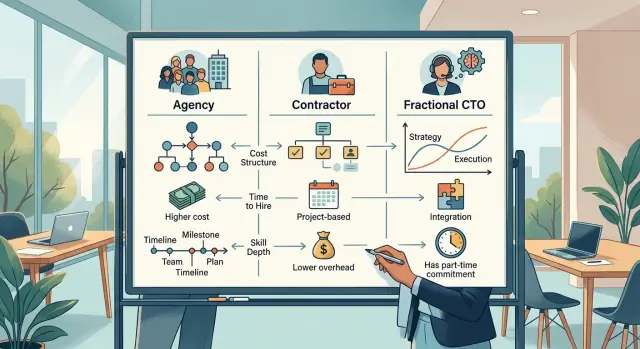
Table of Contents
Why this choice gets messy fast
Agency, contractor, and fractional CTO can all help build software, but they do different jobs.
An agency sells delivery. A contractor sells hands on work. Outside technical leadership sells judgment, priorities, and ownership.
That sounds obvious until a company is under pressure. A founder needs something shipped, hears similar prices, and assumes the options are close enough. They usually are not.
The cost shows up later, not at the start. One quote may look cheaper, but delays, rework, vague specs, and messy handoffs can wipe out that gap fast. A project that slips by six weeks often costs more than the difference between the original proposals.
One of the most common mistakes is buying execution when the real problem is direction. If nobody has decided what to build first, what quality level is good enough, or which shortcuts are safe, adding more developers does not solve much. It just spreads the confusion.
Picture a small startup with one founder and two developers. The founder hires a contractor to move faster, but the roadmap keeps changing and nobody makes final calls on scope. The contractor keeps coding, the team keeps revising, and the release date drifts because nobody owns the whole picture.
Teams also stall when ownership is split the wrong way. One person writes tickets, another reviews code, someone else approves deadlines, and nobody owns the result. When scope grows, bugs pile up, or estimates miss, each person can point to someone else.
That is what makes this decision harder than it should be. You are choosing who will do the work, but you are also choosing who defines the work, who protects quality, and who says, "no, this is out of scope" before the budget disappears.
What each option actually means
The easiest way to separate these options is by ownership. Who owns the plan, who does the work, and who makes the hard calls when scope changes? That answer usually tells you whether you need an agency, a contractor, or outside technical leadership.
An agency gives you a team under one contract. You are not hiring one person. You are buying design, engineering, project management, and a shared process. That works well when you need several skills at once and want one party to answer for delivery. The tradeoff is distance. If you do not manage scope closely, the team can stay busy while moving the product in the wrong direction.
A contractor is one person selling time and skill. You hire a contractor when you already know what needs to get done, or when someone inside the company can write clear tasks and review the work. Contractors often start fast and cost less than an agency. They are also easy to misuse. If nobody sets priorities, even a strong contractor ends up guessing.
Outside technical leadership solves a different problem. This person usually does not replace the build team. They set direction, review plans and code, question estimates, and help the business make sound product and engineering choices. A fractional CTO often sits in this role. They connect founders, product decisions, hiring, architecture, and delivery so the setup holds together.
In plain terms, an agency adds execution capacity. A contractor adds individual skill. A fractional CTO adds judgment and oversight. Some companies need only one of these. Many need two at the same time, especially when founders can describe the product well but cannot yet run a technical team.
Where an agency works well
An agency makes sense when the work needs several skills at the same time. If you need design, development, testing, and release help in one project, one agency can cover that faster than hiring people one by one. You get one contract, one plan, and one team that already knows how to work together.
This model works best when the scope is clear before work starts. A product redesign, a client portal, or an MVP with a fixed deadline are common examples. When the feature list, budget, and timeline are defined, an agency can assign the right people and move with less friction.
It also works when you want one vendor instead of managing several freelancers. Separate hires can look cheaper on paper, but they often eat up founder time. An agency usually costs more than a single contractor, but it can save hours of coordination every week.
Still, agencies need direction. Someone inside your company should review progress every week, answer open questions, and approve changes quickly. Without that, the team can keep building while the project drifts away from what you actually wanted.
A good agency fit usually has four things in place: defined scope, a budget set before kickoff, a real need for multiple roles right away, and someone on your side who can review work weekly.
A simple example: a startup needs a polished app in 12 weeks for investor demos and early users. The screens are known, the budget is approved, and the founder can join a weekly review. That is usually a better agency job than a solo contractor job.
Where a contractor works well
A contractor fits best when you already know the job and need someone to do it well. The work should be narrow enough to explain in a few pages, estimate with decent accuracy, and review every week.
This setup works when one part of the product needs focused attention. Maybe your team needs a mobile payment flow, a new admin screen, a database cleanup, or help fixing a slow deployment pipeline. The rest of the product stays with your team.
A contractor also works well when your company already has someone who can make decisions fast. That person does not need to write code, but they do need to answer questions every day, clear blockers, and say yes or no without delay. If nobody owns the work internally, even a very good contractor will drift.
The best contractor setups have clear scope, an internal team that owns roadmap and priorities, one manager available for quick answers, and a short term need for extra hands rather than a full delivery team.
This is often the cheapest way to add capacity for a short stretch. You pay for execution, not for a full team, extra account management, or outside leadership you do not need.
A common case is a startup with a product lead and two engineers that needs one more person to ship an AI search feature before launch. A contractor can take that feature, work inside the existing codebase, and hand it back to the team.
Contractors are a poor fit when the brief is fuzzy, priorities change every few days, or the company expects them to figure out product direction on their own. That is where this choice usually breaks.
Where outside technical leadership works well
Outside technical leadership fits when the company does not need more code yet. It needs better decisions.
If the roadmap keeps shifting, estimates move every week, and nobody can say what should happen first, a fractional CTO often helps more than another developer. The same is true when founders keep hearing technical answers they cannot really test. A vendor says one thing, a contractor says another, and both sound confident. An outside technical leader can translate the tradeoffs into plain language, push back on weak estimates, and explain what is risky, wasteful, or worth delaying.
This setup also works when product direction, hiring, and delivery need one owner, but a full time CTO is too early. Someone has to decide what gets built, who should build it, and how the work gets reviewed. Without that owner, teams stay busy while progress feels slippery.
It often pays off before a larger build starts. A few weeks spent on architecture, scope, hiring, and delivery rules can save months of rework later. Many teams miss this point: leadership usually needs to come before scale.
Imagine a startup with a rough product idea and two competing quotes. One agency wants a large rebuild. One contractor offers a quick patch. Outside technical leadership can define the smallest version worth shipping, check whether the estimates make sense, and set a path the team can actually follow.
If you want better decisions before you spend real money, this option often pays for itself quickly.
Who should manage each setup
One person inside your company needs clear control. In a small company, that is usually the founder. In a slightly larger one, it may be a product lead. That person owns goals, budget, and tradeoffs, and makes the final call when speed, scope, and quality pull in different directions.
If two or three people share that job, work gets messy fast. One person pushes for speed, another wants more features, and someone else cares most about cost. The team gets mixed signals, and nobody owns the result.
An agency can manage its own designers, developers, and project manager, but it still needs one decision maker on your side. That person approves work, answers open questions, and keeps the agency tied to the real business goal. Without that, the agency starts following the loudest comment instead of the right priority.
A contractor needs even tighter management. Most contractors do best with fast feedback, a clear backlog, and one person who checks progress day to day. If reviews take a week or requirements keep shifting, even a strong contractor will either wait too long or make guesses you did not want.
Outside technical leadership should sit close to the founder. If you bring in a fractional CTO or another outside technical lead, that person should not get buried under vendor process. Their job is to judge technical choices, challenge estimates, and protect the company from bad shortcuts.
The split is simple. The founder or product lead owns goals, budget, and tradeoffs. The agency contact owns approvals and business context. The contractor manager owns daily direction and quick feedback. The outside technical lead owns technical judgment and vendor oversight.
Keep ownership clean. Once several people share it, small decisions turn into delays, rework, and blame.
How to choose step by step
Start with the result, not the hiring model. If you cannot describe the outcome in one plain sentence, you are not ready to choose between an agency, a contractor, or outside technical leadership.
Write that sentence as if you were explaining it to a busy colleague. "Launch a customer portal in 10 weeks" is clear. "Improve our tech" is not.
Then pin down the facts you already know. Scope, deadline, budget, and one owner all need to be written down. If one of those is missing, the setup gets shaky because nobody knows who can say yes, no, or not yet.
From there, the choice usually becomes clearer. If the work is narrow and well defined, a contractor often fits. If you need design, development, testing, and project management at the same time, an agency usually makes more sense. If the plan is fuzzy, the team needs direction, or vendors need oversight, outside technical leadership is often the better first move. And if you need both delivery and supervision, split those roles on purpose. Do not expect a contractor or agency to police itself.
Skill count matters more than most teams expect. A mobile app, backend, analytics, and security review all at once is rarely a one person job. A small API fix or short audit often is.
Do not start with a six month commitment unless the work is already stable. Start with a small milestone that reveals how the team communicates, estimates, documents, and handles surprises. That early test can save weeks of cleanup later.
This is also where a good fractional CTO can help before any build starts. They can turn a vague goal into a short plan, set the first milestone, and help you avoid hiring the wrong kind of help.
A simple example
Picture a small SaaS company with a clear business problem. Customers need a portal to track orders and update billing details. The team also wants two internal automations, one for support handoffs and one for invoice follow up. The founder knows why these jobs matter, but cannot yet turn that into screens, workflows, priorities, and a build sequence.
If the founder hires one contractor, work may start fast. In the first week, the contractor can sketch the portal, set up login, and ship an early version. Then progress often slows. Someone still has to answer basic product questions: who gets which permissions, what happens when billing data does not match the CRM, and which automation should ship first. A good contractor can build. They usually should not invent the plan.
An agency can do well here if the scope stays tight. If the company can say, "Build this portal with these fields, this approval flow, and these three reports," an agency can estimate the work and deliver against that plan. The trouble starts when the founder keeps changing priorities in the middle of the project or adds vague requests like "make support smarter" without clear rules.
A fractional CTO changes the shape of the project before code starts. They turn the founder's rough idea into a build plan, split work into phases, review agency or contractor estimates, and catch missing decisions early. They can also review output each week so the company does not discover basic mistakes at the end.
In that setup, the company does not need to choose one option forever. A fractional CTO can define the work, a contractor can handle a focused feature, and an agency can take a well scoped piece. That mix is often better than asking one person or one team to guess the whole product.
What usually goes wrong
Most mistakes start with one bad trade: a founder picks the cheapest help for the hardest problem.
A solo contractor gets asked to fix product strategy, delivery, hiring, and architecture at once. An agency gets hired to move fast on a product that nobody has defined. An outside technical leader gets brought in after months of drift, then treated like an advisor with no real say.
The next problem is even more common. Teams start work before they agree on scope, ownership, and how decisions will get made. The first week feels productive, the second gets fuzzy, and by the third everyone argues about what they thought they were buying.
Agencies often get blamed for being slow when the slow part is the client. The client takes four days to answer a product question, changes priorities in the middle of a sprint, or sends feedback through three different people. A fast agency cannot save a slow client.
Contractors hit a different wall. They can build, fix, and ship, but they usually should not invent the business on their own. If nobody answers product questions, the contractor either waits or guesses. Waiting burns time. Guessing creates rework.
Outside technical leadership fails in a quieter way. The company hires someone for direction, but nobody gives them authority to set priorities, stop bad ideas, or say no to rushed work. Then they become a note taker with a senior title.
A few basic checks prevent most of this. Match the problem to the level of help you need. Name one person who owns product decisions. Decide who approves scope changes. Set response times before work starts. If you hire outside leadership, give that person real authority or skip the role.
That is also the point where experience matters. Someone like Oleg Sotnikov, through oleg.is, works as a fractional CTO and startup advisor, which can be useful when a company needs technical judgment across product, architecture, hiring, and vendor oversight rather than more raw coding.
Quick checks before you sign
Plenty of bad hires look fine on paper. The trouble starts when nobody owns the small, boring decisions that keep work moving.
Before you sign, pin down who decides what "done" means. If nobody can say what a finished feature, landing page, or migration looks like, you will argue later about whether the work is complete. A short written acceptance note beats a long sales deck every time.
Then check how product questions get answered. Work stalls fast when a developer or agency waits three days for a reply about edge cases, copy, pricing rules, or user roles. Name one person who can answer within a day. If that person is too busy, the project will slip.
Ask a few direct questions. Who approves the result before you release payment? Who answers product and business questions within one business day? What review process catches weak code, broken flows, or missing details? What happens if scope changes in week two? Can both sides stop after the first milestone without a fight?
Quality control matters more than most founders expect. If you cannot review technical work yourself, give that job to someone who can. Sometimes that is an internal engineer. Sometimes it is outside technical leadership. A fractional CTO should not sit on the side and comment from a distance if their real job is to own review, risk calls, and tradeoffs.
One more thing: make the first milestone small enough to test the relationship. Two weeks of real work tells you more than a six month promise. If the team misses basic communication, avoids written scope changes, or pushes for full upfront payment, stop there.
What to do next
Start with the smallest decision that removes uncertainty. You do not need to settle your full hiring plan on day one. You need enough clarity to avoid paying the wrong person to solve the wrong problem.
If the work still feels fuzzy, buy direction before you buy more coding. A few focused sessions to define the product, sort priorities, and assign ownership often save weeks of rework. That is usually the better first move when people disagree on scope, deadlines, or who makes technical calls.
If the scope already feels stable, match the model to the job. Hire a contractor when the task is narrow and someone on your side can manage details. Use an agency when you need a team to ship a defined package of work. Bring in outside technical leadership when decisions, priorities, and team structure still need work.
Keep the first commitment small. Try a short discovery phase, a limited build, or a clear 30 day plan. That gives you real signals: how fast decisions happen, where the blockers sit, and whether the work is ready for execution.
A short consultation can help here. Oleg Sotnikov at oleg.is works with startups and smaller companies on technical strategy, product architecture, and fractional CTO support, which fits this stage well if you need to size the work before choosing a vendor or hire.
A simple test works well: if you can describe the result, the deadline, and the owner in a few plain sentences, pick a delivery model and move. If you cannot, fix that first. Clear ownership beats extra coding hours almost every time.
Frequently Asked Questions
How do I know if I need a fractional CTO first?
Start with a fractional CTO if your team keeps changing scope, missing estimates, or arguing about priorities. If nobody owns product decisions, architecture, and vendor oversight, more coding rarely fixes the problem.
When is an agency the better choice?
An agency fits when you need several roles at once and the scope is already clear. If you have a defined budget, a real deadline, and someone on your side who can review work every week, an agency often works well.
When should I hire a contractor instead?
Hire a contractor when the work is narrow, easy to explain, and your team can manage day to day questions. This works best for a specific feature, cleanup job, or short burst of extra capacity.
Can I use a fractional CTO and an agency together?
Yes, and that mix often works better than forcing one party to do everything. A fractional CTO can define the work and review delivery, while an agency or contractor handles execution.
Who should manage the work on my side?
One person inside your company should own goals, budget, and tradeoffs. In a small company, that is usually the founder or product lead.
What usually makes these setups fail?
Most failures start when a company buys execution for a direction problem. Fuzzy scope, slow answers, shared ownership, and no clear approval process usually create delays and rework.
Should I start with a long contract?
No. Start with a small milestone or short discovery phase first. A two week or 30 day test shows how the team communicates, estimates, and handles changes before you lock into a bigger deal.
How should I compare an agency quote and a contractor quote?
Do not compare price alone. Check who owns planning, who answers product questions, who reviews quality, and what happens when scope changes. A cheaper quote often costs more later if nobody owns the hard decisions.
What should I define before I sign anything?
Write down the outcome, deadline, budget, owner, and what "done" means. Also decide who answers product questions quickly and who approves scope changes.
Is a full-time CTO too early for my startup?
Yes, for many early teams. If you need someone to set direction, review vendors, and make technical tradeoffs but you do not need a full time executive yet, a fractional CTO usually fits better.


